

If you're a member, scroll past. If not, here's the deal. Free readers get the top 10 scored every month. Members get all 50 with every trap flagged. Six names scored below 2.0 this month and only two of them are in the ten below.
The highest yield in the S&P 500 right now is 7.03%.
The company is Pfizer (PFE), the pandemic darling, which scores a 1.5 out of 5 in dividend safety. Only three companies were worse on this month’s list.
The market is offering you 7% to hold a dividend it has no faith in, and my dividend safety scoring model agrees with the market.
The 60-second lesson
Yield is a price signal.
The formula tells us why. We calculate yield by dividing the annual dividend by the current share price. So a yield can get big two ways: the dividend grows fast, or the price falls hard and fast. With a mature company like Pfizer, it’s almost always the price. Sometimes it can be a surprise, but most times it’s not.
The market drove Pfizer’s price down for a reason.
When a company yields three times the index average, currently 1.3x, the market is telling us it expects something to happen to the dividend. Either for it to shrink or disappear. Other times it is telling us something is going wrong with the company. Since the market is forward-looking, it can anticipate downturns in revenue, margin contraction, or general business decay.
Now, sometimes the market is wrong, and those exceptions can be fantastic investments, I am looking at you Accenture (ACN), hopefully.
The scorecard is how we tell the exceptions from the bait.
If you want to check out the socrecard, input by input, I walked through it here in this free post.
If you want to trace any grade below back to its inputs, start there.
How the tracker works
Every issue of the tracker going forward follows the same four rules, so let’s set them up.
The universe: the S&P 500, sorted to identify the top 50 dividend yields.
The grade: every name gets my dividend safety score, 0 to 5, from the same model I use in the deep dives.
The bands: below 2.0 is trap territory and gets flagged. 2.0 to 3.0 is study-only. 3.5 and up is the safe tier.
The schedule: a fresh list every month, scored fresh, with the prior month’s list graded in public.
Free readers always get the top 10 with scores. Members get all 50, with every trap flagged.
One more rule, and it helps give us a start on the analysis work. The list is a screen, only. A high score earns a name on our research pile, with us to do the work identifying the other elements of the business quality, i.e., moat, financial strength, dividend strength, and valuation.
The top 10, scored
Here are the ten biggest yields in the index as of August 4, 2026, each with its safety score and my one-line analysis on the dividend safety (good or bad).
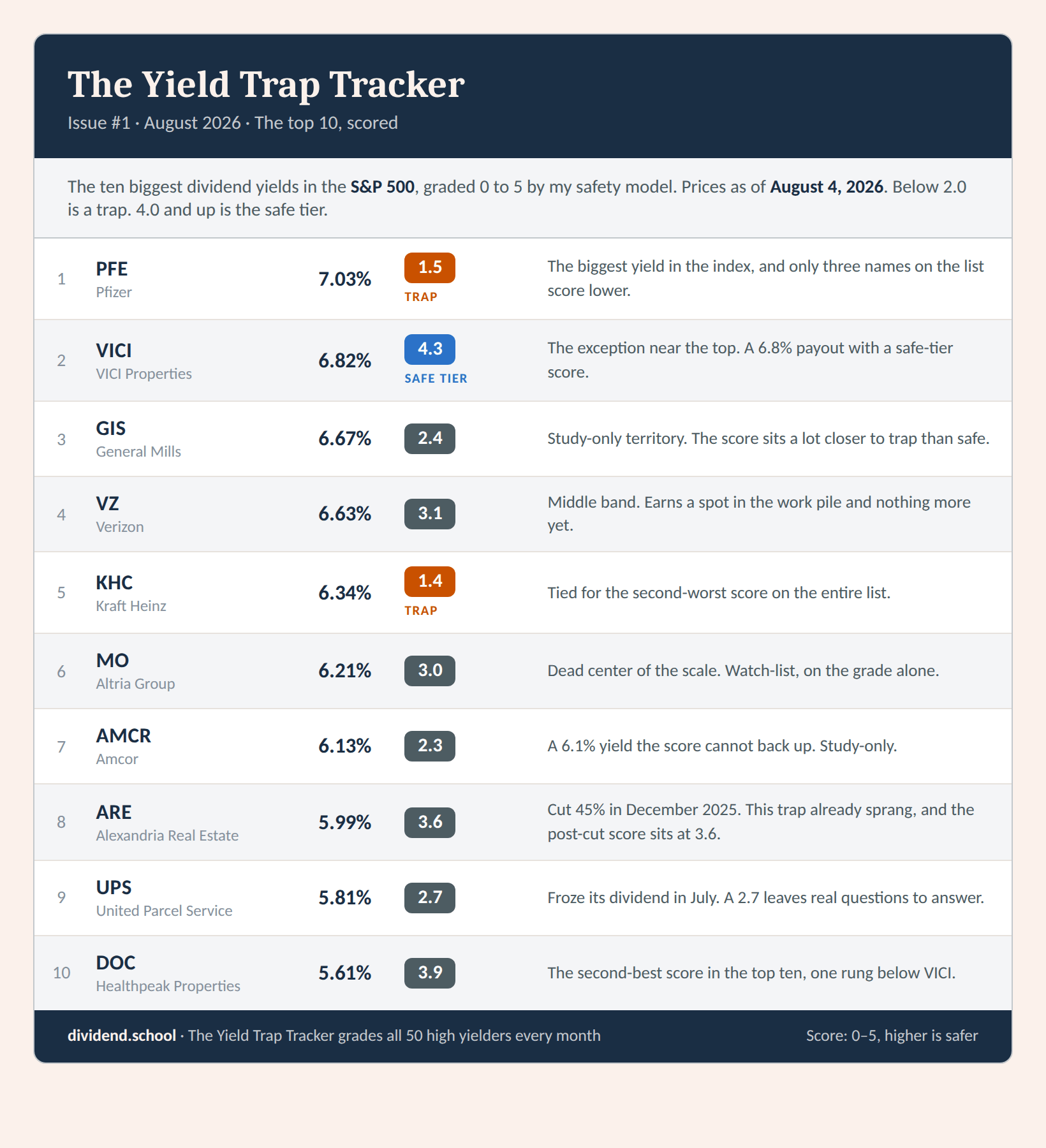
The average score across the ten is 2.82, compared to 3.30 for the forty names behind the wall, which highlights the first lesson. On this list, the bigger the yield, the worse the grade. Remember our chat covering yield from above.
Sometimes the yield is high for a reason, and often it’s not a good one. Buyer beware is the ultimate lesson here.
Test Case: Pfizer (PFE)
Pfizer currently pays the highest yield in the S&P 500 at 7.03%, priced at $25.13, and our Dividend Safety Score of 1.5 out of 5.
What’s driving the low Safety Score?
Simple: payout ratios. Both payout ratios (earnings and free cash flow) from the second quarter 2026 performance:
EPS payout ratio: 126%
FCF payout ratio: 108%
Both numbers tell us the same thing. For every dollar Pfizer earns, it pays $1.26 in dividends, and for every dollar of free cash flow produced, it paid $1.08.
Companies can cover those gaps for a time with cash on hand, asset sales, borrowing, or equity sales. And that works until it doesn’t. What they can’t do is grow a dividend the business cannot fund.
Those two payout ratios drag Pfizer’s grade down to 1.5. When both ratios sit above 100%, the dividend costs the company more than it earns and the cash it produces, and that combination puts the grade in trap territory. Something has to give, the company generates more growth in revenue and profits, or the dividend gets cut, frozen, or stops growing.
For the dividend safety to improve, both payout ratios have to get under 100%. Pfizer can do this in three ways:
Earnings recover
Free cash flow growth
Dividend shrinks
The first two are the bull case; the third is the market pricing in the 7% yield.
A 1.5 Dividend Safety score of 1.5 is a verdict. Pfizer fails this test, and the market is telling us with a high yield.
That's one name taken apart. I ran those same two payout ratios across all 50 and graded every one. Six came back below 2.0. If you'd rather read the finished board than work through it a name at a time, that's the membership.
Two traps on this list already sprang
Here’s a couple more traps to showcase the yield trap idea.
Two companies on this month’s list cut their dividends in the last 12 months:
Alexandria Real Estate (ARE): cut the quarterly payout 45% in December 2025, from $1.32 to $0.72 per share. The company made the cut to shore up liquidity and preserve roughly $410 million in annual cash flow while life science real estate stays soft.
The second name sits behind the paywall. It cut 32% in mid-2025 and still scores just 1.6 today.
The tracker exists to inform before announcements like those two.
That’s the top 10, scored, plus the full workup on the scariest one.
Behind the wall, members get the other 40, and a few of them deserve a warning label:
The safest name on the list: a 3.7% payer with a perfect 5.0, and almost nobody talks about it.
The worst score on the entire list is a 1.1, and it belongs to a regulated utility yielding 4.9%, sitting quietly at number 16.
6 of the 50 score below 2.0. I flag every one, and only two of them are in the top ten you just read.
A brand sitting in your medicine cabinet right now yields 4.4% and lands in study-only territory.
And the mid-2025 cutter that still scores 1.6, because a cut resets the payout without always fixing the business.
Start with a 7-day free trial and read the full list before paying a dollar. Membership is $369 a year or $35 a month, with a 30-day money-back guarantee either way.
Want a complete member deep dive first? My full Johnson & Johnson analysis is unlocked, free, start to finish.