

Hi everyone!
Three weeks since the last earnings update, and all’s quiet on the Western Front.
Sorry, a little history joke.
With all of our companies finished reporting, there isn’t much news related to earnings and dividends. But that doesn’t mean our companies aren’t doing things to continue moving and growing.
Even though we don’t have a report card for the portfolio, many of them went to the bank. Five companies moved money this week. For example, Realty Income closed a billion dollars of convertible notes and then turned around and bought back stock with part of it. VICI cleared it’s 2026 maturities (good news), and Taiwan Semiconductor approved another $29 billion of capex spending.
None of this shows up on a earnings report, but it will drive dividends and what happens next.
Let’s dive in and see who else went to the bank.
In this issue
Taiwan Semiconductor: $29 Billion Approved in Capex
Realty Income Borrowed at 3.750% and Bought its Own Stock
VICI Paid Up to Buy Time
NextEra’s $3.3 Billion First Tranche
Accenture: Where the Tripwires Stand
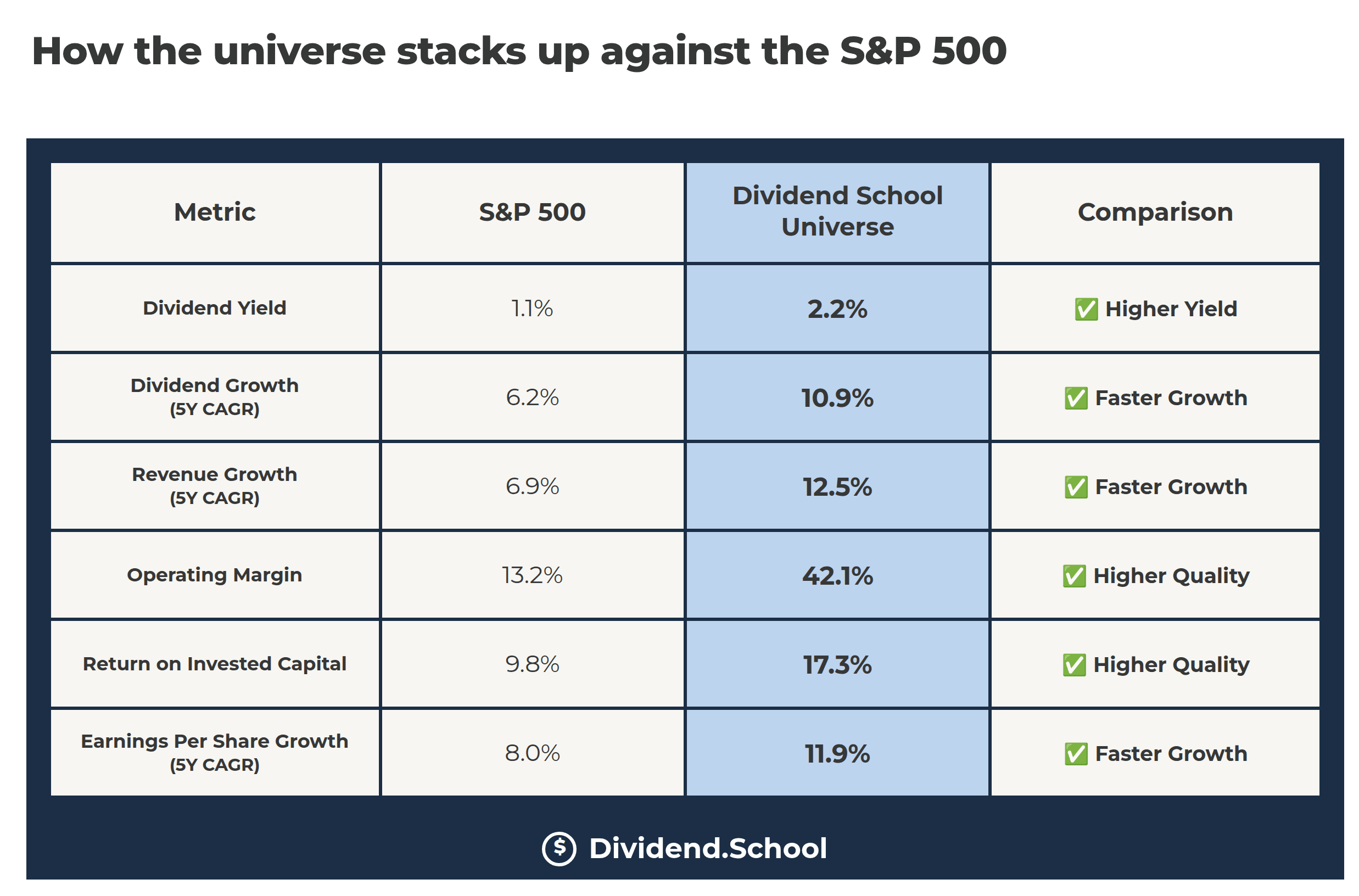
Dividend Universe Scorecard
Taiwan Semiconductor: $29 Billion Approved in Capex
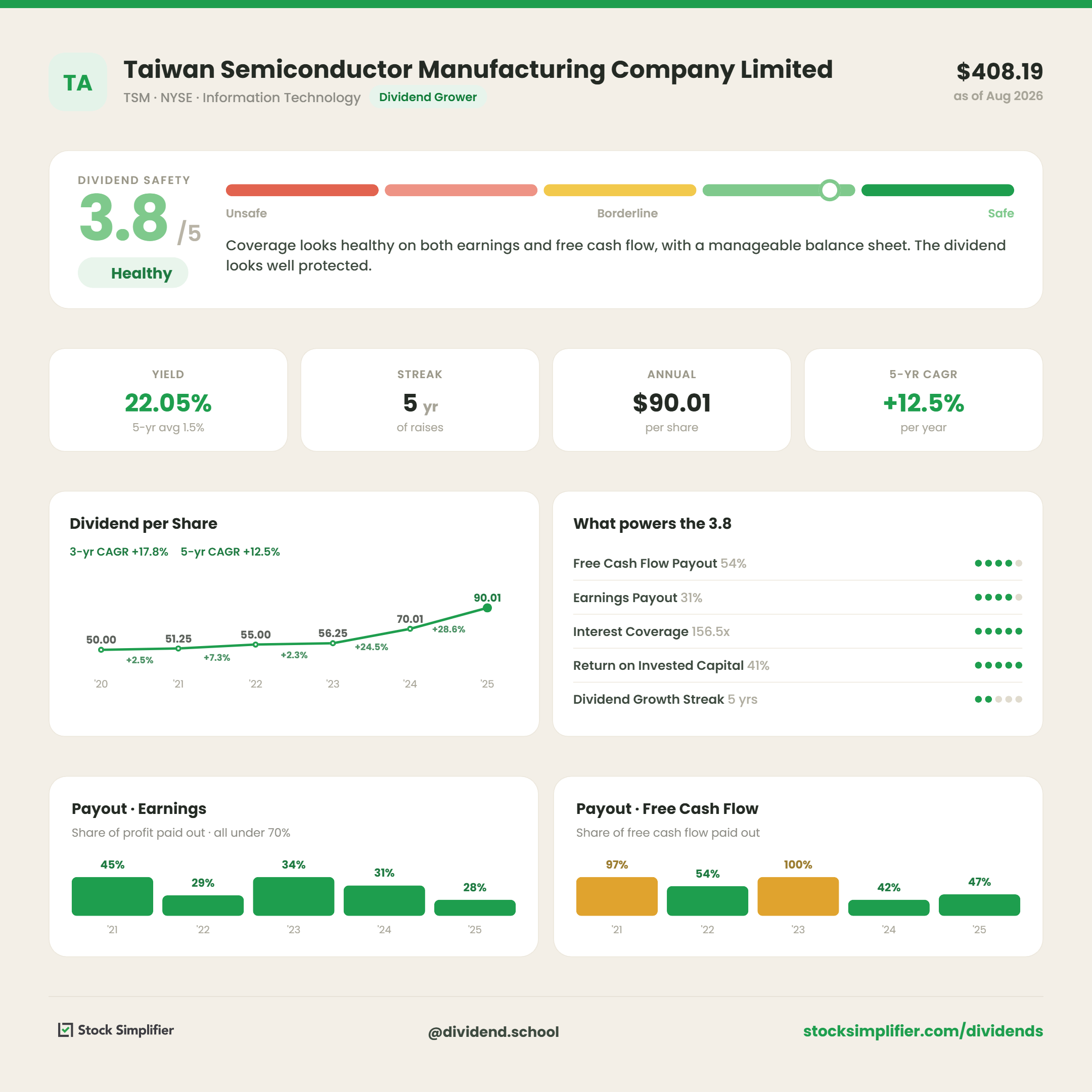
On August 11th, TSM’s board made two announcements:
They will spend $29.4 billion on Capex
It declared a second-quarter dividend of NT$7.00 per share, the same as the first quarter, so no raise.
Big capex number, which was expected, but flat dividend payment, also expected.
Big caveat here when analyzing TSM’s dividend, and this matters. TSM raises the dividend every two quarters, not every quarter. For example, TSM ran NT$5.00 for the first two quarters of 2025, NT$6.00 for the back half of 2025. And now NT$7.00 for the first two of 2026.
This is the pattern the company has established, and if it holds, we should see an increase in the third quarter.
So the dividend’s lack of a raise is a nothingburger.
The capex might offer other information.
Let’s run Taiwan Semi through our five-question analysis. Note, these numbers will be in TWD (Taiwanese dollars).
Did free cash flow cover the dividend with room to spare?
Yes, with the direction going the wrong way.
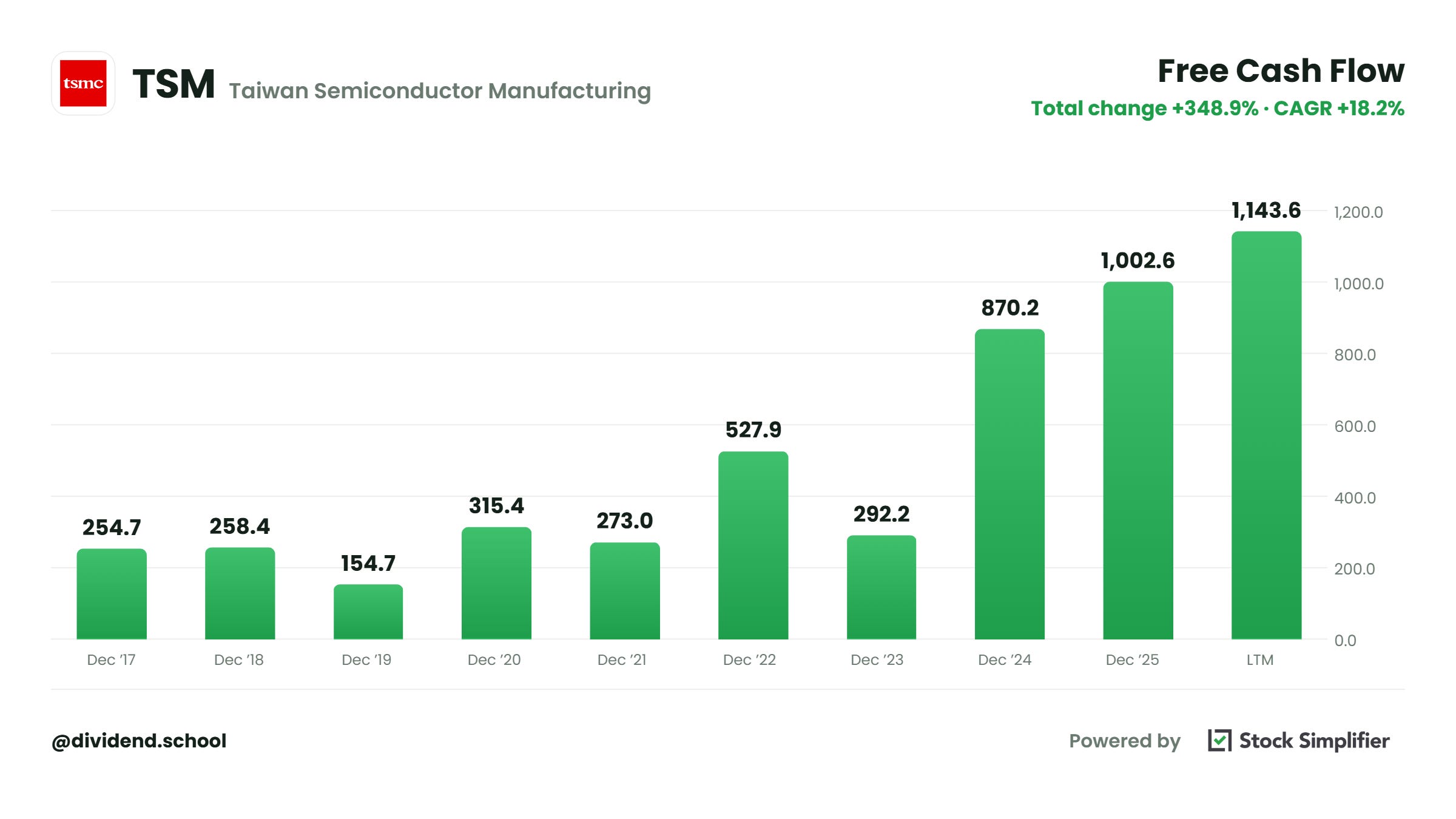
TTM operating cash flow: $2,634.6 billion
TTM capex: $1,493.1 billion
TTM free cash flow: $1,143.6 billion
Dividends declared: $26.00 per share
That puts dividends declared at 59% of free cash flow, up from 56.9% in 2025. This is our math and something to watch over the next few quarters.
What did the company guide to?
TSM guided to higher revenues and flat-to-higher margins.
Third quarter revenue guide: $44.6 to $45.8 billion, against $40.20 billion generated in the second
Full-year 2026 revenue growth: raised to slightly above 40%
Third quarter gross margin guide: 65% to 67%, against 67.7% from operations
July revenue: NT$467.58 billion, up 44.7% from a year ago (crazy growth)
Management attributes the 3 to 4-point margin decrease to dilution from the 2 nm ramp (lower yields initially, improving with ramp-up). That’s TSM’s cost of building the next node, which management announced well in advance. Bonus points for management communication.
Where is the payout headed?
Margins are certainly growing despite the increases in capex spend.
Gross margin: 67.7%, against 58.6% a year ago
Operating margin: 60.3%, against 49.6%
Net margin: 55.6%, against 42.7%
Diluted EPS: NT$27.25, up 77.4%
Nine points of gross margin improvement from a capital-intensive company like TSM is mind-blowing. That is pricing power at full power on display.
Is capex impacting the dividend?
Great question, and so far, not yet.
The 2026 capex guide went from $52 to $56 billion in January to $60 to $64 billion in July. Then, in August, they announced an additional $29.4 billion, plus funding for a joint venture to develop a new image sensor with Sony. Any revenues from this JV aren’t expected until at least 2029.
Those are some big numbers spent on future growth.
Most of the investments are going into the company's expansion of the 3nm and 5nm nodes. These nodes represent over 63% of wafer revenue last quarter, and into high performance computing. 2nm is still early, but expectations are that it will generate substantial revenue in the next few years.
TSM is spending and intends to keep spending to stay ahead of the demand curve, which is already passed them by. Their order book is full, according to the last few quarterly calls.
Management is telling them they are committing large sums of capex to demand they are already seeing but cannot fulfill. These commitments could impact the dividend; it is something to keep an eye on.
My verdict: TSM remains a Buy for now. Two of five questions came back looking good, two gave us strong numbers, and one came back with a verdict of “watch this.” I will run the numbers on the valuation before our next Best Buys issue next week. I understand this is a cyclical play, and we need to temper our enthusiasm for the AI boom and for this company’s place in it. They are a bottleneck business and are seeing benefits from their position, but nothing in the markets lasts forever.
That’s the free half. Taiwan Semiconductor graded on all five questions, and my verdict on the capex.
Paid members, keep scrolling; the rest is yours.
Here’s what the grade doesn’t cover.
Four other companies in the Universe moved money over the last three weeks, and each of them was making the same decision TSMC made. What does the balance sheet buy, and what does the shareholder get?
Seven days free to read all of it. After that, it’s $369 a year or $35 a month, with a 30-day money-back guarantee either way.
Want to see the depth before you decide? Here’s a full deep dive, free, start to finish: Johnson & Johnson: A Dividend Machine.