

Casinos are not where most go looking for a safe dividend.
VICI Properties has struggled this year, touching $25.81 on August 17th, its lowest price this year. The stock has declined 19.7% over the past 12 months. During the same stretch, the company has raised its dividend 4%, signed three new tenants, and guided AFFO higher.
All signs that the business is operating well.
In today’s post, we will discuss:
What VICI does
Why the yield is worth a look
Why the company and the price have struggled
Is the dividend safe?
Is it still a buy?
Okay, let’s dive in and figure out whether a 6.8% yield on a casino landlord is a bargain or a trap.
What VICI does
Let’s clear up one misconception right away. VICI is a landlord; it does not run casinos.
Big difference.
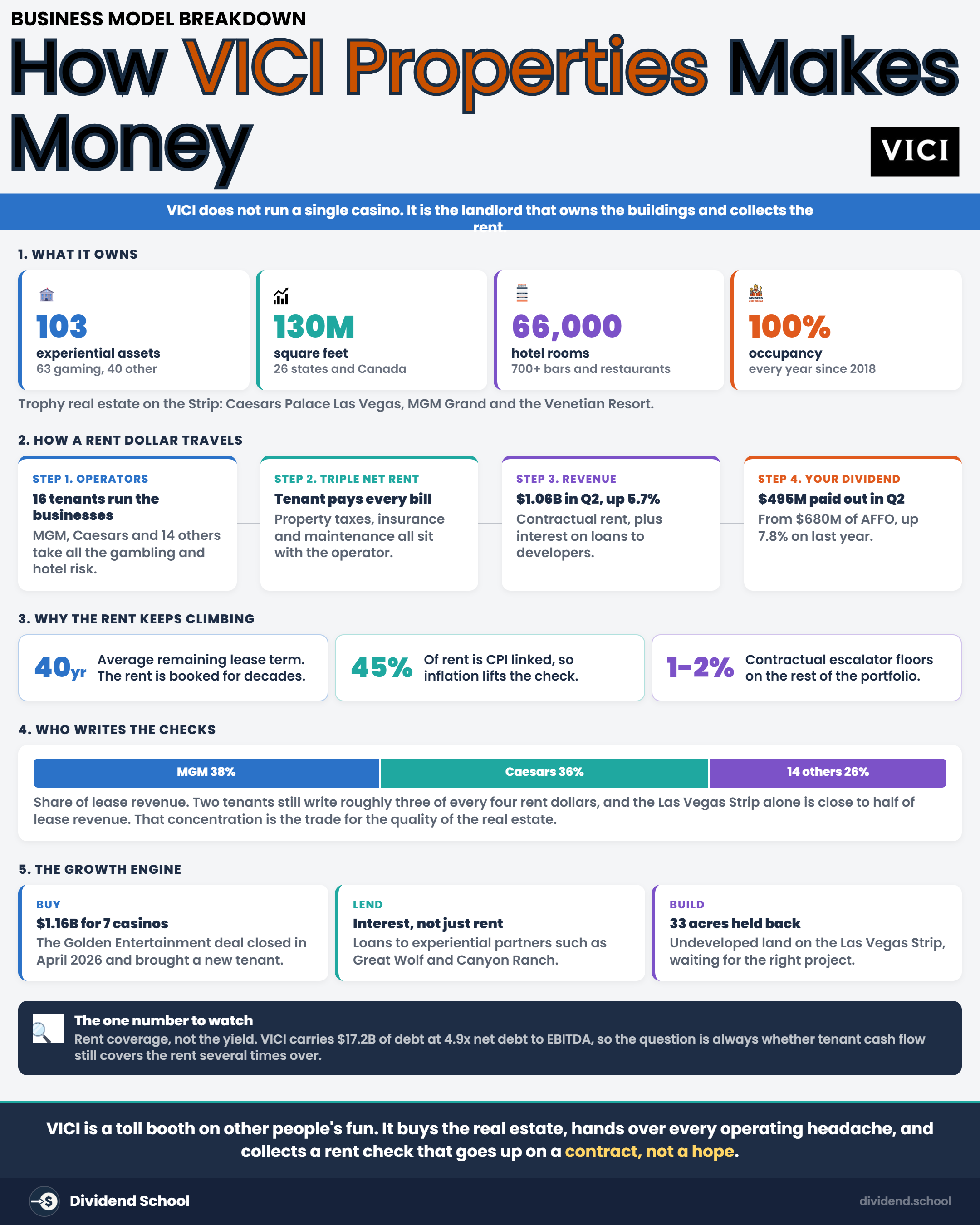
What VICI owns, as of June 30th:
103 experiential properties: 63 gaming, 40 other
16 tenants, up from 13 a year ago
Occupancy: 100%
Weighted average lease term: 39.6 years
One number from above to pay attention to: average lease term is 39+ years.
Also, the leases are triple-net, meaning the tenant pays for taxes, insurance, and maintenance. We can see the capital-light nature in VICI’s capital expenditures line on the cash flow statement. In the second quarter, they spent $131 thousand. Not millions. Thousand.
Which is why adjusted EBITDA margins are 82.1% (adjusted EBITDA of $869.5M ÷ revenue of $1.06B).
Now, the part to keep in mind. Revenue concentration is always something to be aware of.
For VICI, two companies carry the large majority of lease revenue, 72% total.
MGM is 37%
Caesars is 35%
Other fourteen tenants: 28%
So, 72 cents of every dollar comes from two companies.
Most of the companies' rent comes from the Las Vegas Strip, over 49%, so in addition to building risk, we also have location risk to consider.
This is a concentration to be aware of, as well as a risk associated with this investment. No lease term length can make that concentration risk go away.
The company understands this, which is why they are adding new properties, with the three new ads this year. Slow and steady.
Why the yield is worth a look
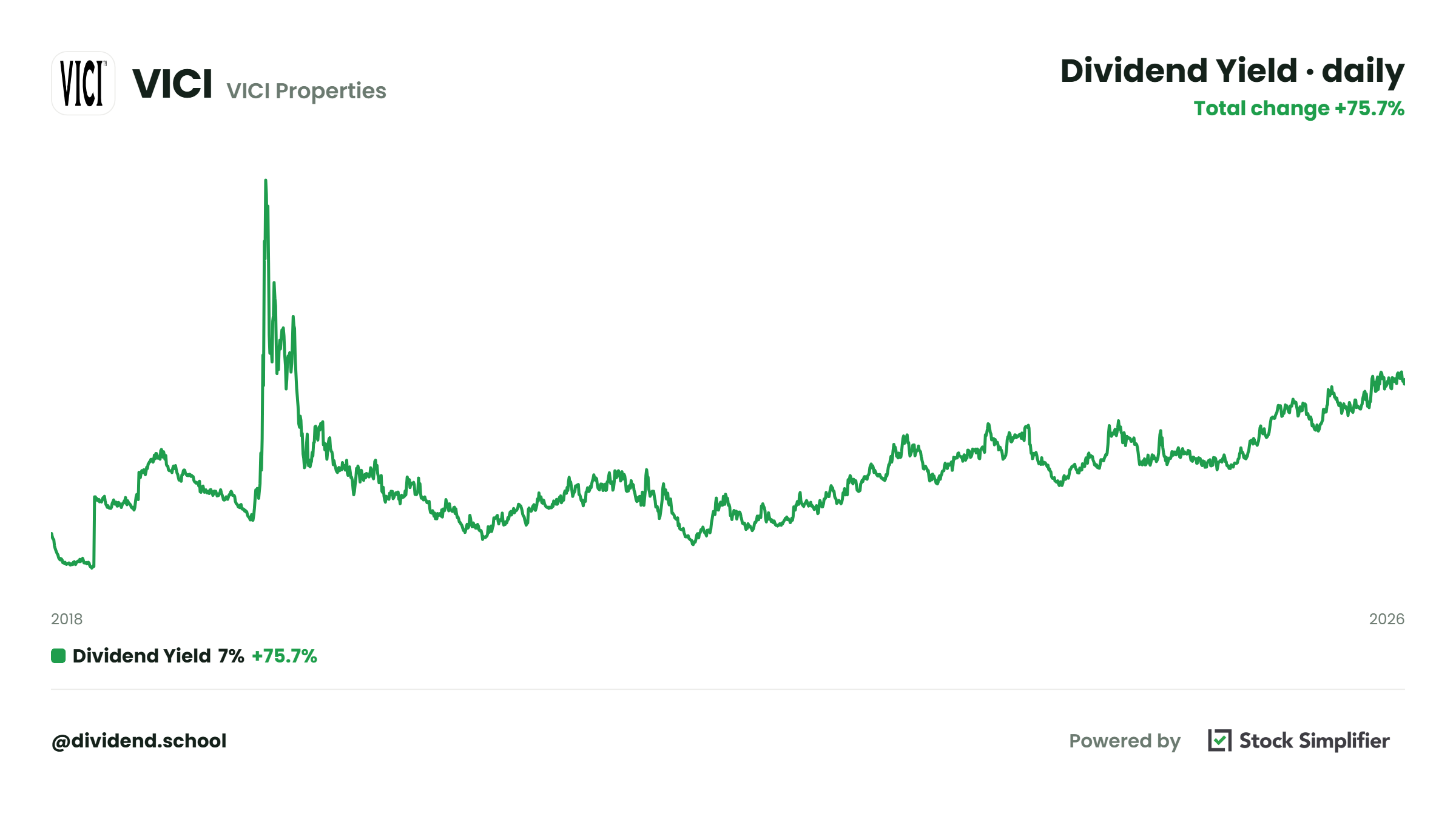
VICI currently pays a quarterly dividend of $0.45, totaling $1.80 a year. At the current market price of $26.58 (as of writing), we receive a yield of 6.77%.
Looks good; we will cover how safe it is in a moment.
VICI has raised the payment every year since going public in 2018. The last raise was September 4, 2025, a 4% increase. Eight raises in eight years; love the consistency.
It’s easy to see from a high-level overview why we like this company. Long lease terms, growing AFFO and dividend. We are getting 6.8% today, with regular raises and cash coming in from long, stable leases.
Why the company and the price have struggled
Three main reasons for the recent company struggles:
Bond market
Earnings miss because of accounting
Upcoming refinancing of debt
Bond Market
The bond market is moving a lot lately.
For example, the 10-year Treasury is trading at elevated levels right now. It closed on August 19th at 4.65, after touching as high as 4.75%. These are the highest levels since early 2025.
So what’s the big deal?
When the risk-free rate (10-year Treasury) climbs, every income asset gets repriced against it. And any REIT will be hit hardest, ie. Realty Income, VICI, etc.
Think about this from the other side of the trade. Why own a REIT with its concentration risk, casino risk, and, in general, more headaches? When you can own a Treasury earning 4.65% with no tenant risk. Easy question to answer.
This question answers a lot of the 19.7% decrease.
The bond market will influence both the borrowing costs and prices of REITs, always something to watch closely if you invest in REITs.
The $413 Accounting Impact
In the latest second-quarter earnings report, VICI reported GAAP earnings of $0.48 per share, while the market expected $0.71. A 23-cent miss- or was it?
Well, the market didn’t like it, and the stock fell 3.4% the next day.
Here are the accounting rules behind what happened.
Most of VICI’s portfolio sits on its balance sheet as sales-type leases and financing receivables, not as buildings. That brings an accounting rule, known as CECL, which requires a company such as VICI to carry a reserve for credit losses it expects over the life of that receivable. Similar to a bank holding reserves against expected credit losses. These are not actual losses, but expected losses. Instead, they are estimates of losses they “might” take in the future. The money is still there, held in case of a loss.
These reserves move every quarter and impact earnings every quarter. For example:
Q2 2026: a charge of $271.1 million
Q2 2025: a release of $142.0 million
Swing, year over year: $413.1 million
The above change equals the “accounting” miss from the quarter. No actual money moved.
What caused the elevated reserve?
The second quarter 10-Q named three things:
VICI booked a $72.6 million of day one reserve on the Gamehost and Golden acquisitions, which is CECL rule required on any purchase of a performing asset.
One of its tenants issued new senior secured debt at a lower credit rating and VICI takes its inputs off agency ratings
A lower macroeconomic forecast
So a weather report, rating agency, and required accounting rules accounted for the earnings “miss.”
VICI’s allowance now stands at $1.9 billion against $49.5 billion of amortized cost, or 3.84%. Something worth watching, but not worthy of a cause of concern.
Consider the performance of the company:
Total revenues: $1.06 billion, up 5.7%
AFFO: $679.6 million, up 7.8%
AFFO per share: $0.62, up 4.6%
Full-year AFFO guidance: raised at the low end, to $2.45 to $2.47 a share
The market always sells the news, always.
Refinancing of a debt
VICI had two debt maturities scheduled in 2026. The company used refinancing to clear those debts.
On August 5th, the company executed two new senior notes.
$900 million at 5.4% due in 2031
$850 million at 5.75% due in 2036
Here are some numbers I didn’t share on Thursday. The old paper (debt) had a weighted-average coupon of 4.32%. The new paper carries a higher weighted coupon of 5.57%. On the $1.75 billion borrowed, that is $21.9 million in extra interest, or $0.02 a share. That equals 0.8% of this year’s AFFO guidance.
Two cents is what it costs the company to clear some debt from this year’s list of worries. Money well spent if you ask me.
Is the dividend safe?
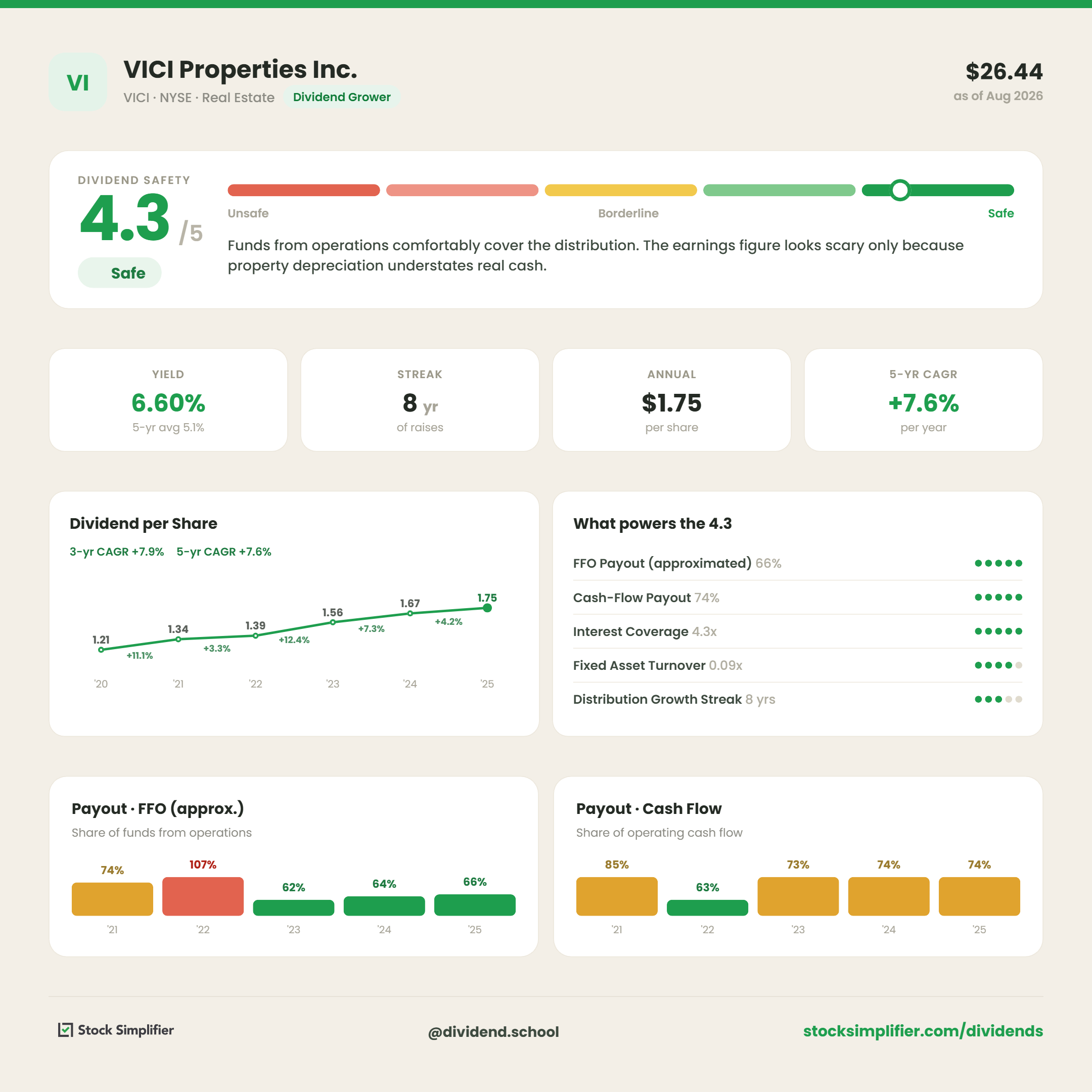
We grade every company on the same five questions. Before we run them, the caveat goes first, because it always does with a REIT.
Free cash flow does not work here. A landlord with no capital expenditures reports free cash flow that flatters it, and depreciation on buildings we will own for forty years makes GAAP earnings meaningless. For REITs, we substitute AFFO. Same five questions, new denominator.
1. Did AFFO cover the dividend with room to spare?
Yes. Guidance midpoint is $2.46 against a $1.80 dividend, so we are looking at a 73% payout ratio, covered 1.37 times. AFFO would have to fall 27% before the dividend stops being covered, and AFFO went up 7.8% last quarter.
2. What did guidance do?
It went up. VICI raised the bottom of the range from $2.44 to $2.45 a share on the same morning it reported the miss. A company worried about its cash flow does not raise the floor.
3. Where is the payout ratio headed?
Up, slowly, and this is the one answer in the score that nags at me.
Follow it with me. The dividend grew 4.0% last September. AFFO per share is guided to grow 3.4% this year, down from 5.1% in 2025. When the raise outpaces cash flow, the payout ratio has to climb. Another 4% raise against 3% AFFO growth puts us at 74% next year, then 75% the year after.
There is room. VICI has traded in the low 70s for years, and the sector has lived comfortably at 75% to 80%. But this is arithmetic, not opinion, and it tells us that the current pace of raises is borrowing from a cushion with a bottom.
4. Are margins holding?
Yes. Adjusted EBITDA margin was 82.1% this quarter against 82.1% a year ago. Occupancy is 100% and has never been anything else. Every tenant paid.
5. Is capex crowding the payment?
Not the way it does everywhere else. Triple net means capital expenditures are somebody else’s problem, and $131 thousand in a quarter proves it.
The REIT version asks whether acquisition spending is crowding the dividend, and there we get something more interesting. VICI spent $1.16 billion on the Golden portfolio, $141 million on Gamehost, and committed $75 million to Club Med. It funded it entirely with debt and cash and issued no equity in the first half.
Net leverage sits at 4.9 times annualized EBITDA, and the debt behind it is 98.4% fixed at a weighted average of 4.45%. All three agencies rate VICI investment grade, Baa3 at Moody’s and BBB- at S&P and Fitch.
The score: VERY SAFE. No change.
Four of the five come back clean, and the fifth is a drift, not a break. A dividend covered 1.37 times by a 39-year rent roll at 100% occupancy is about as durable as a 6.8% yield gets.
What the score does not measure.
A safety score indicates whether the dividend is paid. It does not tell us whether we make any money owning it.
Different questions, and this is where the trap lives, if it lives anywhere. Not in the CECL charge. Not in the payout ratio. Here it is, in two numbers.
VICI’s AFFO yield at $26.58 is 9.26%. The Golden Entertainment portfolio it just bought cost $1.16 billion, with $87 million in annual rent and a 7.5% cap rate.
Put those side by side. The company’s own cash flow is priced to yield 9.26%, and the assets it buys yield 7.5%. Every share issued at this price to fund a deal at that cap rate leaves us worse off than we were. The math does not care how good the property is.
So VICI stops issuing equity, which it has. It funds with debt at 5.400% and 5.750%. That still clears a 7.5% cap rate, and it still works.
Until leverage stops it. At 4.9 times, we have some room, but not a lot.
WARNING: this is the whole growth question, and it is easy to walk past because nothing in the quarter looks wrong. The contractual escalators are 2%, with CPI upside capped at 3% on the big leases. That is our floor, and it arrives no matter what. Everything above 2% has to be bought, and buying takes capital that costs less than what the assets yield.
At $26.58, VICI’s equity does not qualify.
That is the free half. All five questions answered, and the reason the growth rate is the number that decides this.
What I have not given you is what to do about it.
VICI has been the deepest discount on the board.
Seven days free to read all of it. After that it’s $369 a year or $35 a month, with a 30-day money-back guarantee either way.
Want to see the depth before you decide? Here’s a full deep dive, free, start to finish: Johnson & Johnson: A Dividend Machine.