

This 8% yielder is safer than the market thinks
Most income investors see an 8% yield and assume something is broken.
Sometimes they are right. A yield that high usually means the market is pricing in a cut, a stalled business, or a balance sheet that is one bad quarter from trouble. So when Western Midstream Partners (NYSE: WES) shows up on a screen at an 8.2% yield, the reflex is to keep scrolling.
Today we are going to slow down and look closer, because the reflex is wrong on this one.
In this post, we will cover:
What Western Midstream actually owns and why those assets throw off cash
How the money flows, using the latest SEC numbers from the Q1 2026 earnings release
Whether the 8% distribution is safe, using a real safety scorecard
The Occidental question that scares people away
What the units are worth, and a framework for a buy-below price
Okay, let’s dive in and figure out whether this 8% payout is a trap or a gift.
The scorecard
Here is the one-breath version before we do the work:
Yield: 8.2% (5-year average 8.1%)
Dividend safety: 3.5 / 5, “Healthy” (Stock Simplifier)
Distribution coverage: 1.5x
Net debt / EBITDA: 3.3x
Interest coverage: 5.9x
Verdict: below, for members
Buy below: below, for members
Western Midstream is a Delaware Basin pipeline and water business that pays you 8% to wait while it grows. The market treats it like a distressed yield. The cash flows say otherwise.
1. The bet
The bet here is simple.
You are buying a collection of hard-to-replace midstream assets in the best oil basin in North America, wrapped in fee-based contracts, at a price that pays you an 8% cash yield with room to grow. The reason it is cheap is a fear about who owns it, not a problem with what it earns.
If that fear is overblown, you are getting a high-quality cash machine on sale.
One wrinkle makes this different from the usual deep-value setup. The units have averaged an 8.1% yield for five years, so the market has doubted this business the entire time, through record EBITDA, falling leverage, and four straight years of raises.
That kind of persistent doubt is exactly what an income investor wants to find. A mispricing that closes next quarter pays you once. A mispricing that lasts for years pays you 8% annually, in cash, the whole time you wait to be proven right.
2. What Western Midstream does
Let’s start with the business, because most people who dismiss WES have never looked at what it owns.
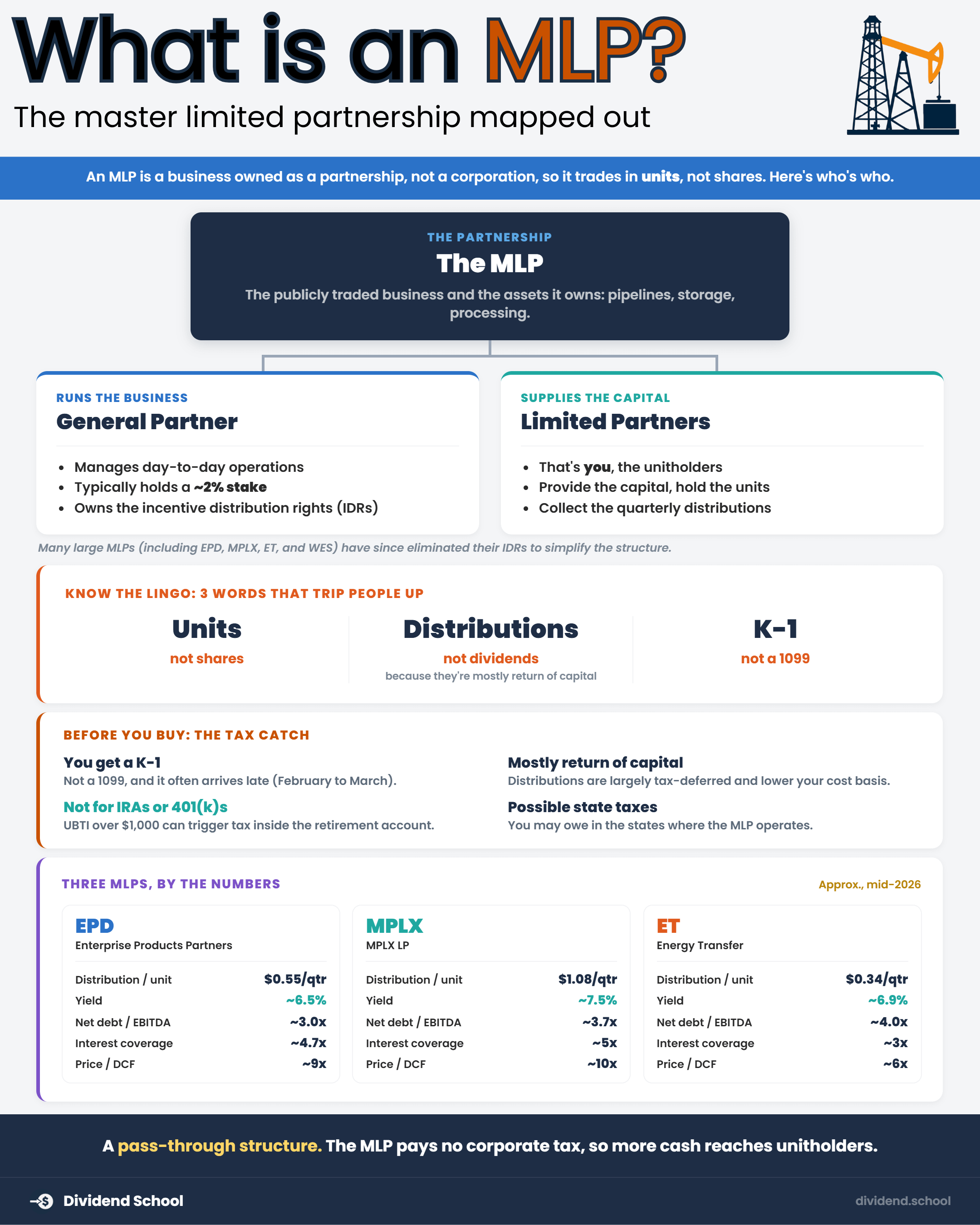
Western Midstream is a master limited partnership. It gathers, processes, and transports the stuff that comes out of the ground after a producer drills a well. Think of it as the toll road between the wellhead and the market. WES does not bet on the price of oil. It gets paid for the volume that moves through its pipes.
The company runs three streams:
Natural gas: gathering, compressing, treating, and processing
Crude oil and natural-gas liquids: gathering, stabilizing, and transporting
Produced water: gathering, recycling, treating, and disposal
That third stream is the one people underrate. Every barrel of oil in the Permian comes up with several barrels of salty water that has to go somewhere. Handling that water is a real, growing, fee-based business, and WES became one of the three largest water handlers in the Delaware Basin after buying Aris Water Solutions in October 2025.
Now, the geography matters.
More than 60% of WES’s 2026 expected EBITDA comes from the Delaware Basin, the western half of the Permian in Texas and New Mexico. That is the lowest-cost, highest-activity oil region in the country. Producers keep drilling there even when prices soften, which keeps volume flowing through the assets WES owns.
The contracts are the quiet advantage.
A substantial majority of WES’s cash flow is fee-based, meaning WES gets paid per unit of volume regardless of the commodity price. Many of those contracts carry minimum-volume commitments and acreage dedications, so a producer is on the hook to either move a set amount of volume or pay for it anyway. That structure is what turns a cyclical industry into a predictable cash stream.
3. How the money flows
Let’s look at the most recent quarter as our guinea pig, using the Q1 2026 earnings release filed with the SEC.
The headline is that this was the strongest quarter in the partnership’s history.
Here is the Q1 2026 scorecard:
Total revenue: $1.12 billion (up from $917 million a year earlier)
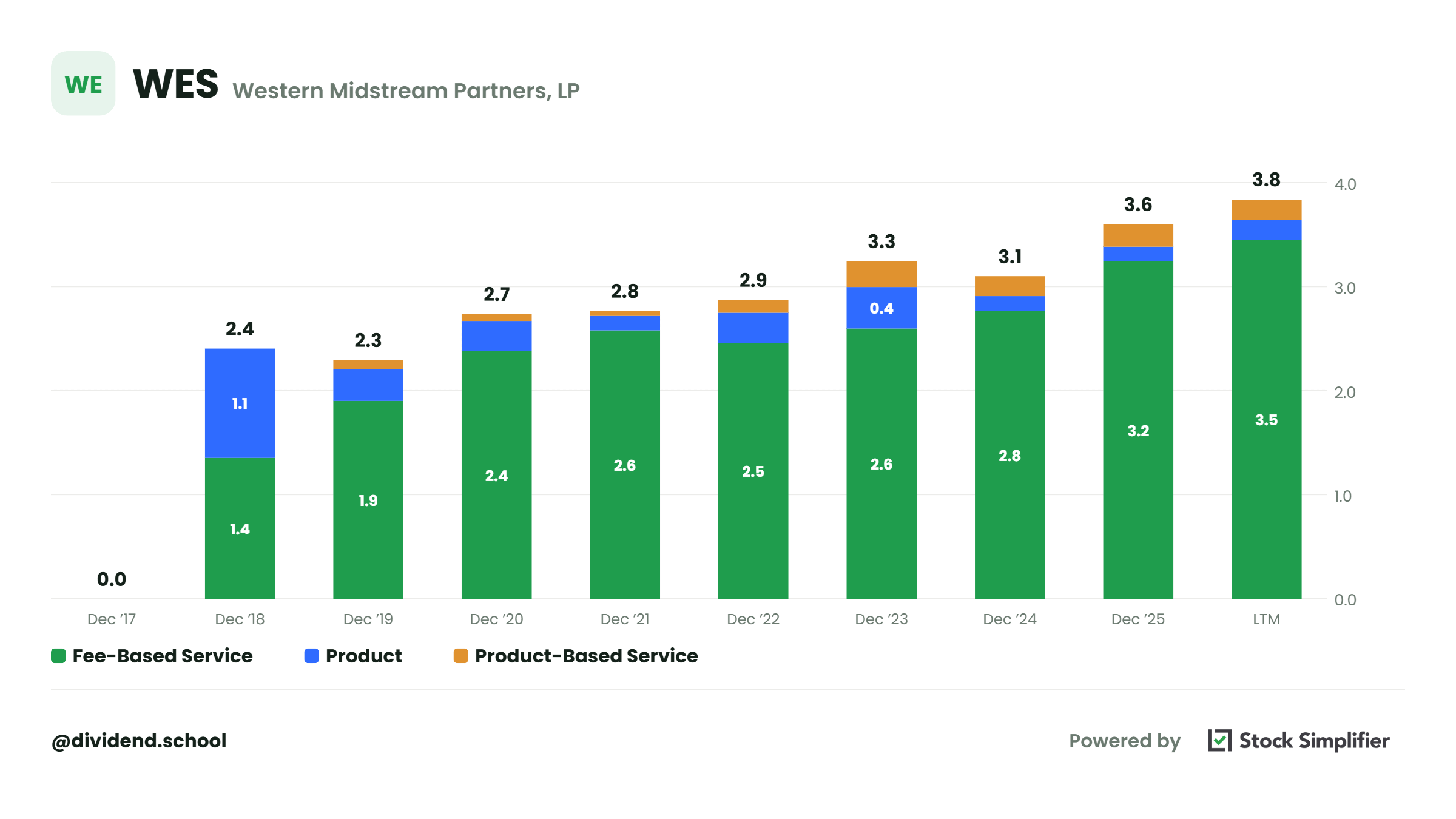
Fee-based service revenue: $933 million, about 83% of total revenue
Net income to limited partners: $342.4 million
Diluted earnings per unit: $0.85
Adjusted EBITDA: $683.1 million (a record, up 15% year over year)
Distributable cash flow: $508.9 million
Operating cash flow: $469.9 million
Free cash flow: $242.3 million
The number that tells the story is the fee-based revenue. When 83 cents of every revenue dollar comes from fixed fees, the business behaves more like a utility than an oil stock.
Volume backed up the results. WES gathered a record 272 thousand barrels per day of crude and NGLs in the Delaware Basin, up 6% from a year earlier, and moved a record 2.8 million barrels per day of produced water.
The balance sheet is where the safety story really lives.
As of March 31, 2026, from the Q1 2026 balance sheet:
Total assets: $14.9 billion
Long-term debt: $8.2 billion
Net debt to EBITDA: roughly 3.3x, with a stated target near 3.0x
Credit rating: investment grade
That leverage figure is one of the lowest in the midstream sector. A lot of pipeline MLPs run at 4x or higher. WES sits around 3x and wants to stay there, which is exactly what you want to see behind a high yield.
Management is also putting the cash flow to work. WES closed the Aris water acquisition in October 2025, and in May 2026 it announced a deal to buy Brazos Delaware II for about $1.6 billion, split between $800 million of cash and $800 million of WES units. That deal is expected to add roughly $100 million of annual EBITDA and close by the end of the second quarter of 2026.
For the full year 2025, WES generated record Adjusted EBITDA of $2.481 billion and record free cash flow of $1.526 billion. For 2026, management guided to Adjusted EBITDA of $2.50 billion to $2.70 billion and distributable cash flow of $1.85 billion to $2.05 billion, and said it expects to land near the high end.
Strong business. Strong basin. Strong balance sheet. Now the real question.
That’s the free half: the assets, the contracts, and a record quarter, every number from the SEC filings.
And it leaves the only question that matters: if the business is this steady, why is the market paying you 8% to own it? Somebody is wrong here, the market or the math. The rest of this piece finds out which.
Below the paywall, members get:
The safety score, line by line. Four strong inputs, and the one factor that costs WES a perfect grade (there’s a cut in this payout’s past, and it changes how you should size the position).
The Occidental question. The three fears that keep this yield at 8%, and the February transaction, most investors read backward.
Why P/E lies about pipelines, and the cash metric this business actually trades on.
Three valuations. The multiple, a full DCF where even my bear case lands above today’s price, and a reverse DCF that reveals what growth rate the market is really paying for. That last number decides the whole piece.
The verdict, my buy-below price, and the three tripwires that would change my mind.
Membership is $369 a year or $35 a month, with a 30-day money-back guarantee.
Want to see a complete member deep dive first? My full Johnson & Johnson analysis is unlocked, free, start to finish.