

One of the biggest losers in the markets, down 46%, is one of the highest-quality compounders and appeared on my dividend screens lately. The best part, most investors won’t touch it.
That’s what this month’s issue covers. Five companies from our Dividend Universe trading below my buy-below prices, along with the story told from the SEC filings, and where the dividend safety scores land. We look at each number from the latest 10-s, 10-Qs, and earnings releases.
In today’s issue, we will cover:
The July glance table, all five names at once
CME Group, and why I own a Borderline safety score on purpose
ADP, the Dividend King reporting fresh numbers two days after this issue
Accenture, the 46% discount everyone is afraid of
Domino’s, the quiet share gainer in a flat category
Realty Income, the monthly payer with its best coverage in years
How the safety score works, for new readers
Okay, let’s dive in and look at the list.
CME Group (CME)
Quick look stats
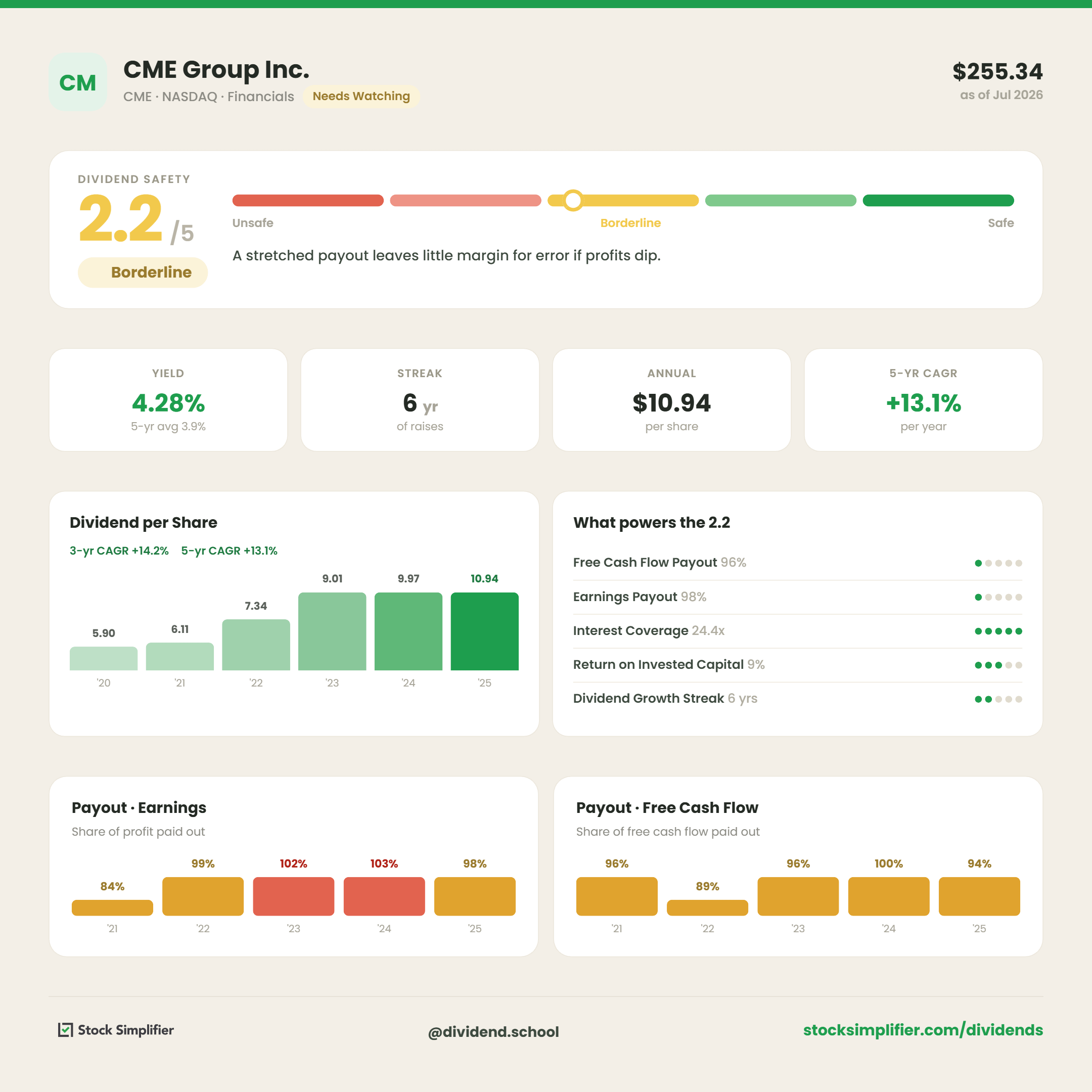
Recent price: $255.71
Buy below: $344.00
Safety score: 2.2 / 5 · Borderline
Yield: 4.44% including the variable dividend, about 2.0% on the regular alone (which boosts the current yield).
Regular quarterly dividend: $1.30 ($5.20 annualized), plus a $6.15 variable paid March 2026
Sector: Financials, futures exchanges
Why I like it
Near-monopoly position in US interest rate futures, with fiscal 2025 marking the fourth straight year of record revenue at $6.52 billion, up 6% (FY2025 10-K, filed 2/26/26)
A free cash flow machine: $4.28 billion in operating cash flow against just $83.5 million of capex in 2025, so almost every dollar of profit converts to cash
Q1 2026 set an all-time volume record at 36.2 million contracts per day, up 22% (press release, 4/22/26)
Market data revenue is compounding: $803 million in 2025, up 13%, then a record $238 million in Q2 2026, up 20% (Q2 2026 10-Q, filed 7/24/26)
Interest coverage of roughly 24x with only $3.4 billion of total debt
The thesis
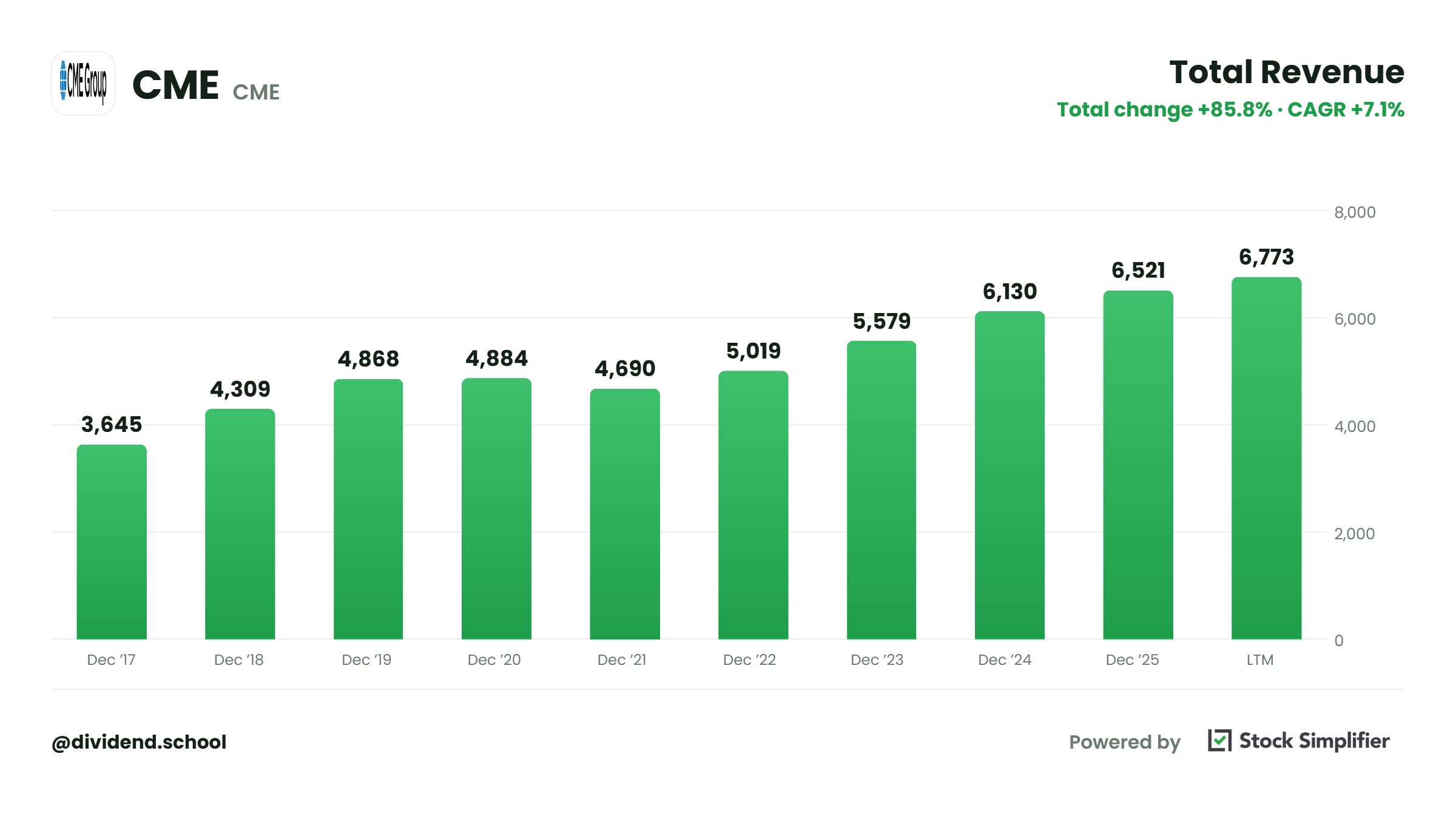
So what does CME do? The are the toll booth for hedging interest rates, equity indexes, energy and agriculture. And you know I am a sucker for a good toll booth. When the world is in turmoil, trading volumes rise, and CME collects a small fee on every contract. Simple and incredibly profitable as evidenced by their 60%+ operating margins.
Network effects and switching costs drive CME’s moat. Traders go where other traders are; better yet, liquidity begets liquidity. The more traders participating in a market, the tighter the spreads, the lower the execution costs, and the more attractive the market becomes for the next trader.
This liquidity attracts institutional traders entrenched in the ecosystem, with their systems, data, and connections entwined with CME’s.
Market volume is the main growth driver; the new growth story is market data. That segment grew 20% year over year in the second quarter, and it behaves like subscription software revenue sitting inside an exchange.
CME is expanding its market in three areas:
Event contracts and retail expansion
Crypto
Single stock futures
Regulatory will also contribute, with the new mandated SEC Treasury clearing as the nearest-term catalyst.
Dividend safety: the Borderline score, explained
The 2.2 score looks ugly, and I want to take a moment to explain it.
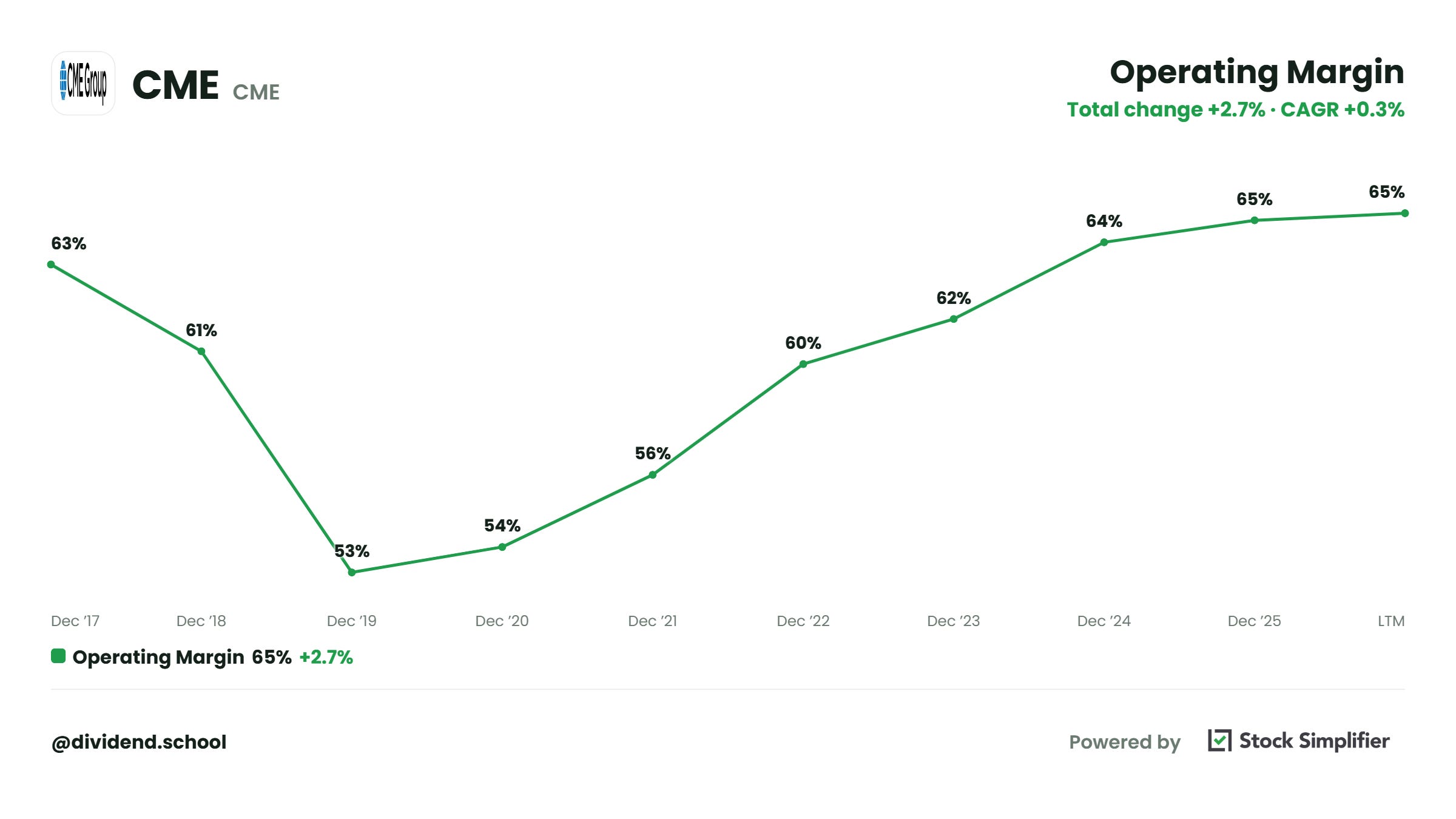
Most investors don’t know this, but CME pays two dividends. A regular quarterly dividend, currently $1.30, and an annual variable dividend sized to whatever cash is left over each year. For 2025, that variable was $6.15 per share, around $2.2 billion, declared February 2026.
It’s a different capital allocation model than most, but with the incredible liquidity the company operates at, they have to put the money somewhere, and instead of building up cash, they pay us.
We need to count both, which makes the payout math looks not great:
Earnings payout including the variable: roughly 98%
Free cash flow payout including the variable: roughly 94–96%
Regular-only earnings payout: about 47%
Regular-only free cash flow payout: about 43%
The safety score treats the whole payment as what’s going to happen, and on that basis a 2.2 is fair.
My view is that the variable dividend is an option, by design. Keep in mind many companies pay variable dividends such as Costco and Blackrock.
In a bad year, the variable shrinks and the regular keeps growing, which is exactly what a policy like this is built to do. If you own CME, own it knowing the headline yield can flex down in a slow year. That’s optionality, and I think a smart move.
One housekeeping note. CME moved the variable payment from January to March starting in 2026, so some screeners show a phantom “cut” in the 2025 declared numbers. That is a calendar change, and the 10-K confirms it, so don’t let a data feed scare you out of the position.
Valuation: buy below $344
At $255+, CME trades around 26% below my estimated buy-below-price. The company’s current P/FCF is 22x, which runs below it’s five year historical average of 24.7x. A toll-booth business growing high single digits with 24x interest coverage doesn’t stay there long.
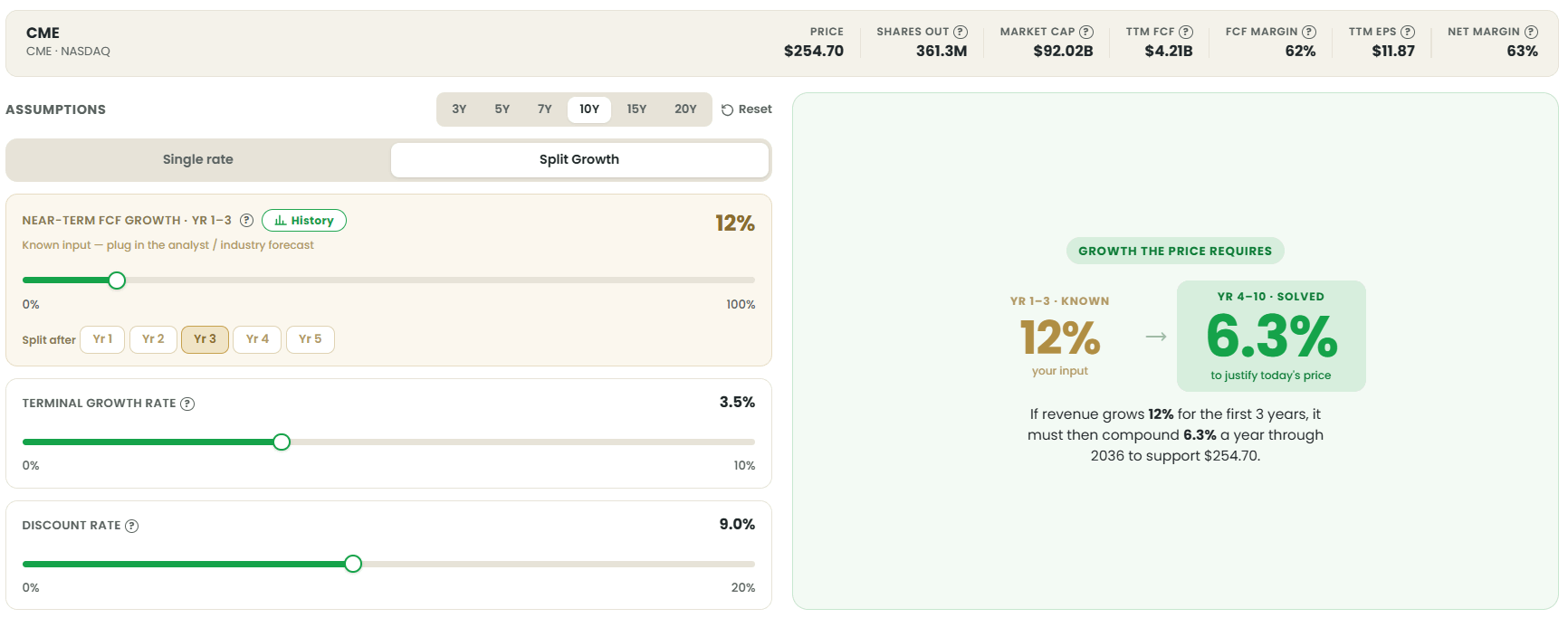
If we dig deeper using a DCF and rDCF for a sanity check, we see some potential dislocation of pricing. Estimating FCF growth of 12% (10-year historical ranges in the 11-12%), and a 60% free cash flow margin (which is insane), we get a fair value of $344.
And if we look at the rDCF for a sanity check, we see the market is pricing in the same 12% FCF growth over the next three years, with growth slowing to 6.3% over the next seven years.
If we ask ourselves if we think that is reasonable, I would say yes, based on their historical performance plus the future expectations.
Green flags
Fourth consecutive year of record revenue and adjusted earnings
Record Q1 2026 volume, up 22%, with non-US volume up 30%
Market data revenue accelerating to 20% growth
$1.24 billion of buybacks executed in the first half of 2026 at an average of $281
Regular dividend covered more than twice over by earnings and free cash flow
Red flags
Q2 2026 clearing and transaction fees fell year over year, $1.35 billion versus $1.39 billion, as volume came off Q2 2025’s record
Rate per contract slipped from $0.702 in 2025 to $0.678 in Q2 2026, so volume is growing faster than revenue
The total payout leaves no cushion, which is why the score sits at 2.2, and a weak volume year would shrink the variable dividend
Automatic Data Processing (ADP)
Quick stats
Recent price: $250.09
Buy below: $333.81
Safety score: 4.2 / 5 · Safe
Yield: 2.72%
Quarterly dividend: $1.70 ($6.80 annualized), raised 10.4% in November 2025
Streak: 51 consecutive years of increases
Sector: Industrials, payroll and HR outsourcing
Why I like it
51 straight years of dividend increases, and the last raise was 10.4%, so the streak is aging like a compounder, and the raises are not token
Q3 FY2026 revenue of $5.94 billion, up 7%, with diluted EPS up 10.5% to $3.38 (10-Q, filed 4/30/26)
Management raised full-year guidance mid-year: revenue growth to 6–7% and adjusted EPS growth to 10–11%
Trailing free cash flow of roughly $4.8 billion against $2.6 billion of dividends, a 53% payout
Return on invested capital north of 30%, with long-term debt under one year of net income
The thesis
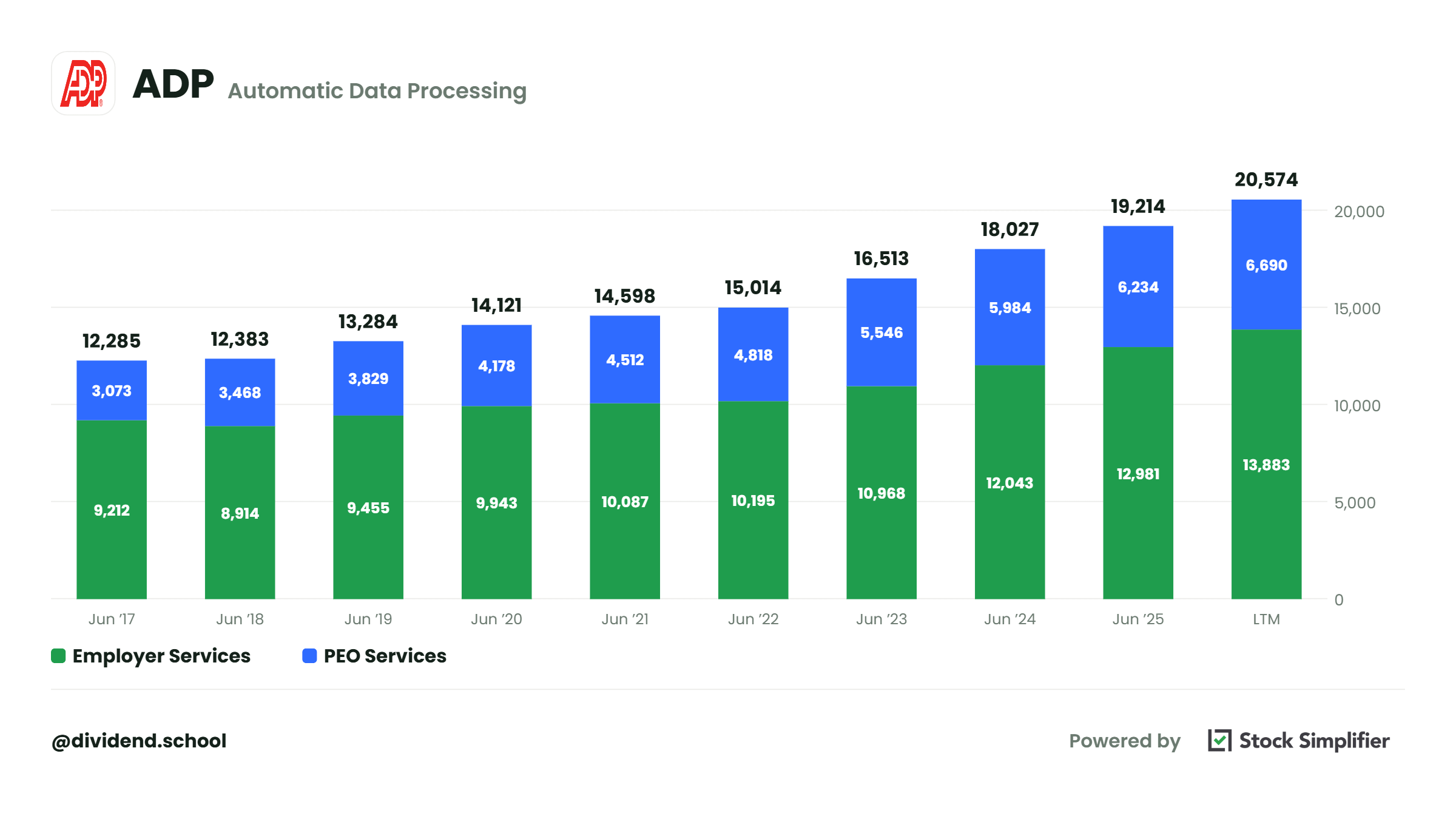
What does ADP do? They process paychecks for over a million businesses, and payroll is the last thing any company stops paying for. ADP’s client retention ran 92.1% (ridiculous) in 2025, which was near record levels.
ADP has one of the widest, most stable moats in the markets today. Driven by their incredible stickiness. Payroll switching costs are one of the most underrated structural advantages in enterprise software. If you’ve ever had to switch payroll providers or work for a company which has, then you understand the pain and stress I am speaking of. It requires extracting employee data and tax withholding, all while maintaining current payrolls. Not easy.
Growth comes from slow and steady price increases, 3-5% annually. Along with growth in the PEO sector, but the earnings growth tends to outpace revenues. Mainly because of profitabity and buybacks.
But the quiet earnings engine is float. ADP holds client payroll funds for a few days before disbursing them, and it earns interest on an average balance of about $48 billion. This engine has grown from $422 million in 2021 to $1.19 billion in 2025, and it is all margin.
The average yield on that float is still only 3.3%, because older low-rate bonds keep maturing into higher rates. The tailwind has more room to run.
Dividend safety
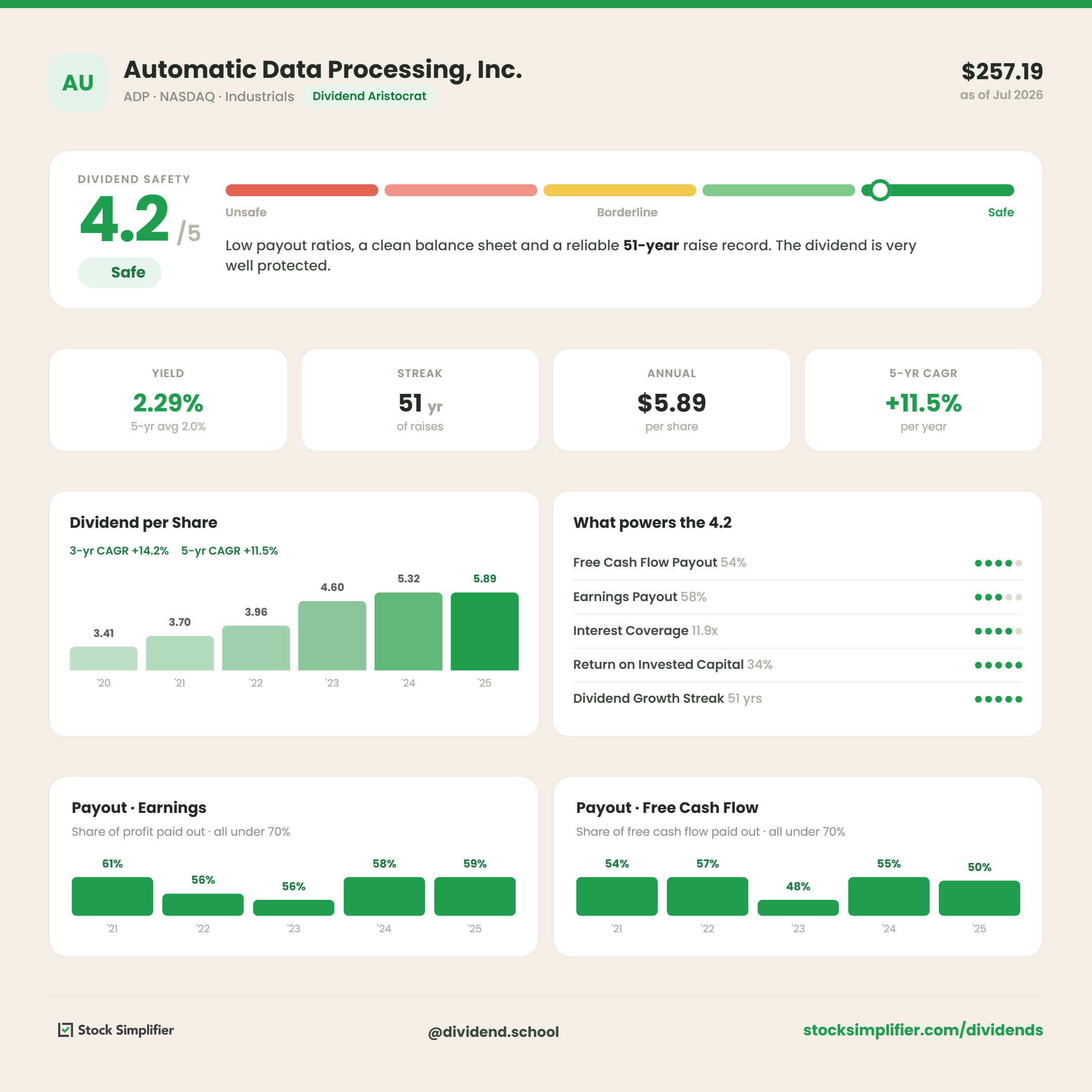
A 4.2 is what a Dividend King is supposed to look like.
Fiscal 2025 earnings payout: 59%
Fiscal 2025 free cash flow payout: 55%
Interest coverage: about 12.6x
Capex plus capitalized software: under 3% of revenue
With a 5-year CAGR of 11% increases, this is a safet dividend, with plenty of room to continue to run. And while the yield isn’t super exciting, it is the steady growth like a turtle that we like.
Valuation: buy below $333.81
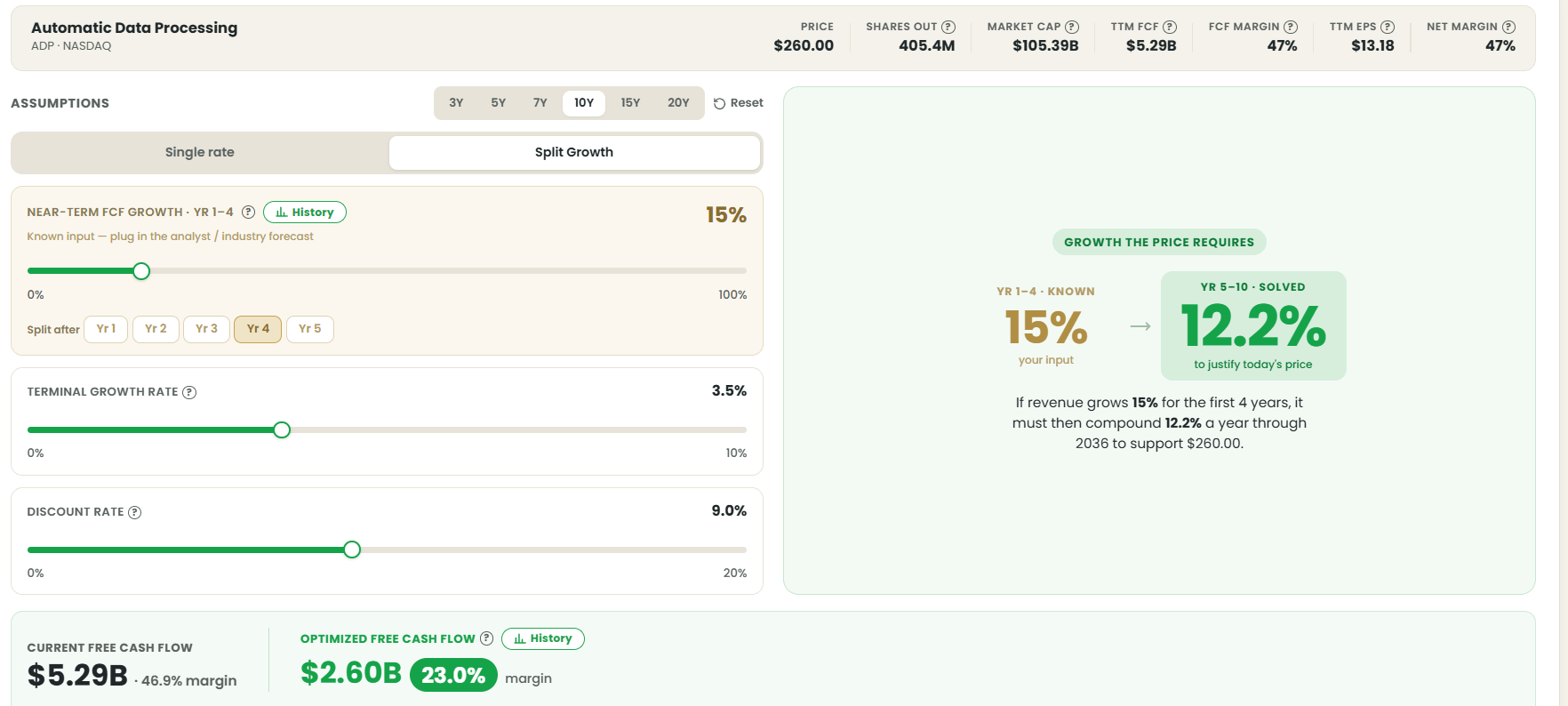
At $250.09, ADP sits 25% below the buy-below price. You rarely get this company at a discount, and the market is offering one now because employment growth is cooling.
The current P/FCF of 19.7x is well below it’s historical average of 27.1x, making it attractive at these levels. The market is pricing in a cooling of the hiring cycle.
Digging in with a rDCF, we can see the market is pricing in 15% free cash flow growth over the next three years, and 12%+ for the remainder. I feel that this is a fair estimate based on past performance and future expectations.
The market doesn’t give us opportunities like this often.
Green flags
51st consecutive annual increase, at a double-digit raise rate
Guidance raised mid-year on both revenue and EPS
Trailing free cash flow of $4.8 billion, about 111% of net income
Float income guided up 13% for fiscal 2026 with reinvestment tailwinds intact
Retention near record at 92.1%
Red flags
PEO segment profit fell 2.4% in Q3 while revenue grew, a margin squeeze in the second-biggest business
Pays per control grew only about 1%, and June payroll data shows hiring is slowing
If the Fed cuts aggressively through 2027, the float tailwind switches to a headwind
That’s two complete workups, free: the full thesis, the safety math, the Buy Below price, and the flags on each. That’s also two of the five. The board says the best three are still face-down.
Below the paywall, members get:
The 46% discount. The highest safety score on this month’s list, a net-cash balance sheet, a dividend covered three times over by free cash flow, and a market convinced AI is killing the business. The filings say otherwise, and I show you exactly where.
The royalty stream wearing a pizza costume. Thirteen straight raises, the last three at 25%, 15%, and 15%. Free cash flow jumped 31% last year and the dividend costs just 35% of it, yet the market prices this like a slowing restaurant chain.
The monthly payer yielding almost 5%, with its best dividend coverage in years and a brand-new way of earning fees on other people’s money.
The full board: all five names, Buy Below prices, and safety scores on the same 0-to-5 scale, so you can watch it the way I do.
Every number comes from the latest 10-Ks, 10-Qs, and earnings releases, with filing dates noted so you can check my work.
Start with a 7-day free trial and read all five names before paying a dollar. Membership is $369 a year or $35 a month, with a 30-day money-back guarantee either way.
Want to see a complete member deep dive first? My full Johnson & Johnson analysis is unlocked, free, start to finish: JNJ Deep Dive