

The Dividend Universe gets two new companies this week, and the companies could not be more different.
One is a roofing company most have never heard of, compounding its way toward Dividend King status. The other is a 150-year-old whiskey maker you have heard of trading at a yield it has never offered in my investing lifetime.
In today’s post, we will discuss:
A quick refresher on what the Dividend Universe is and how names get in
Why Carlisle Companies (CSL) earned its spot, and the moat protecting it
Why Brown-Forman (BF.B) earned its spot, and the moat protecting it
What would get either name removed down the road
Okay, let’s dive in and meet the new additions.
First, a quick refresher
The Dividend Universe is the master list of dividend growth companies we track and own. Every name on it clears the same three-part filter:
Long record of dividend raises
Free cash flow payout that the company carries with room to spare
And a business I can explain to you in a few sentences
There are a few more steps to it, but those are the highlights; you can learn more on the complete filter here.
A seat on the list is that, a seat on the list. The company earned its place with quality, and then it waits, sometimes for a while, until the price works. The Buy Below column is what turns a seat into a purchase.
Bottom line, these are, I believe, the highest-quality dividend-paying companies in the markets, and the goal is simple: own as many of them as the markets allow, at prices that make sense.
No removals this update. Two additions, let’s meet them.
Addition #1: Carlisle Companies (CSL)
Who is Carlisle, you ask? Never heard of them? Most haven’t.
Carlisle makes commercial roofing systems and building envelope products- the membranes, insulation, and waterproofing that keep weather out of warehouses, schools, and office buildings. Or as a ten-year old would understand: Carlisle keeps the rain out of big buildings. It makes the roofing sheets, the insulation, and the sealants that go on top of warehouses, schools, and office buildings.
The company runs two segments:
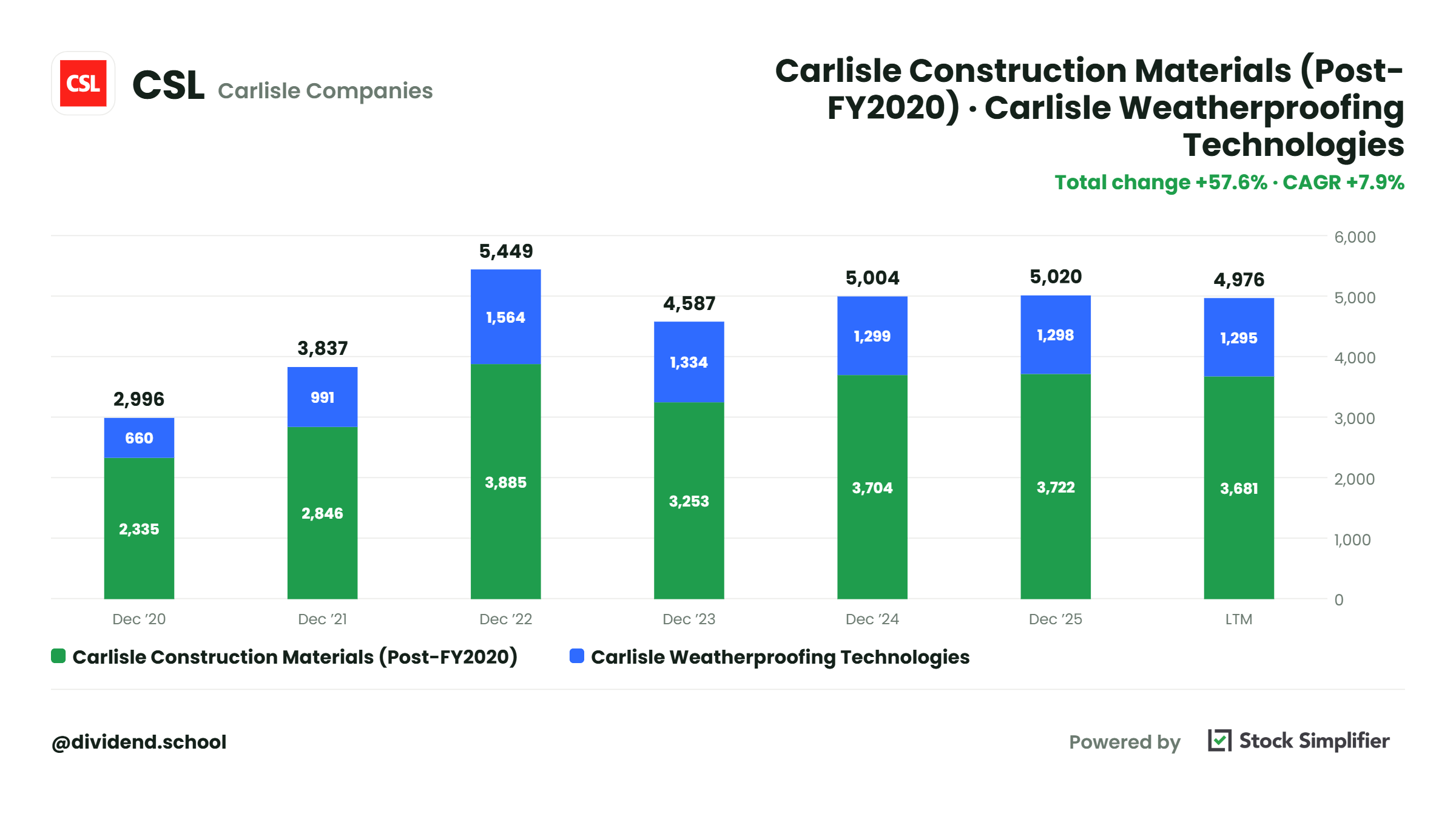
Construction Materials (CCM), the roofing business
Weatherproofing Technologies (CWT), which covers sealants, coatings, and moisture barriers.
Over the past few years, Carlisle has sold off some non core segments in aerospace and interconnect to focus on becoming a pure play on the building envelope. I think that is smart, focusing on your core business. Focused businesses are easier to analyze, and now Carlisle focuses on what it’s “one thing.”
A big chunk of roofing demand comes from replacement. Commercial roofs wear out on a schedule, and building owners replace them whether the economy is booming or wobbling. That reroofing cycle gives Carlisle a recurring revenue base most industrial companies would kill for. Not what you expected huh? A recurring revenue base in an industrial, it’s why they have a strong moat and outstanding financials.
The Carlisle moat
The membrane on a roof is a simple product, and easily copied. Not much competitive advantage there.
Carlisle’s advantage lives in everything wrapped around the membrane.
When a building owner replaces a roof, the decision runs through a process:
Architects who spec the system
Contractors certified to install it.
Carlisle backs those jobs with system warranties that can run 20 or 30 years, and the warranty holds only when a certified contractor installs Carlisle components top to bottom. Specs, certifications, and warranties stack switching costs into every layer of the job.
This is part of what sets them apart.
Carlisle’s installed base does the rest of the work. Every Carlisle roof sitting on a warehouse today is a candidate for a Carlisle reroof when it wears out, sold through the same contractor who installed the first one.
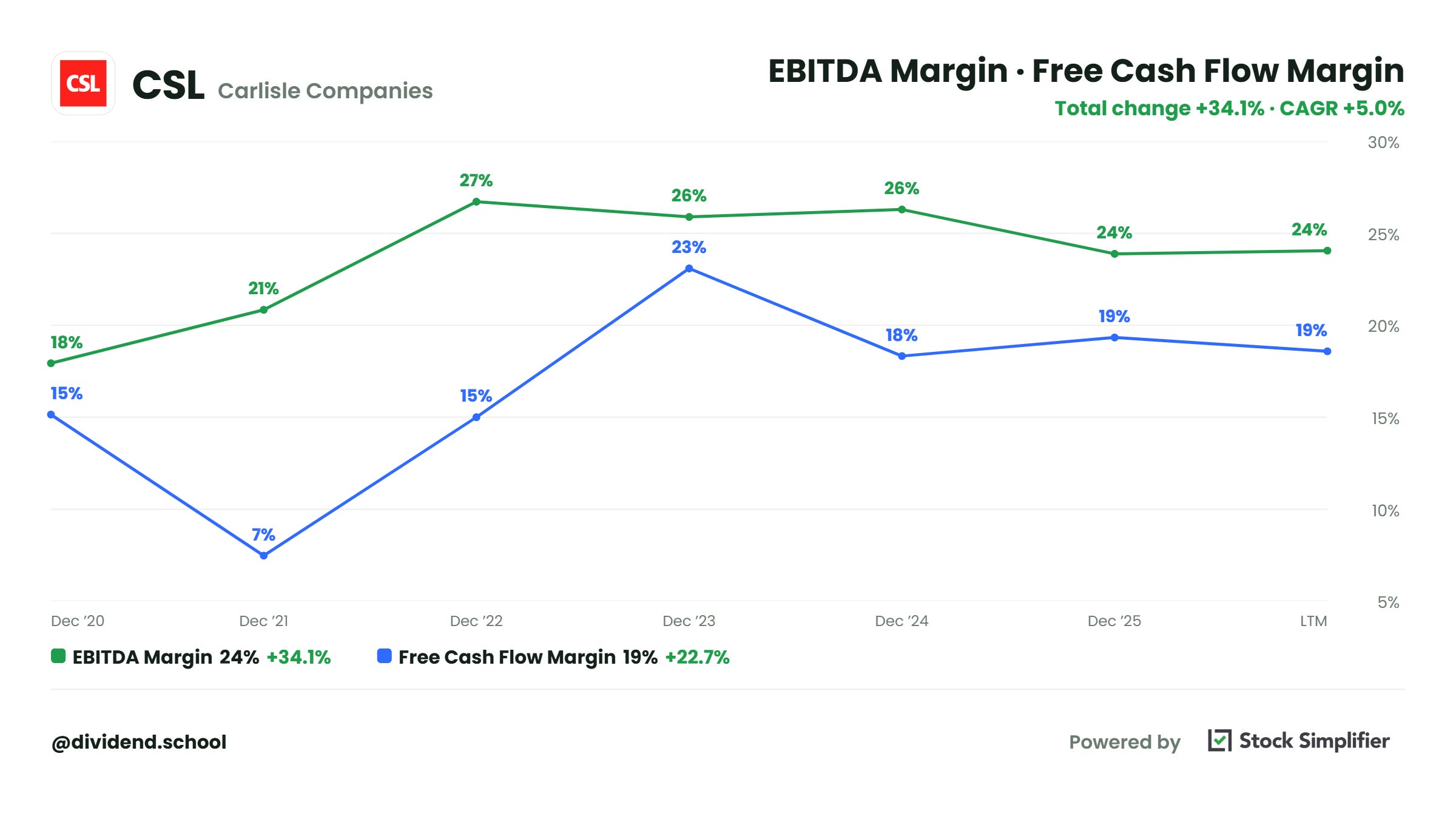
You can see the moat in the margins.
The roofing segment posted a 27.4% EBITDA margin in the first quarter while revenue fell 5%, and this year’s growth guidance leans entirely on price increases that customers keep paying. Commodity businesses cannot raise prices into a down market.
Now, the dividend record.
Carlisle has raised its dividend for 49 straight years. The next raise, expected in August, would make it 50 and put Carlisle in Dividend King territory. This is rarified air, only about 50 U.S. companies have done that. The company is reporting shortly after this report is being created, so we will try to update.
Here’s the fiscal 2025 scorecard:
Revenue: $5.0B
Net income: $740.7M
Free cash flow: $970.6M
Operating margin: ~19%
Nearly 19 cents of every revenue dollar falls through to free cash flow, which is elite for an industrial company or any company excluding Visa and Mastercard.
And the dividend picture:
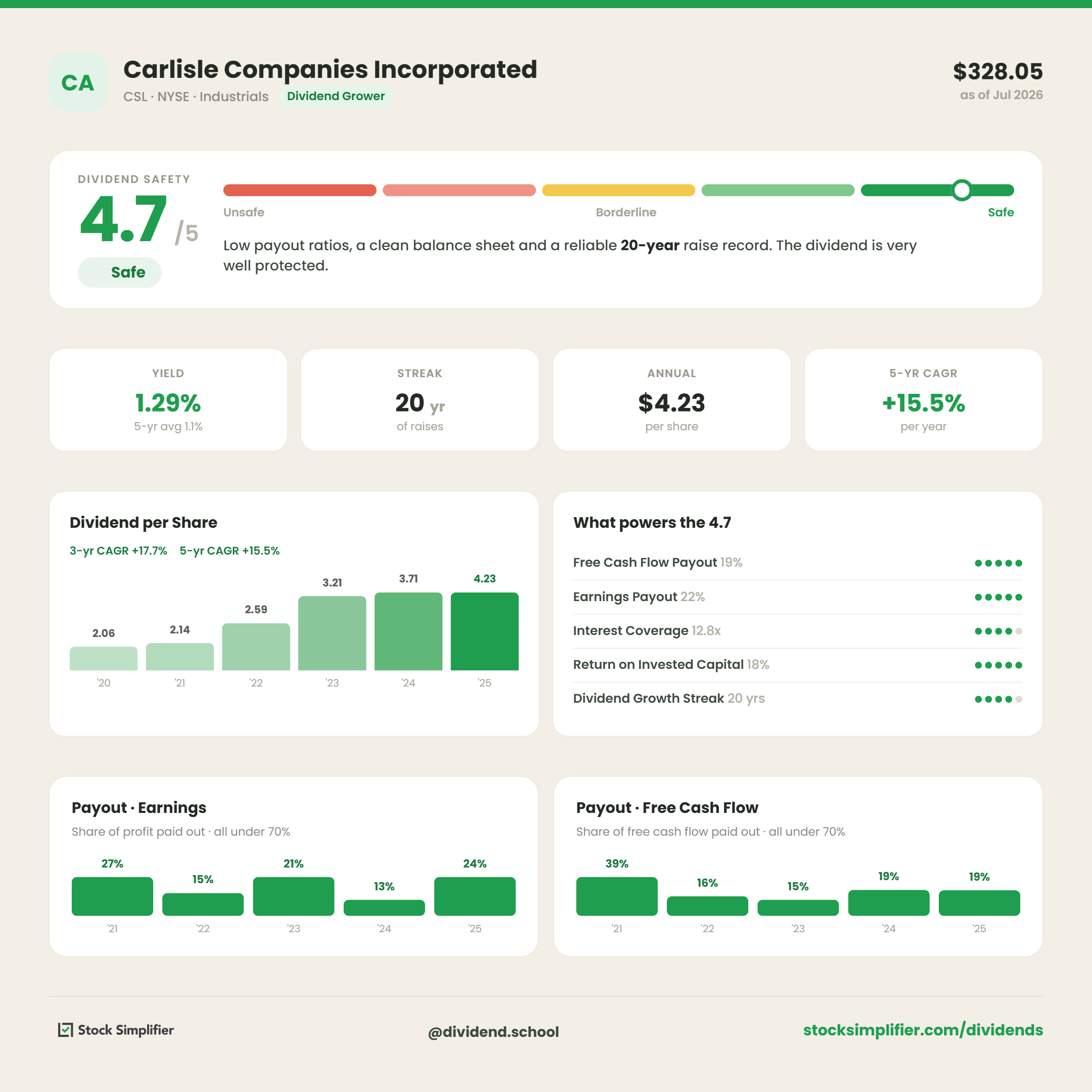
Annual dividend: $4.23 per share
Yield: ~1.3%
Free cash flow payout ratio: ~19%
Latest raise: 10% (15% CAGR over the past 5 years)
20-year track record of raises
The 1.3% yield will not get any income investor excited, look past it. Carlisle’s payout ratio in the high teens with a 15% 5-year raise rate means the dividend has decades of runway. Management is also buying back stock on top of it, with a $1 billion repurchase target for 2026. Capital allocation at it’s finest. And with net debt at 1.7x EBITDA, well within their own 1x to 2x comfort zone, this is a strong business with fantastic financials.
Management’s Vision 2030 plan targets $40 in adjusted earnings per share and ROIC (return on invested capital) above 25%. With current ROIC of 18% and adjusted EPS of $19.40, those are ambitious numbers. But with historical growth of 16% in earnings and 6% in ROIC, they have a realistic shot, and I wouldn’t bet against them.
Carlisle is the low-yield, high-growth flavor of dividend investing, and the raise rate is what we are buying.
What to keep an eye on: the construction cycle. First quarter revenue fell 4% on weather delays and soft new construction. Carlisle reports second quarter results this week.
That’s the free half: the Dividend Universe rules, the full Carlisle case, and a moat you can read straight off the margins, a roofing company one raise away from Dividend King status.
The second company is the more interesting one. They have raised their dividend for 42 straight years, the founding family that controls it has protected the payout since 1870, and the market has knocked the stock down to a yield we haven’t seen before.
Below the paywall, members get:
The full Brown-Forman case, built on a moat with two walls (one of them is measured in barrel years, and no amount of money can shortcut it).
The fiscal 2026 scorecard. The income statement had a rough year, and free cash flow nearly doubled anyway. One of those numbers decides whether the dividend is safe.
The honest risks. What management’s own fiscal 2027 guidance admits, and the one scenario that would shrink the growth story for good.
The removal tripwires for both new names, the exact triggers that would take Carlisle or Brown-Forman back off the list.
Where the buy below prices land. Both additions get the full valuation treatment in the next issue of Best Buys Now.
Start with a 7-day free trial and read all five names before paying a dollar. Membership is $369 a year or $35 a month, with a 30-day money-back guarantee either way.
Want to see a complete member deep dive first? My full Johnson & Johnson analysis is unlocked, free, start to finish.