

Not a single S&P 500 company cut its dividend this month.
Cuts have historically come in clusers, and long gaps between clusters can trick or lull investors to stop analyzing companies, and the cash flow statement.
Here’s the history and what July looked like compared with recent years:
2020: 43 S&P 500 companies suspended their dividends
2025: 176 US companies cut or suspended
July 2026: zero
That makes this a good month to practice our cut-spotting skills and learn the signals before we get burned.
Welcome to the first issue of The Dividend Danger Report. Every month, this free report will report on:
Cuts this month (every US-listed payer, not just the S&P 500)
Freeze Watch (skipped raises and token raises)
The Danger List (names whose safety scores deteriorated)
Scorecard on past calls (starting next issue)
We start with the biggest freeze of the year, at a familiar company and many own.
Okay, let’s dive in and look at what July did and did not tell us.
1. Cuts this month
As we mentioned above, the S&P 500 count for July was zero.
Broaden the horizon and the zero looks different. According to S&P Dow Jones Indices’ January 7, 2026 release, 176 US companies decreased or suspended their dividends in 2025, cutting $12.9 billion in payments. That was up 33% from 132 companies in 2024.
Companies kept cutting through 2025, mainly outside the usual places dividend investors look.
Here’s the base-rate picture from that same S&P DJI release:
2025 decreases/suspensions: 176 companies ($12.9 billion cut)
2024 decreases/suspensions: 132 companies
2025 increases: 2,293 (down from 2,450 in 2024)
Q4 2025 alone: 634 increases vs. 38 decreases
Increases outnumber cuts by a wide margin in any normal year, which is why a drought feels safe. The Covid hits and 43 S&P 500 companies suspended their dividends in 2020. And worse still, the index’s full-year net dividend change flipped to a negative $40.8 billion. That cluster focus is what hits the hardest.
Meanwhile, all the unread signs say relax. The S&P 500 paid a record $78.92 per share in 2025, the 16th consecutive year the 409 dividend-paying companies (out of 500) have paid a dividend.
Those 16 straight years train a dividend investor to stop checking the numbers. It creates a sense of safety.
There was one cut in July, outside an area most dividend investors pay attention too.
Blackstone Private Credit Fund (BCRED) cut its July distribution to $0.18 from $0.20, per AltsWire. That’s the second cut in nine months, with NAV sliding and withdrawal restrictions imposed in June.
If we follow the money. Public dividend cuts became rare, and yield-chasers started hunting for 9% available in private credit, and moved the risk to a corner of the market thinner disclosure and exit gating. Not ideal for most investors.
2. Freeze Watch
A company freezing a dividend is the earliest warning we get. And July handed us a doozy.
UPS CFO Brian Dykes, on the record: “We don’t expect the dividend to increase, and we’re not going to increase it in 2026.”
This news ends a dividend raise streak of 16 years, all without tripping any of the usual signals.
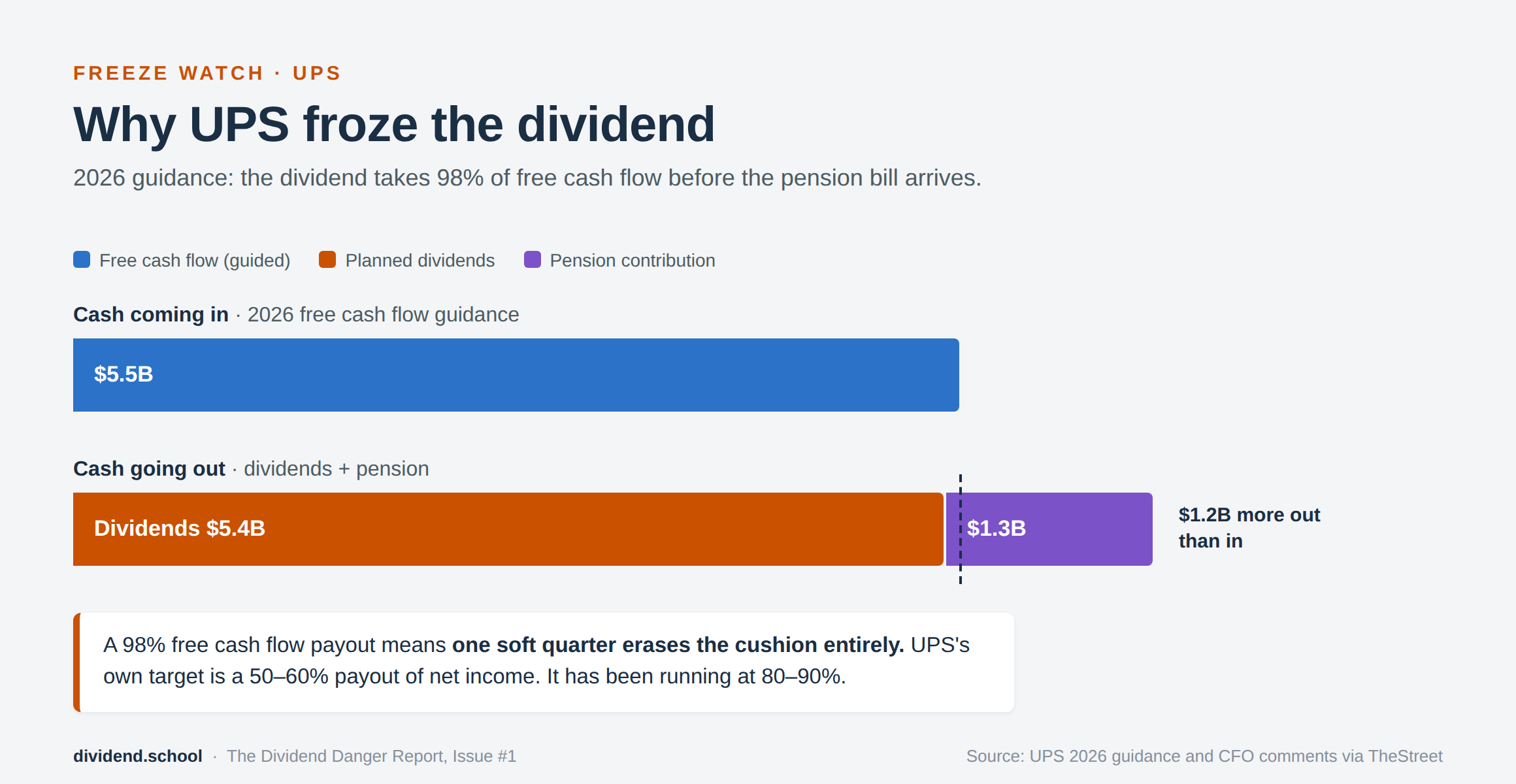
Here’s what UPS brings into 2026, from company guidance and CFO comments reported by TheStreet:
Payout ratio: 80% to 90% of net income
UPS’s own long-term target: 50% to 60% of net income
2026 free cash flow guidance: roughly $5.5 billion
2026 planned dividend payments: roughly $5.4 billion
Implied free cash flow payout: about 98%
Pension contribution on top: $1.3 billion
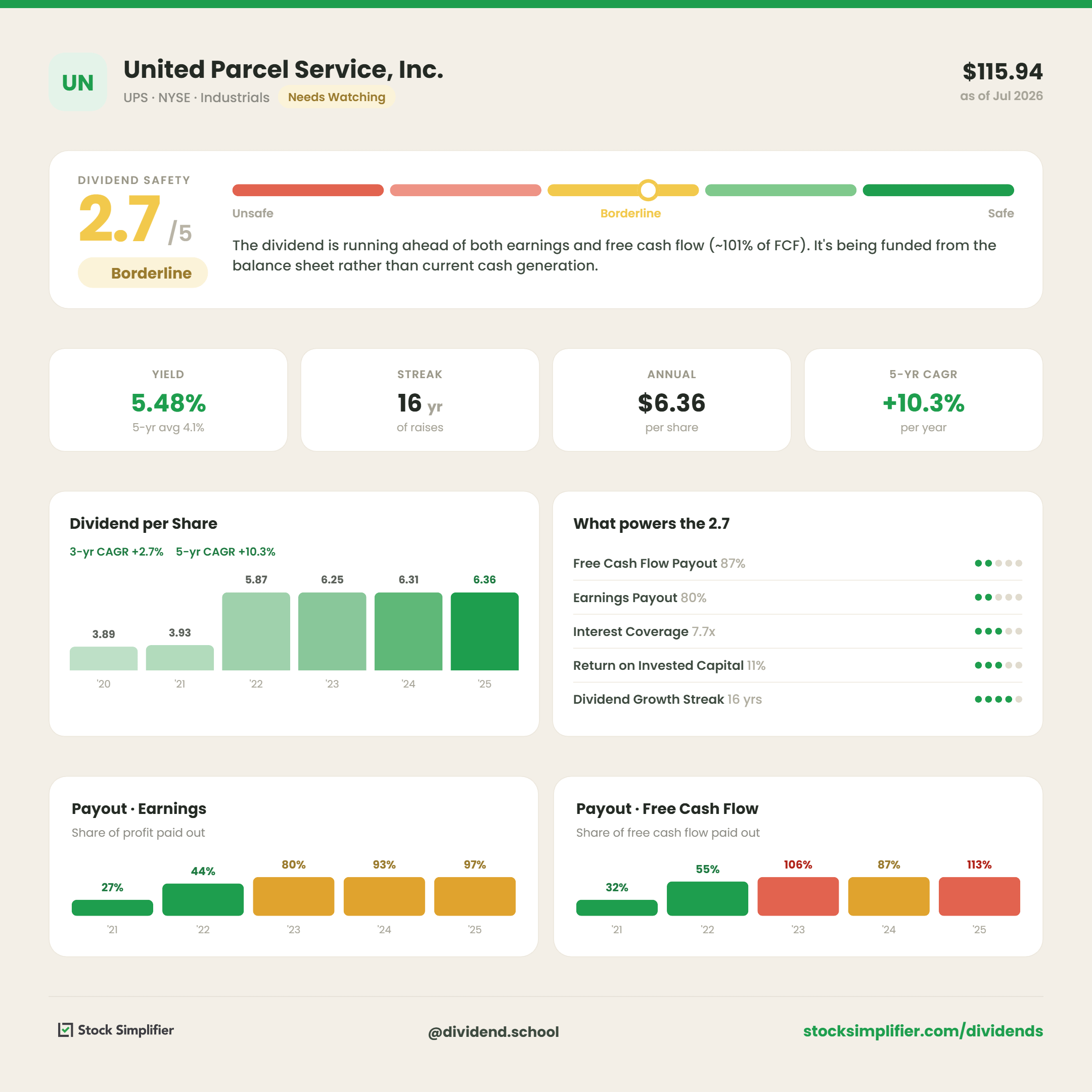
At a 98% free cash flow payout, one soft quarter erases the cushion.
The 98% is why my safety score treats free cash flow payout as a hard-cap. A company, even one as strong as UPS, can fund a dividend out of paper earnings while the actual cash barely covers it. And with the CRO narrating, UPS is playing this out in public.
S&P DJI’s own analyst, Howard Silverblatt, senior index analyst, noted that companies “on a perceived schedule” of annual raises are making smaller increases, and some “appear to have put off their actions for now.” Calling out the cash issue at hand himself.
Companies changing their capital allocation decisions is why the rule exists, to catch any changes in advance.
3. The Danger List
Here is the list of companies who safety scores deteriorated this month, with the specific reasons why. The score describes highlights what the numbers how today, not forecasts.
Stock Simplifier (still in beta) will allow us to grade every public company coming soon, and we will share those scores starting in the next issue.
UPS. The score changed on the free cash flow payout factor: roughly $5.4 billion in planned dividends against roughly $5.5 billion in guided free cash flow, plus the $1.3 billion pension contribution. The CFO has confirmed the freeze for 2026. Wolfe Research put UPS on its July 6 dividend-risk list (via CNBC) the same week.
BCRED. Distribution down to $0.18 from $0.20, the second reduction in nine months, with NAV declining and withdrawals restricted since June. Also named on Wolfe’s list. A fund that cuts twice in nine months while limiting exits is telling you where it expects NAV to go.
Conagra (CAG). The yield crossed 10% this month (July 2026). A double-digit yield on a packaged-food company is the market pricing in a cut, and the score agrees with the market. I looked at Conagra in June and passed, and none of the inputs have improved since.
PepsiCo (PEP). The big sign of a potential cut: 93% of free cash flow, from my July Cheap or Trap breakdown. Pepsi has decades of raises and a brand almost nobody can touch, but the cash coverage leaves very little room for a bad year. The score shows trouble on the horizon, not a prediction of a cut.
Companies leave this list when the inputs improve or when the cut happens, either way, you will see the scoring here.
If you want to see how a story ends, I wrote the full autopsy of Leggett & Platt, a 52-year Dividend King that cut from $0.46 to $0.05 in one announcement. Read it here.
4. How this report works
Since this is Issue #1, here are the ground rules. Future issues will link back to this section.
What counts as a cut. Any reduction or suspension of a regular dividend or distribution by a company, and special dividends don’t count. Variable-by-design payers including some energy companies or BDCs will only count when the policy changes. I’ll flag these when judgment is required.
The universe. Every US-listed common stock and listed fund that pays a regular dividend, along with select global dividend payers. You can find the 1,000 companies we are following here. The S&P 500 gets its own treatement because that’s where most readers’ money resides. And the gap between indexes and individual companies tells us a story as well, which is useful.
How companies join the Danger List. A company joins when its safety score erodes on a specific input: free cash flow payout crossing a threshold, dividend coverage falling, a freeze announcement, or a credit event. I name the reason every time.
How companies exit. The numbers improve, the cut happens, or twelve months pass with no further deterioration. Exits get announced, and starting next issue, the scorecard section will grade every past call, hits and misses both.
What this report will never do. This report does not forecast cuts. The scores measure the present, so a company on the Danger List can fix its numbers and never cut, and the scorecard will record that improvement.
What this means for your process
One habit to start building this month, when a company you own announces a dividend, check the raise, and a treat any changes such as a skip or a small raise as a trigger.
The next step, pull the cash flow statement and run the free cash flow payout ratio. Compare the company’s dividends paid to free cash flow. Simple.
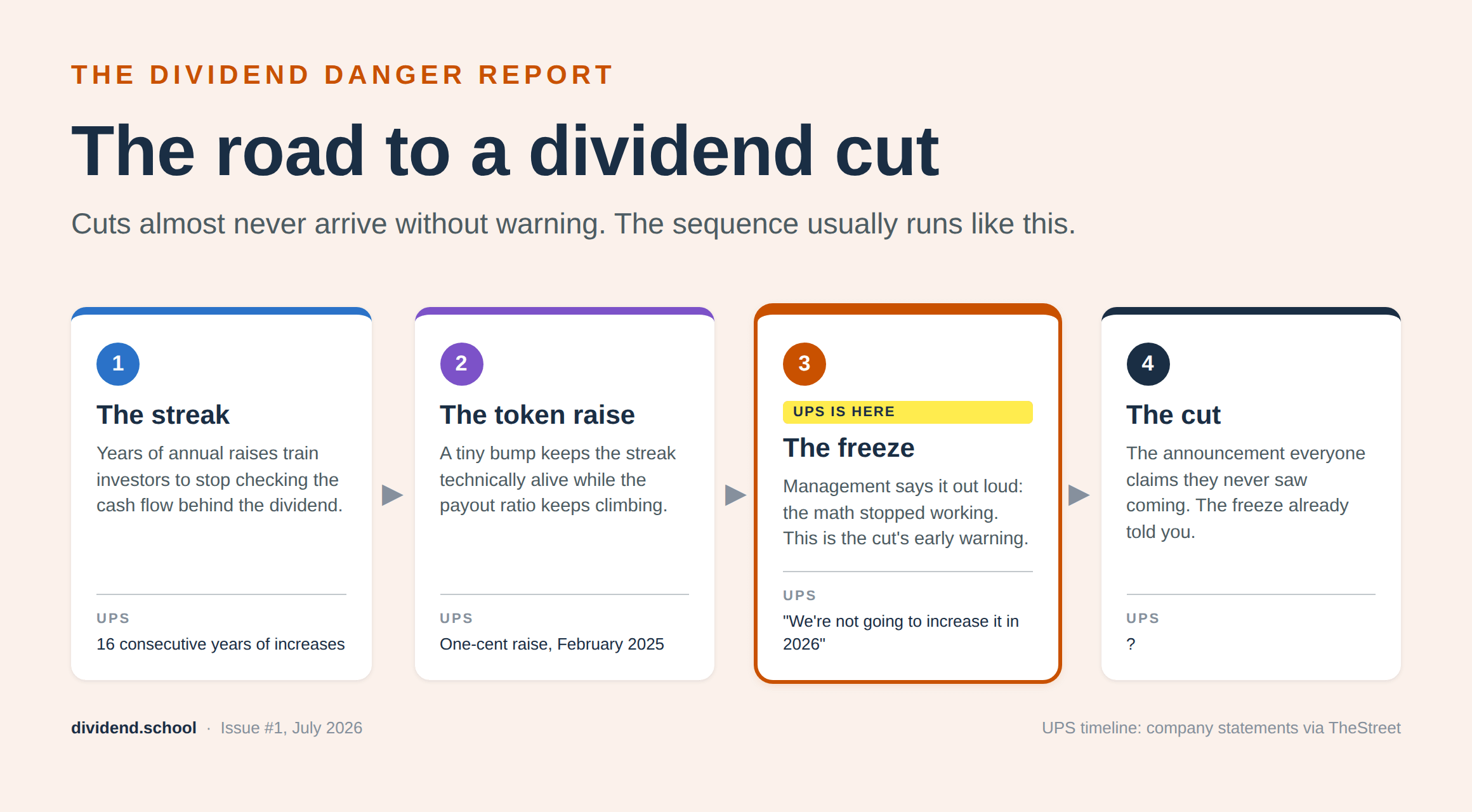
Companies follow a pattern when things start to turn:
Dividend streak
Small raise
Dividend freeze
Dividend Cut
UPS gave a one-cent token raise in February 2025, froze in 2026, and now sits at a 98% free cash flow payout. Leggett & Platt ran the same sequence all the way to the end.
Companies rarely announce a cut in advance, they almost always freeze the dividend first. The freeze is the signal we should build a habit around.
If you want the exact factors I use, grab the printable Dividend Safety Scorecard. It’s the same checklist behind every Danger List entry above.
Members get the full Universe (currently 30 companies) rescored every month.
Until next time, take care and be safe out there,
Dave
Sources: S&P Dow Jones Indices press release, January 7, 2026. TheStreet interview with UPS CFO Brian Dykes. AltsWire, BCRED July distribution. CNBC, Wolfe Research dividend-risk screen, July 6, 2026.