

Hi everyone!
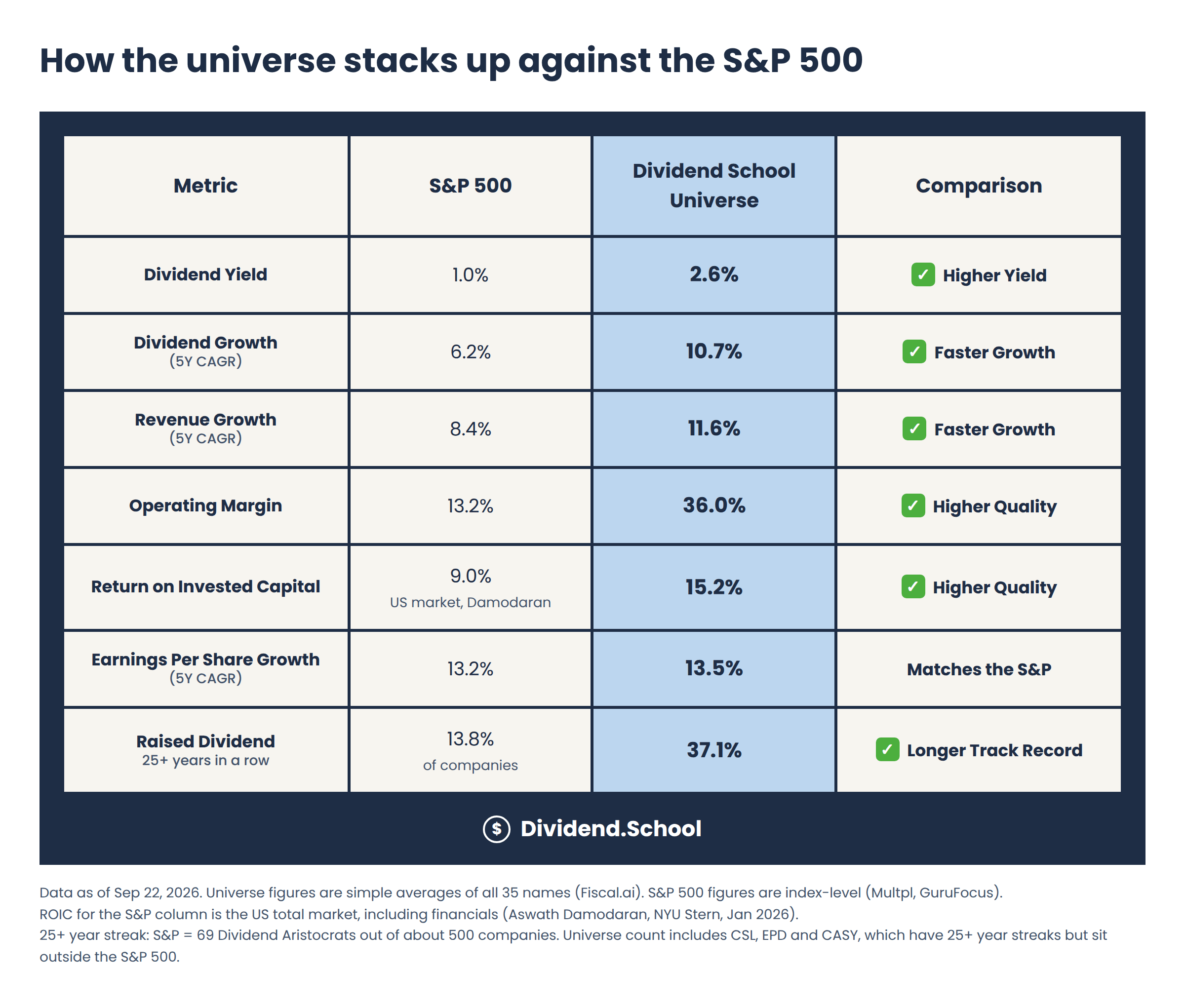
The Universe is growing. We are going from 30 to 35, so we added five new names.
Thirty was never a magic number. As I analyze the current Universe, I am also always looking for good companies to add. Several of these names kept appearing in my feeds, such as Carlisle and Lowe’s. Companies too good to keep ignoring and ones I would like to own when the price is right.
Some of these companies fill places we have no representation in, and others are too good to keep out.
So we are fixing that.
In today’s post, we will discuss:
Why the Universe is growing to 35
Addition #1: Carlisle Companies (CSL)
Addition #2: Lowe’s (LOW)
Additions #3 through #5
The Five New Companies
Earnings to Watch
Okay, let’s dive in and meet the new names.

Why the Universe is growing to 35
Each company in the Universe fits a bill. It fits one of our three strategies (Compounder, Dividend Growth or High Yield), and it passes the five filter questions we ask every quarter:
Does free cash flow cover the dividend?
Is guidance holding?
Which way is the payout ratio heading?
Are margins holding?
Is capex crowding out the dividend?
Why add rather than reduce or remove?
Because nobody in the current 30 has done anything to lose their seat. Dropping a company that passed every filter, only to keep a round number is not ideal and potentially hinders our returns.
Buy Below prices for the new additions will come at the beginning of next month’s valuation work. Until then, we will add them to the Universe with the safety score.
Addition #1: Carlisle Companies (CSL)
Carlisle makes the roof over our heads, or at least the one over the warehouse down the street.
Its biggest business sells the membranes, insulation, and adhesives on the flat roofs of warehouses, stores, and schools. The smaller business sells waterproofs and insulates the rest of the building. Over the past few years, Carlisle sold its other businesses and became a pure building products company.
Boring is beautiful.
Safety score: 4.7 out of 5, Safe. Strategy: Dividend Growth.
2025 revenue: $5.02 billion
2025 adjusted EPS: $19.40
2025 free cash flow: $972.4 million
Annual dividend: $5.00 ($1.25 a quarter)
Yield: 1.59% at $314.70
The dividend
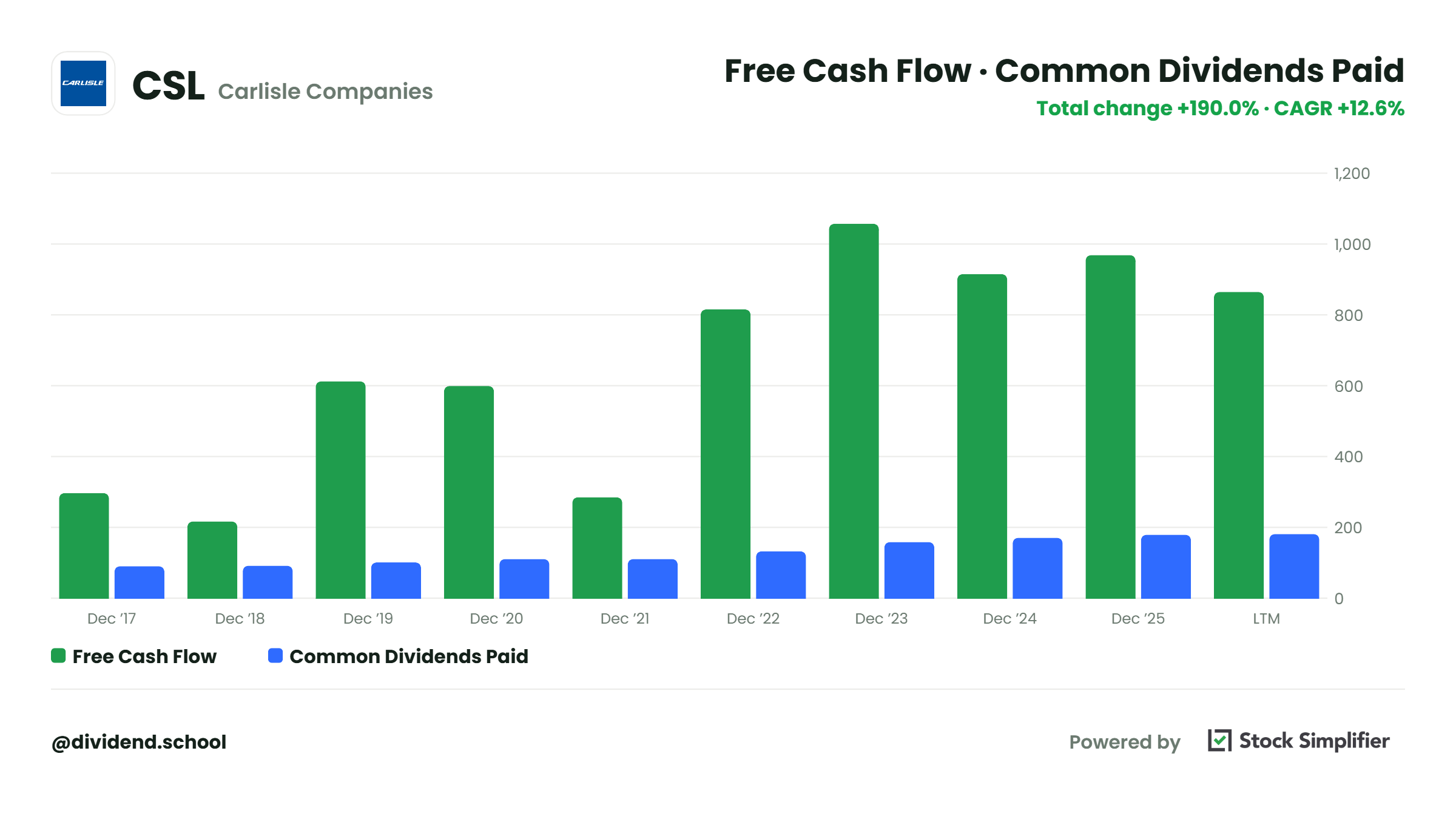
On August 6, Carlisle raised its dividend 14%, from $1.10 a quarter to $1.25. That was its 50th consecutive annual raise, which makes Carlisle a newly minted Dividend King.
What impresses me more than the streak is how little of the cash it uses:
Payout on free cash flow: 18.6% ($181.1 million in dividends / $972.4 million of free cash flow)
Payout on adjusted earnings: 21.6% ($4.20 paid in 2025 / $19.40 of adjusted EPS)
Carlisle pays us $1 of dividends for every $5 of free cash flow. Plenty of room for the next raise, and the one after that. That is an incredible free cash flow payout ratio and remarkable for an industrial. It showcases the profitability of the business.
Has 2026 changed that?
Not much. Cash flow came in lighter in the first half, so the payout over the last twelve months ticked up to 20.9%. Still well inside our comfort zone.
Why re-roofing matters
Re-roofing is the heart of the case for me. More than 70% of Carlisle’s sales come from replacing old roofs, not building new ones. When a commercial roof wears out, the owner has to replace it whether the economy is good or bad. A leaking roof doesn’t wait for interest rates to come down.
The second quarter results illustrated this. New construction fell, both commercial and residential, while re-roofing grew 3%. Revenue came in at $1,570.3 million, up 8%, and management raised full-year revenue guidance to mid-single-digit growth.
What to keep an eye on
Three things, none of them fatal:
Margins
Buybacks
Competition
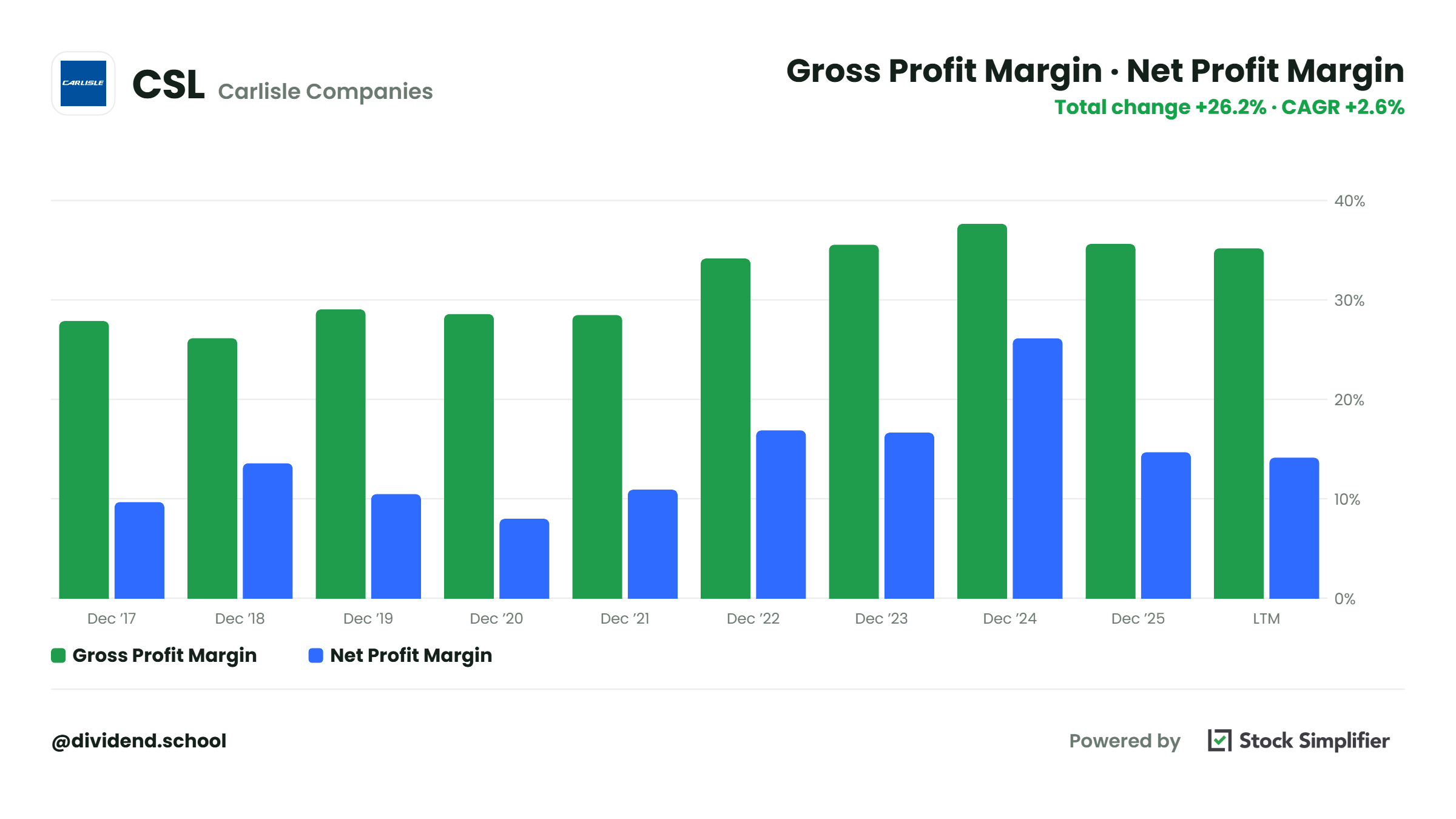
Margins. Raw material and freight costs are running ahead of Carlisle’s price increases, and management cut its 2026 margin guidance to flat. Part of the second quarter’s strength also came from customers buying ahead of price increases, which tends to leave a hole a quarter or two later.
Buybacks. In 2025 Carlisle bought back $1.3 billion of stock and paid $181.1 million in dividends, against $972.4 million of free cash flow. It covered the gap with cash and new debt, and cash fell from $1.1 billion to $665 million. The dividend isn’t at risk, but a company can’t spend more than it makes forever. I’ll be watching this every quarter.
Competition. Kingspan, the Irish insulation giant, is spending more than $1 billion to build a US roofing business, and analysts are flagging 2027 as the year it starts to make an impact.
Verdict
A 50-year raise streak paid out of a fifth of free cash flow, with most of the business tied to replacement demand, is exactly what the Dividend Growth bucket is for. The 1.59% yield is low, and I won’t pretend otherwise. We’re buying payment growth, not the size of it.
The stock is down 18% over the past year and sits near the bottom of its 52-week range. We’ll see where that lands against the Buy Below.
Addition #2: Lowe’s (LOW)
Everybody knows Lowe’s, the second-largest home improvement retailer in the country behind Home Depot.
Safety score: 4.5 out of 5, Safe. Strategy: Dividend Growth.
Fiscal 2025 revenue: $86.29 billion
Adjusted EPS, last twelve months: $12.47
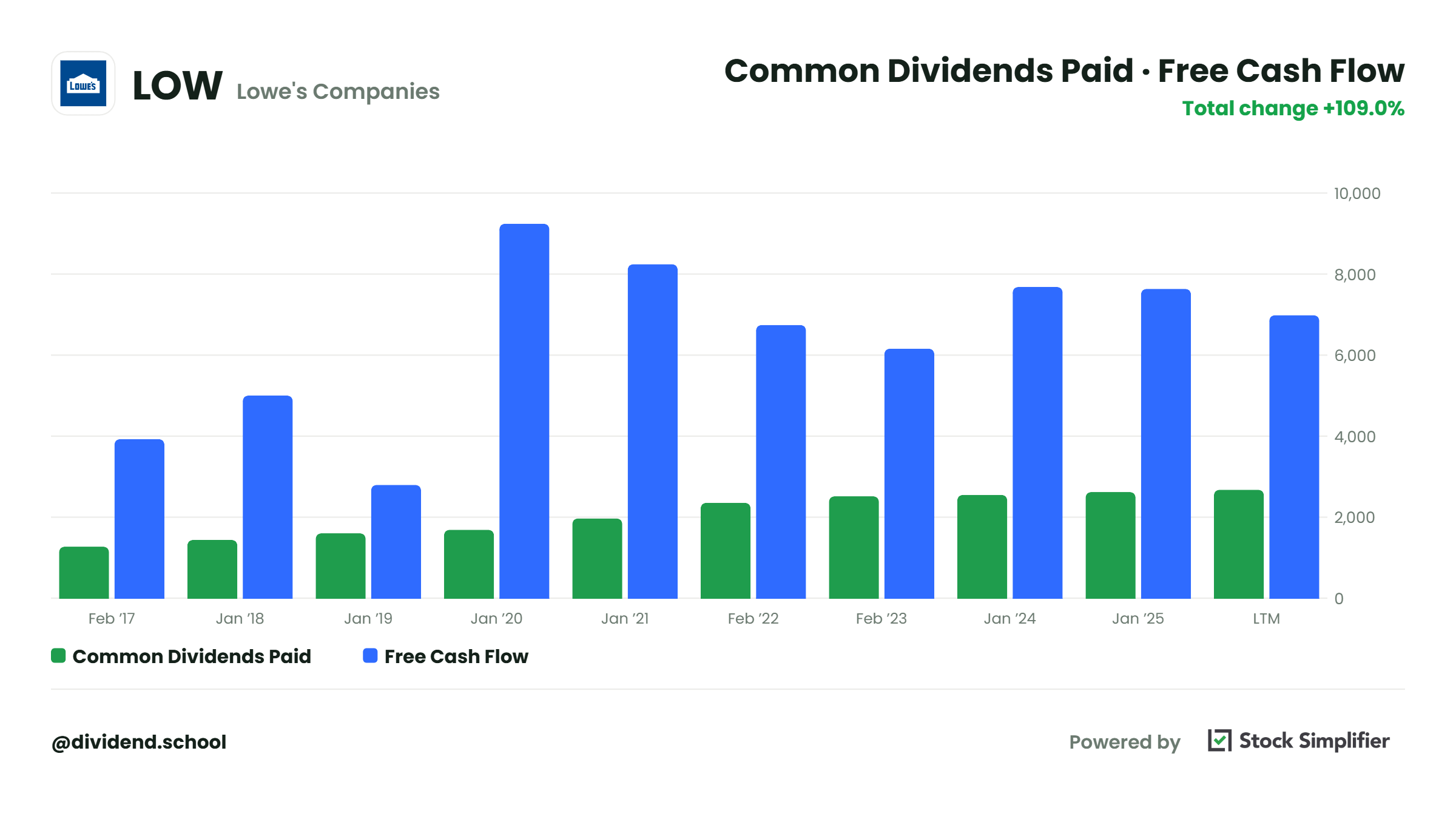
Fiscal 2025 free cash flow: $7.65 billion
Annual dividend: $5.00 ($1.25 a quarter)
Yield: 2.6% at $192.49
Lowe’s has raised its dividend for more than 50 straight years, another Dividend King. The latest raise, in May, was 4%, and the payout is comfortable on both measures:
Payout on earnings: 40% ($5.00 / $12.47 of adjusted EPS)
Payout on free cash flow: 34% ($2.636 billion in dividends / $7.651 billion of free cash flow, fiscal 2025)
So why isn’t it a 5?
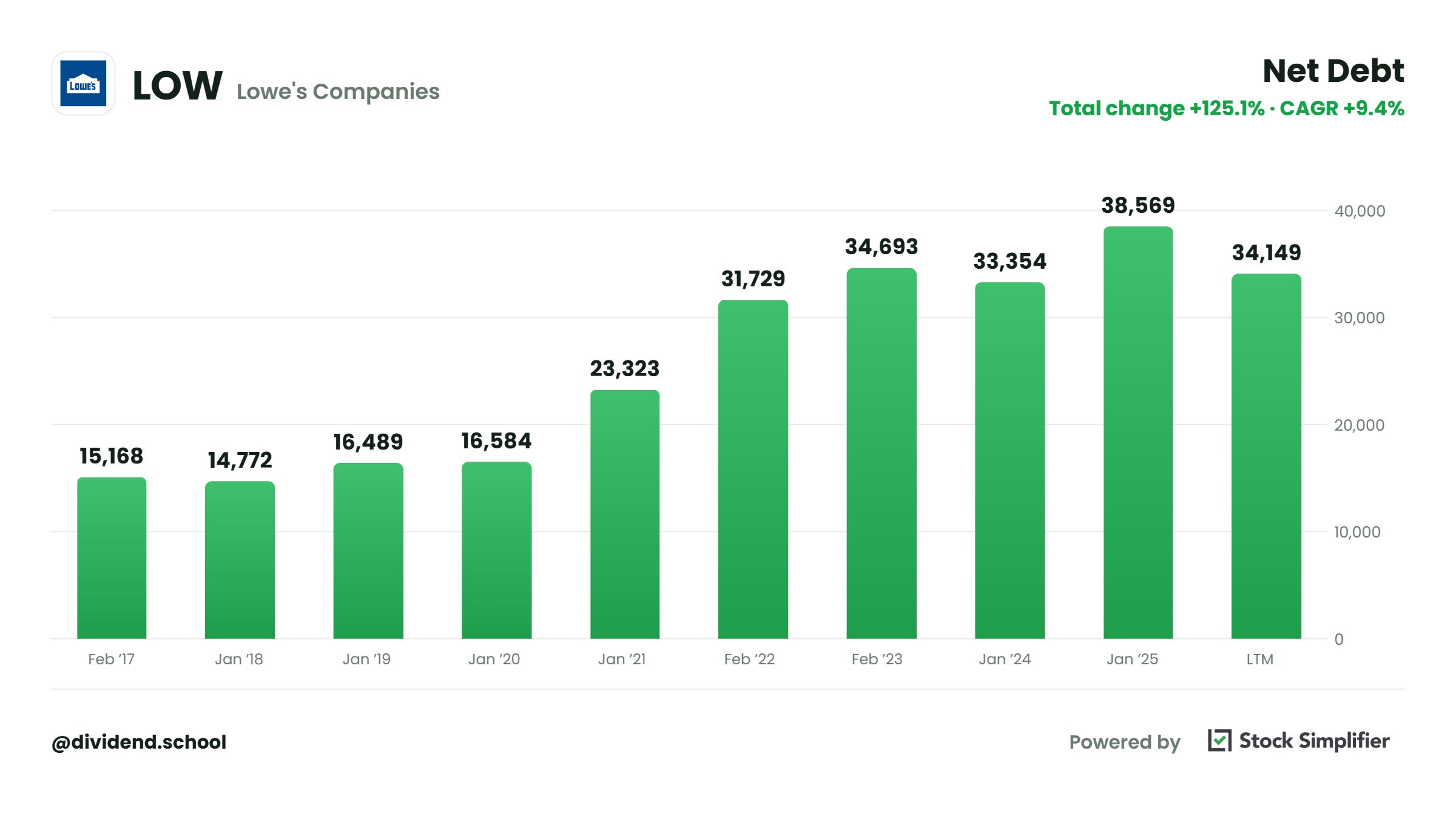
The balance sheet. In 2025, Lowe’s paid $8.8 billion for FBM, a building materials distributor for professional contractors, and funded it with debt. Leverage sits at 3.0 times against a target of 2.75 times by mid-2027, and buybacks are paused.
First-half interest expense rose to $773 million from $650 million. Operating income still covers it 7.9 times ($6,103 million / $773 million). No danger, just less room.
Lowe’s also has negative shareholders’ equity, −$7.44 billion, from years of buying back more stock than it earned. That makes return on equity and debt-to-equity useless for this company, so we stick to the cash flow numbers.
Housing is the real headwind. In August, management cut full-year guidance to the low end: $92 billion in sales, flat comparable sales, and $12.25 of adjusted EPS. People aren’t moving, and people aren’t also redoing their kitchens. The economy matters for this type of investment.
Verdict for our process: a Dividend King paying 40% of earnings, added when housing is at its worst rather than its best. That’s usually the right time to add a name like this, and the stock sits near its 52-week low. This is a planting-a-tree type of investment.
That’s two of the five, graded in full and free.
Below the line, the other four:
The company behind most of the proxy votes you’ve ever cast. Twenty straight raises, a 12% raise in August, and a regulator that proposed rewriting the rules its biggest business runs on eight days before this issue.
A 23-year raiser whose free cash flow payout is falling this year even as its volumes shrink.
A monthly payer the scoring tool rated 1.7 out of 5. I overrode it to 3.5, and I’ll show you exactly why.
Plus the five new rows for the Universe table and the earnings dates worth circling.
Members, keep scrolling. Everyone else, seven days free.
[Unlock the other four]
$369 a year or $35 a month. Thirty-day money-back guarantee either way.