

Hi everyone!
Four of the five companies on today’s list cut their dividend raises before the bad news hit their prices.
Sysco went from a 5.85% raise to 1.85%, and Zoetis went from 15.07% to 6%. Another on the list broke their run of 3-year 10% raises, while another’s cut was minimal.
Most of these happened before the news of them landed. We have to remember, the company boards see the cash flows before we do and make decisions accordingly. Dividend increases or cuts send signals to the market, which is why these decisions remain behind closed doors.
Today, we will run these five companies through my three valuation tools:
P/FCF
DCF
Reverse DCF
We will also look at the dividend safety of each dividend, along with its growth, if any. Three of the five offer some teaching moments from their numbers and how to interpret them.
Okay, let’s dive in and grade this month’s batch.
1. Sysco (SYY)
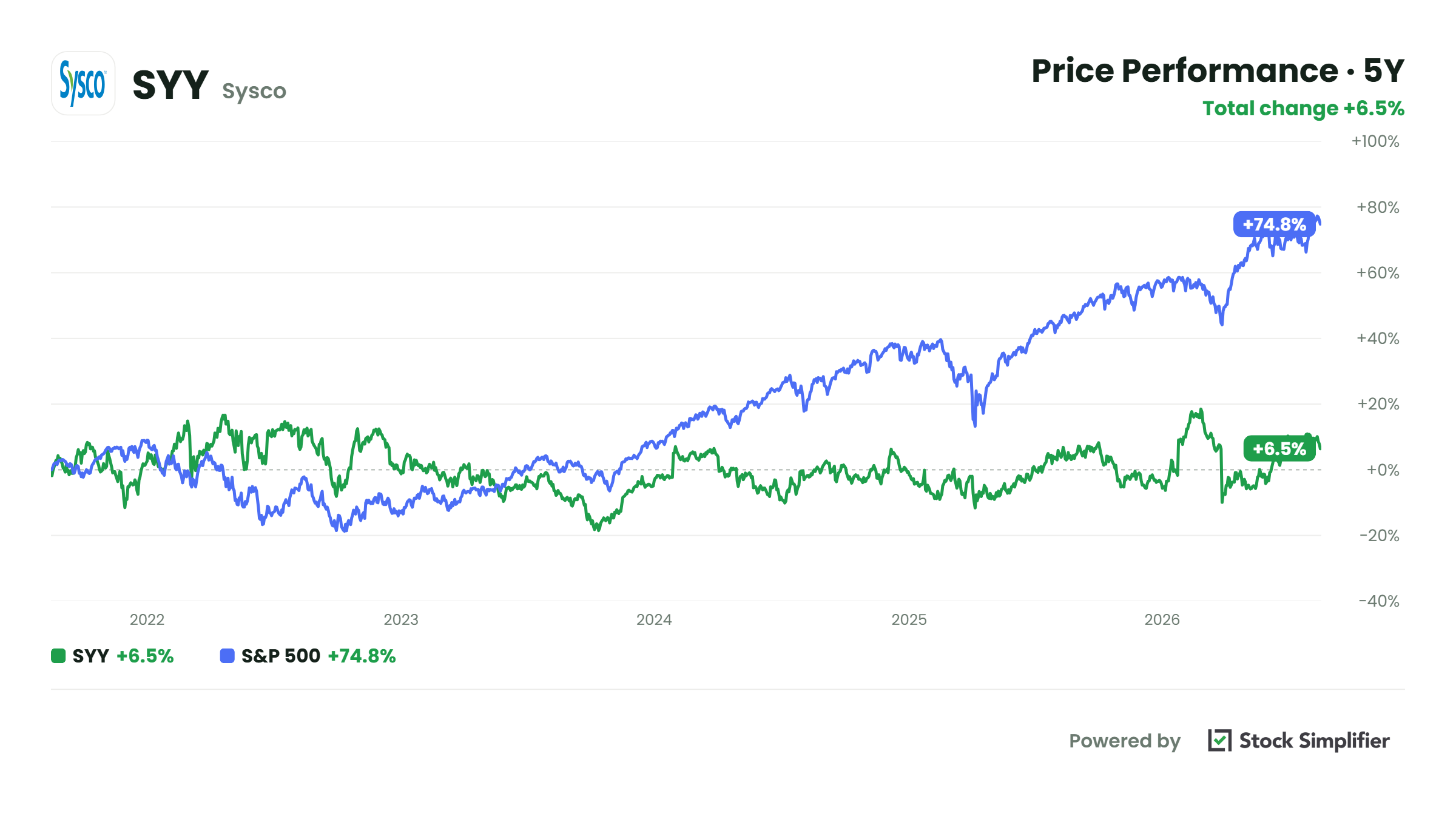
Sysco is the largest foodservice distributor in North America, serving about 17% of a roughly $370 billion US market through 337 facilities. The company’s distribution and route density is hard to replicate, thus their moat.
Using our three tools with a current price (as of writing), $81.96:
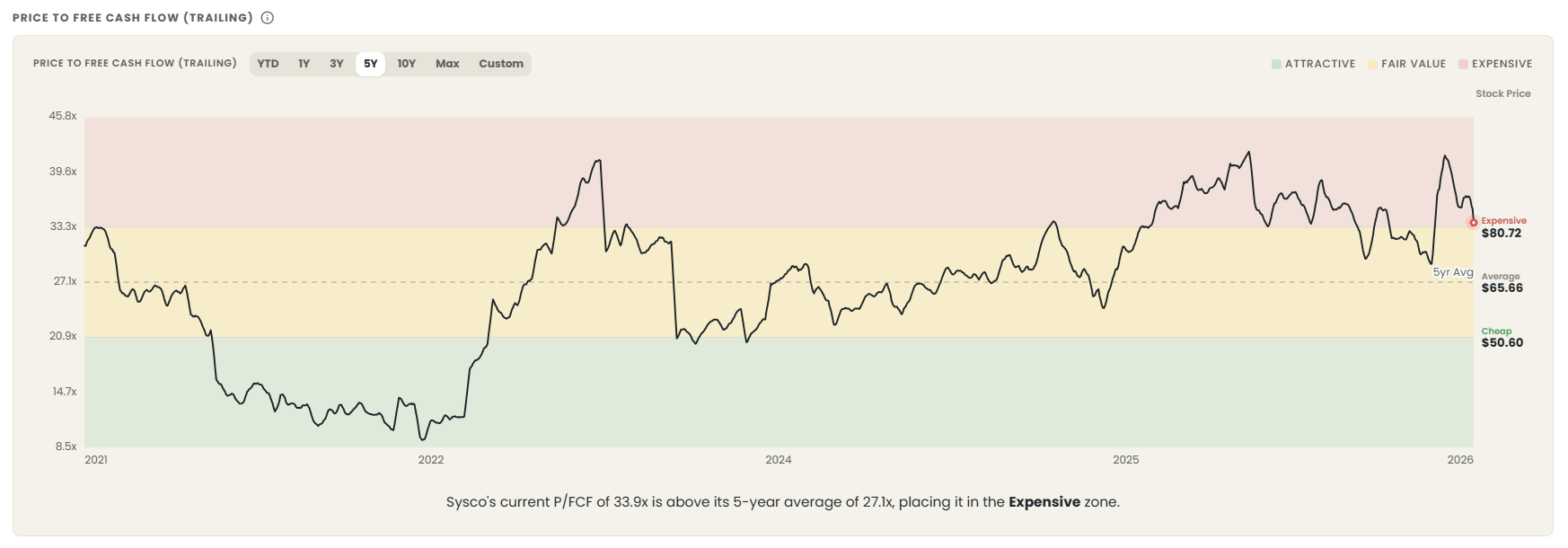
P/FCF (trailing): 20.6x versus a 5-year average of 24.9x (fair value zone)
DCF base case (5% / 5% growth): $94.28, about 13% above the price
DCF bear case: $63.59, roughly 24% below
Reverse DCF: the price implies 2.6% annual growth after year three
Current free cash flow sits at $1.94B with a free cash flow margin of 2.3%. Retail margins are thin, are they not? At 5% growth, based on their historical performance, the company would hit free cash flow of $2.35B by 2031. The company’s own guidance calls for bigger growth beyond the 0.9% we are modeling after year three.
Bottom line, the company looks a little below fair value based on some conservative numbers.
Now the dividend.
The company is approaching its 57th year of dividend increases, with its current dividend of $2.29 representing 49% of free cash flow.
The dividend coverage and safety is in great shape.
The size of the raise is the problem.
April 24, 2025: $0.51 to $0.54, a 5.88% increase
April 17, 2026: $0.54 to $0.55, a 1.85% increase
That raise landed 18 days after Sysco announced a $29.1 billion acquisition of Jetro Restaurant Depot. The investor deck promised to “maintain current dividend amount and dividend aristocrat status.”
Notice the wording: amount, not how much. We can expect more minimal raises in the near future.
The other capital allocation lever, buybacks, fell from $1,250 million to $200 million and is suspended until further notice.
Here is the part that matters most for the valuation.
That DCF models Sysco alone through 2036. Jetro closes in the third quarter of fiscal 2027, in year one, bringing 91.5 million new shares (about 19% dilution) and $21 billion of debt, against roughly $1.9 billion of free cash flow.
Free cash flow per share still improves, from about $4.05 to near $4.89. Run those same numbers through the reverse DCF, though, and the implied growth rate flips from positive 2.6% to roughly negative 1%.
That’s the part that wreaks the valuation.
The verdict for your process: Sysco is a wide-moat distributor trading at a fair price, with a well-covered dividend. The hard part is that the acquisition puts any dividend raises and buybacks on the back shelf and pressures the valuation.
For me, this goes in the too-hard pile and will be revisited in the future.
2. Zoetis (ZTS)
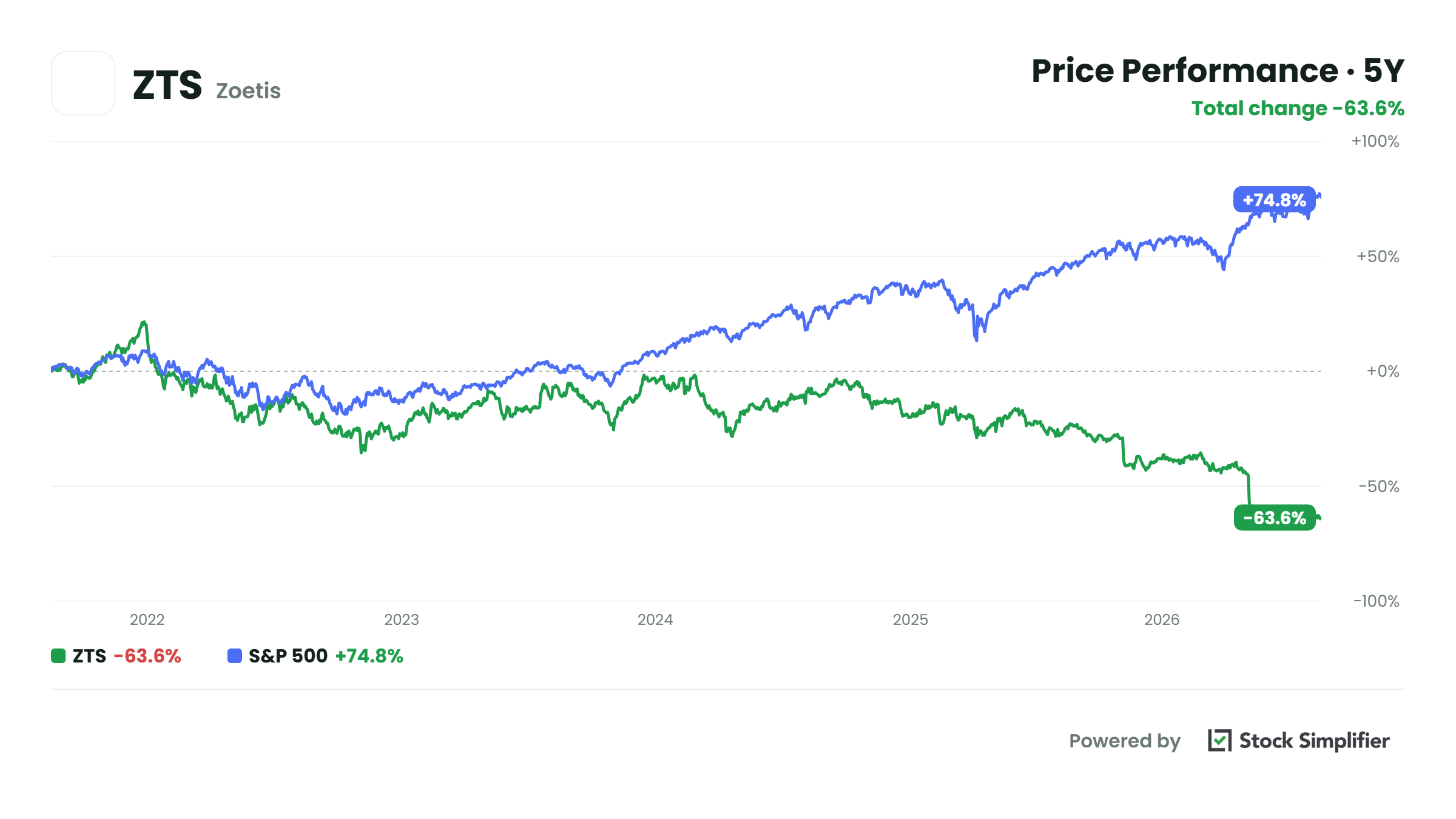
Zoetis is the largest global animal health company. They sell vaccines and medications for pets and livestock, distributed through veterinarians. One of the more polarizing companies in the market right now.
Are they a value or a value trap is the question most want to know.
The company has experienced a 70% drawdown from its all-time high. And on screeners it looks mighty compelling and the cheapest “quality” business out there.
Our three valuation tools tell us:
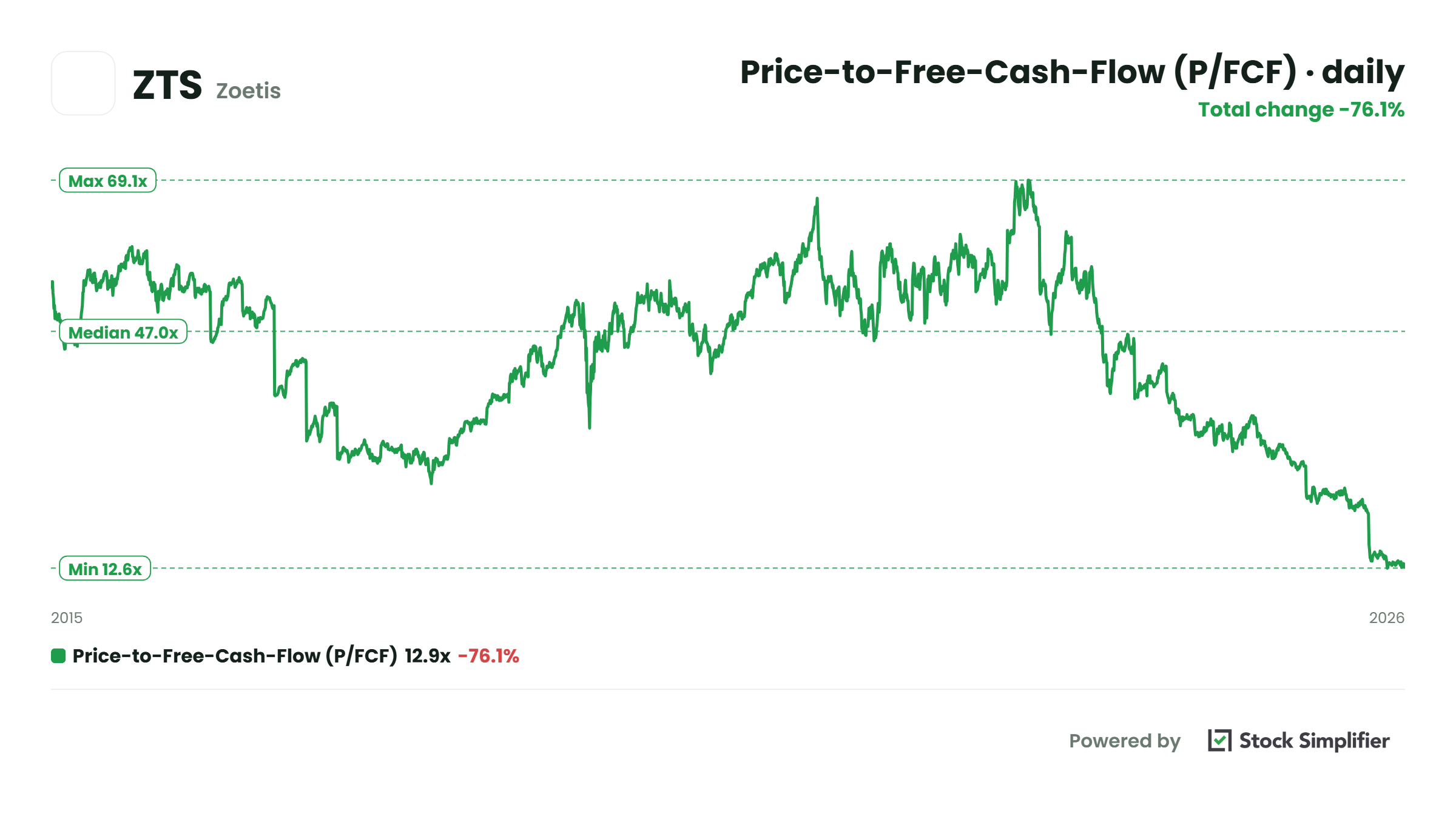
P/FCF(trailing): 13.3x versus a 5-year average of 44.3x (thus the attraction)
DCF base case (5% / 3% growth): $96, around 27% above the current market price ($74)
Reverse DCF: current price implies negative 2.3% annual growth after year three
Zoetis is trading at 30 percent of its own P/FCF multiple, and priced for continued decline. That screams like a gift.
If we dig deeper, we can see some problems.
For example, the reverse DCF implies near-term growth of 5.5% for the first three years. We base this on historical performance. During the most recent earnings call, the company itself guided to revenue growth of-3% to-1%.
Our model is compounding at 5.5%, while the company indicates it believes it will shrink. Now, revenue can flow into free cash flow growth, even if negative, with an extremely profitable, capital-light business, which Zoetis is. But that requires a stretch to reach those numbers.
Pulling on the multiple string, we also see some issues.
Using a five-year average is a fair benchmark for a business that remains the same business. Consider that Zoetis earned a 44.3x multiple during an eight-year monopoly with its drug, Cytopoint. During its run, it held 96% market share.
That moat has been breached with drugs such as Befrena by Elanco, and we can see the impact in the numbers.
Global key dermatology revenue: $395 million, down 16%
US in-clinic dermatology share: about 86%, down 10% year over year
US companion animal revenue: $1 billion, down 11%
A multiple earned during a monopoly is not the multiple to compare it against. It’s not apples to apples.
Next up, dividend safety.
Here, the company performs better. For example, the company pays $2.12 annually with a yield of 2.8%. The free cash flow payout ratio sits at 39%, which is quite comfortable for now.
Zoetis announcing a cut from 15% annual growth to 6% told us something was coming.
The verdict: Zoetis has a well-covered, growing dividend that looks good on the surface. Remember, companies hate to cut a dividend. On the surface, the cheapness looks real, but the reason is real too. Buying Zoetis right now is a bet that management can right the ship and get it back on course to be the dominant animal vaccine and medication company. Even management doesn’t know. Kristin Peck, CEO, from the latest call: “It will take some time to work out. Is that six? Is that 12? Is that 18 months? I can't tell you.”
For me, interesting company, hard pass for now.
That’s the free part: the input check that has to come first, and two of the five graded in full.
Paid members, the rest is yours. Keep scrolling.
Here is what the screen could not tell you.
Zoetis and one of the three names below produce almost the same reading. Both in the attractive zone, both with a reverse DCF pricing free cash flow to shrink. Zoetis is shrinking. The other one raised its dividend 12% nine days ago and keeps 98% of its clients.
Telling those two apart took reading the filings. I did that for all five:
The tool that flatters one of these stocks by $280 million. Fix the input and 33% of upside becomes 3%
A bear case sitting 51% above the share price, and what a reverse DCF is actually telling you when it returns negative 11.4%
The one-page scorecard, all five graded on valuation, coverage, and what the price assumes
Seven days free to read all of it.
Thirty-day money-back guarantee either way, so the only thing you are risking is the time.