

Hi everyone!
Every stock on this month’s list pays us more than it has in years.
General Mills yields 6.85%. UPS yields 5.87%. A fintech that lost a quarter of its value in one morning yields 6.02% at 5 times earnings.
They also share something a screener won’t show us.
General Mills skipped its raise this summer
UPS has paid the same $1.64 for seven straight quarters
A phone company has paid the same dividend since 2022, and plans to through 2028.
The fintech ties its raise to earnings, and earnings are guided down next year
Only one of the five froze its dividend and then started raising it again
A big yield with no raise behind it is a different animal. So this month we count down from the one I’d avoid to the one I’d buy first, and we use three yardsticks on each:
Its own history. What investors paid for this business over the last five years.
Its peers. What investors pay for the same kind of business today.
The paycheck. The yield today, plus the raise we can count on.
The first two tell us where the price sits. The third tells us what we get for waiting.
Okay, let’s dive in, starting at number 5.
5. General Mills (GIS)
General Mills sells Cheerios, Pillsbury, Nature Valley, and Blue Buffalo pet food. We all have some of their products in the pantry.
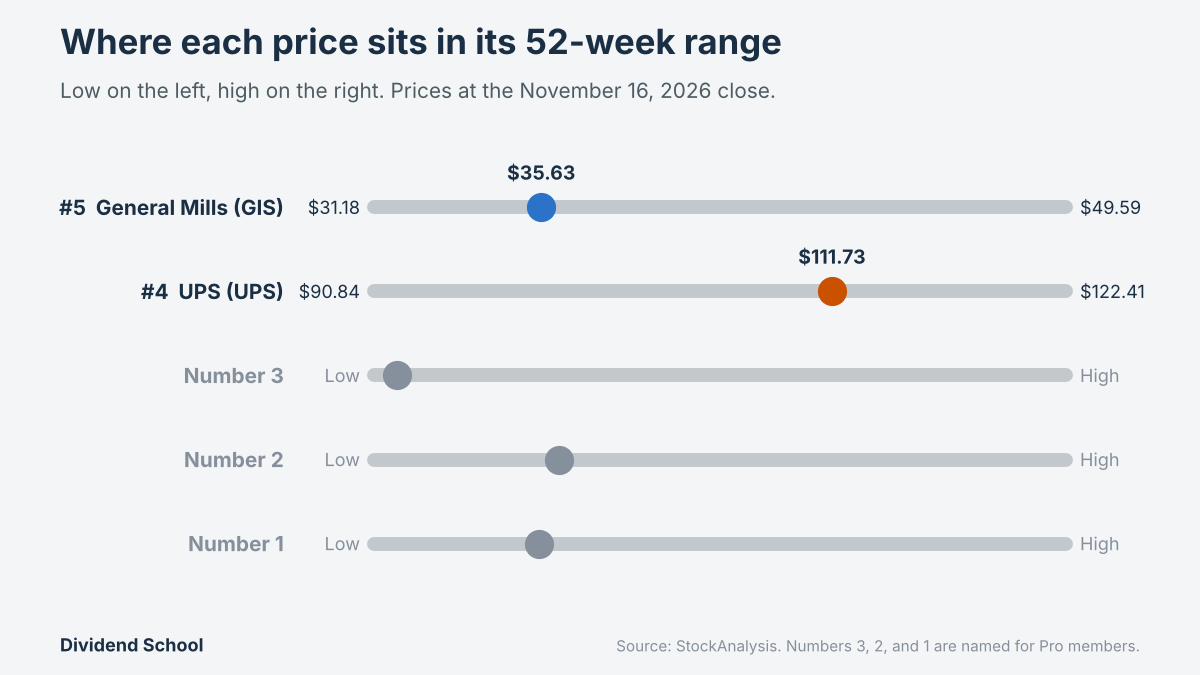
At $35.63, the stock pays us 6.85% and sits 28.2% below its 52-week high of $49.59.
On the screens, it looks like the bargain of the grocery aisle:
11.5 times this year’s guided earnings ($35.63 / $3.10)
11.7 times free cash flow, against a five-year average of 15.6
A dividend paid without interruption for 127 years
So why is it this cheap?
The raise that didn’t come
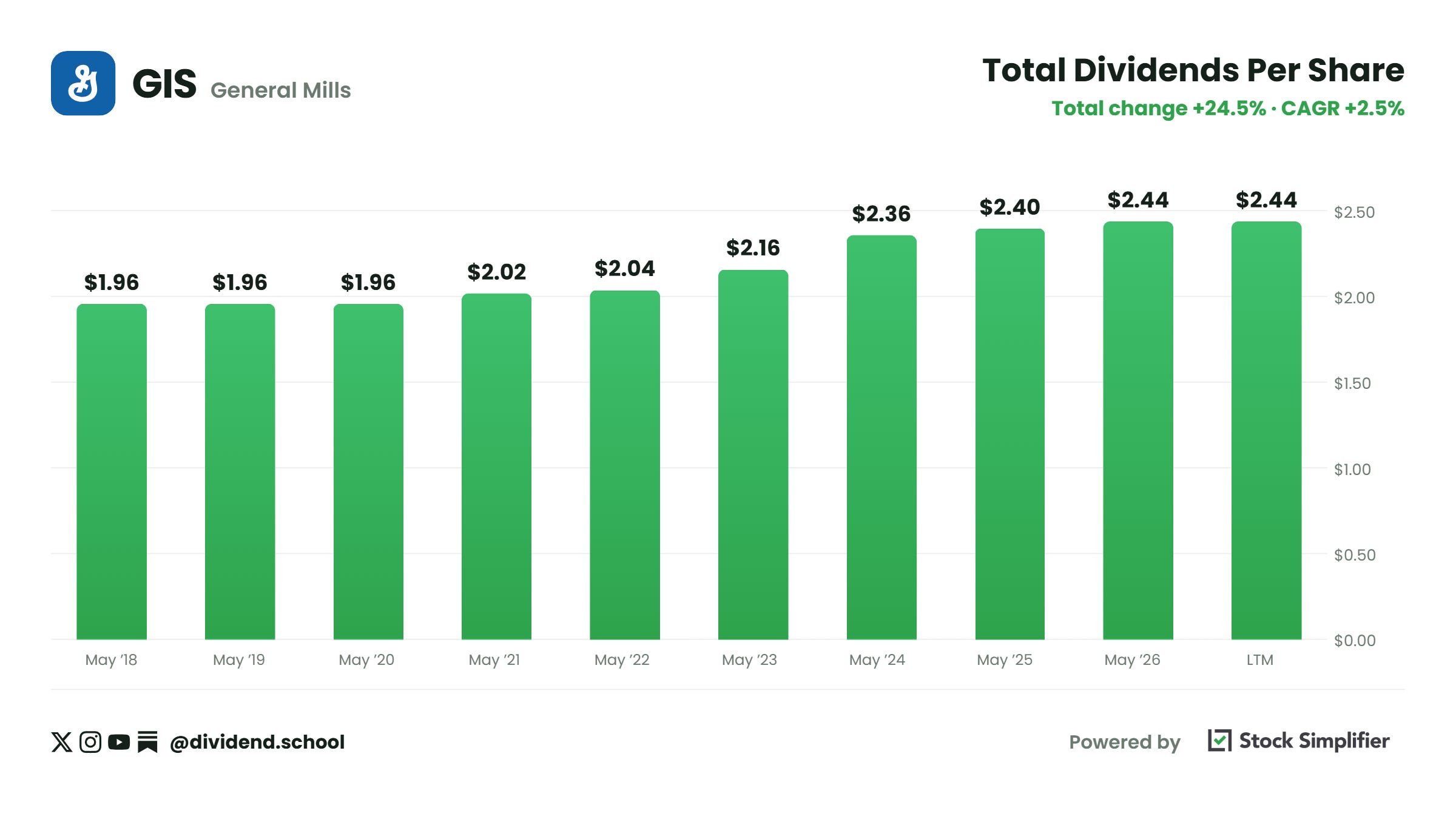
General Mills usually raises its dividend with the August payment. This June, the board declared $0.61, “at the prevailing rate.” It did the same in September.
No press release announces a freeze. We find it by counting, and $0.61 has now gone out six times in a row.
Has this happened before?
It has. The dividend sat at $1.96 a year for fiscal 2018, 2019, and 2020. That freeze started when General Mills borrowed to buy Blue Buffalo.
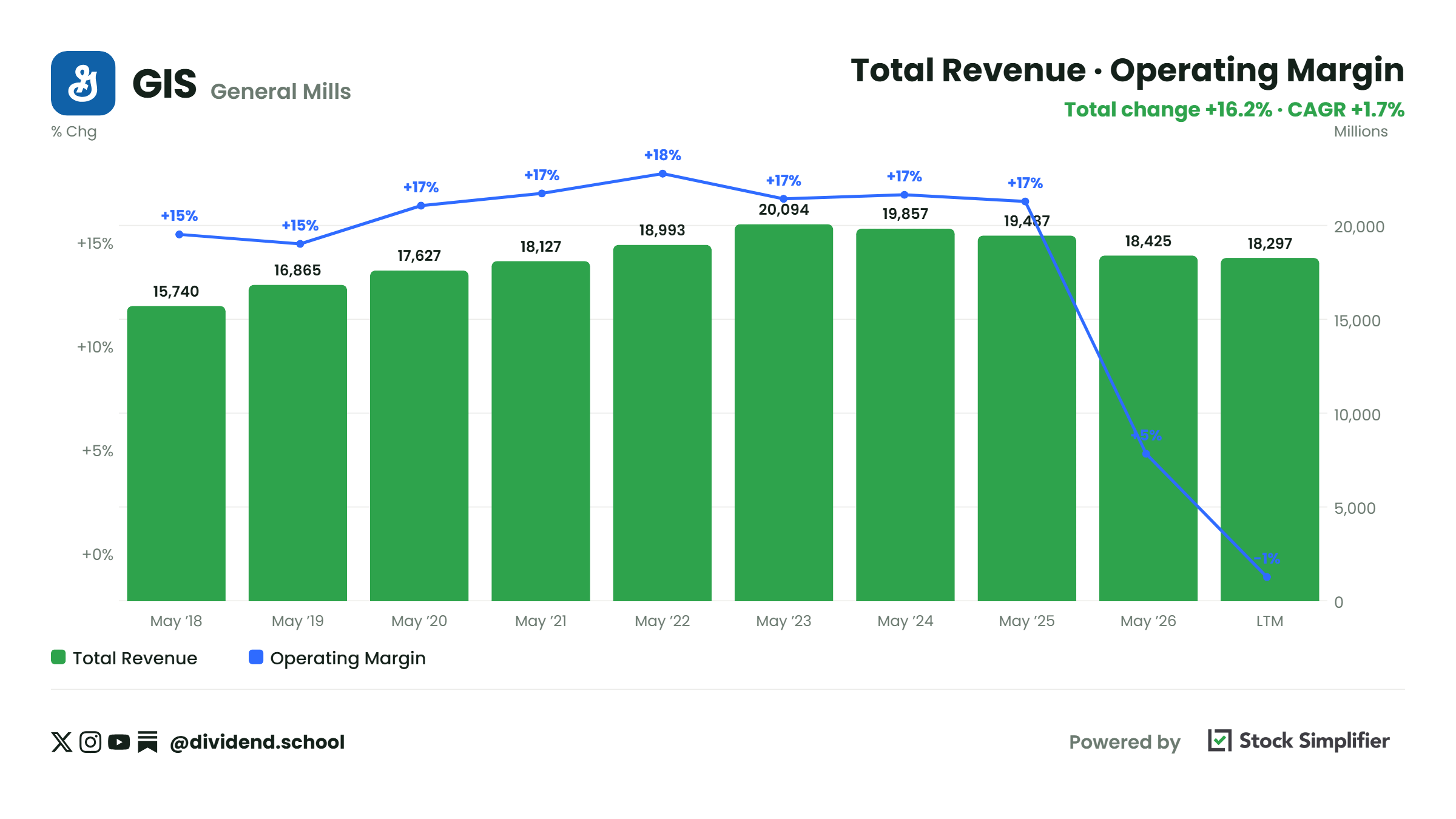
Which brings us to this year’s 10-K. In the fourth quarter, General Mills wrote down $1.5 billion of goodwill in its North America Pet unit, plus $250 million on two pet-treat brands. Add the loss on selling its Brazil business, and the year’s impairment and exit charges came to $3.0 billion. The company lost $0.16 a share for the year.
The write-down is non-cash, and it doesn’t directly affect the dividend. But it’s the company telling us the pet business is worth less than it paid. That stings.
The earnings are still shrinking
What does the business underneath look like?
Adjusted EPS, fiscal 2026: $3.55, down 16%
Adjusted EPS, fiscal 2027 guidance: $3.00 to $3.20, down another 13% at the midpoint
Organic sales, fiscal 2026: down 2%
Organic sales guidance, fiscal 2027: down 1.5% to up 0.5%
First quarter, North America Retail: operating profit down 15%
First quarter, North America Pet: volume down 6 points, operating profit down 12%
In plain English, we’re buying fewer boxes; General Mills cut prices last year to win us back, and profit fell with those cuts. Management calls fiscal 2027 the year the top line recovers. The first quarter came in flat.
On last year’s $3.55, today’s price is 10 times earnings. On this year’s guide, it’s 11.5. The stock gets more expensive while it stands still.
What the dividend costs
Here’s where the freeze makes sense. The dividend is $2.44 a year.
Against guided earnings: 79% ($2.44 / $3.10). Last year it was 69%.
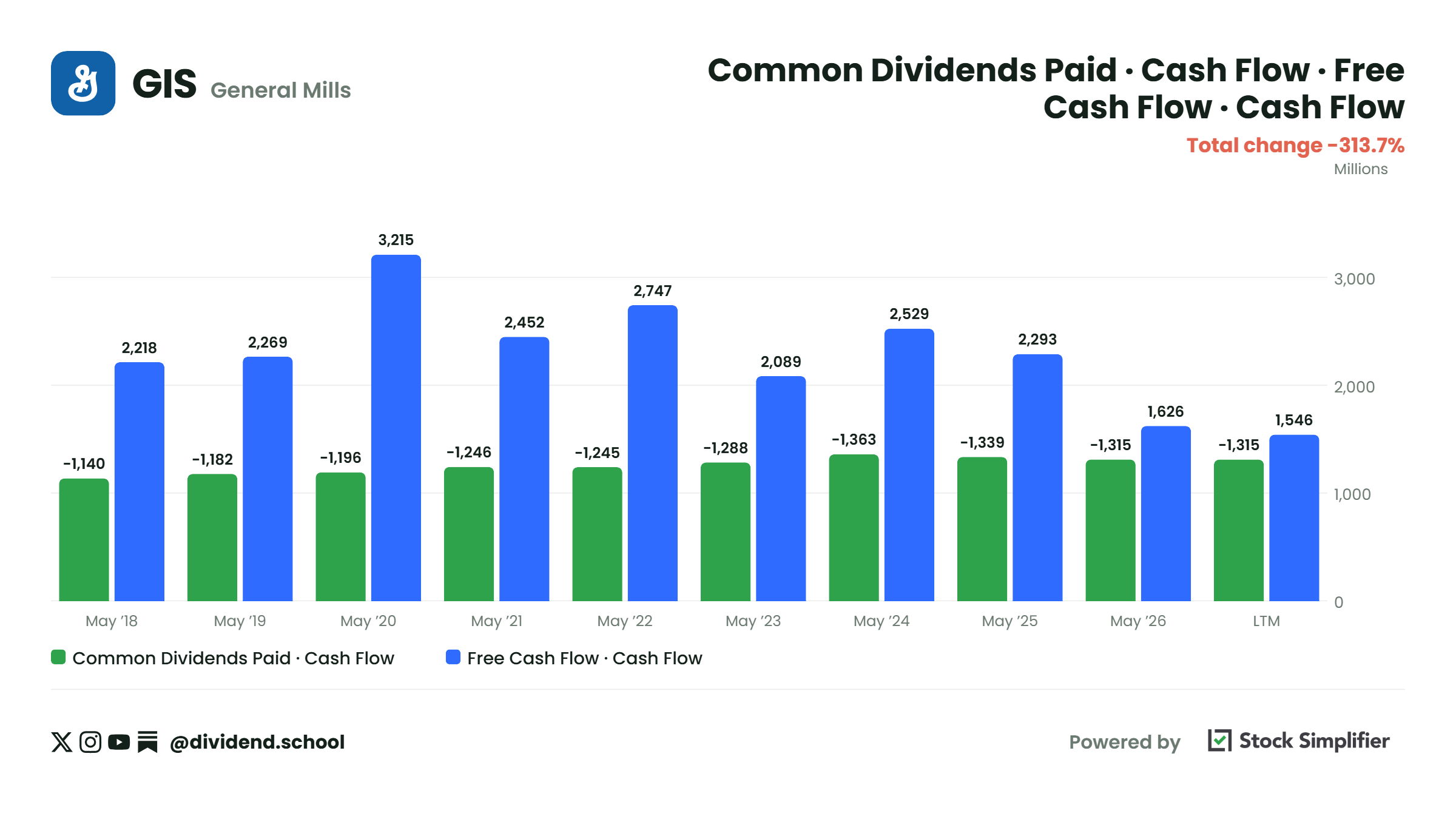
Against free cash flow, fiscal 2026: 81% ($1,315 million / $1,626 million). The year before it was 58%.
And this year? General Mills guides free cash flow to 95% of adjusted earnings. On our math, that’s $1.58 billion ($3.10 x 538 million shares x 95%), against $1.31 billion of dividends.
83 cents of every free dollar goes out the door.
That leaves $270 million a year for everything else, and “everything else” includes $13.6 billion of debt. Interest ran $142 million in the first quarter alone, up from $133 million. Buybacks went from $1.2 billion in fiscal 2025 to zero last quarter.
How it stacks up on all three
Against its own history: 11.7 times free cash flow against 15.6. 25% cheaper.
Against its peers: 11.5 times forward earnings. Kraft Heinz trades at 13.0 and Conagra at 10.6. No discount.
The paycheck: 6.85% today, and no raise until earnings stop falling.
That middle line matters. General Mills isn’t cheap next to packaged food; all of packaged food got cheap together. And one of those peers already blinked. Conagra cut its quarterly dividend in half this summer, from $0.35 to $0.175.
Two more items for the calendar. A new CEO, Dana McNabb, takes over on January 1. New CEOs like a clean slate. And second-quarter results land in mid-December.
Verdict for our process: General Mills is cheap against its own past and fairly priced against its peers, and the paycheck stopped growing. The dividend takes four-fifths of the cash while earnings fall for a second straight year. I don’t see a cut tomorrow. I also don’t see a raise for years, and we’re not paid enough to wait for one.
For me, a trap until the earnings turn.
4. UPS (UPS)
UPS delivered to 10.7 million recipients a day last year. Most of us know the brown truck.
At $111.73, the stock pays a 5.87% dividend.
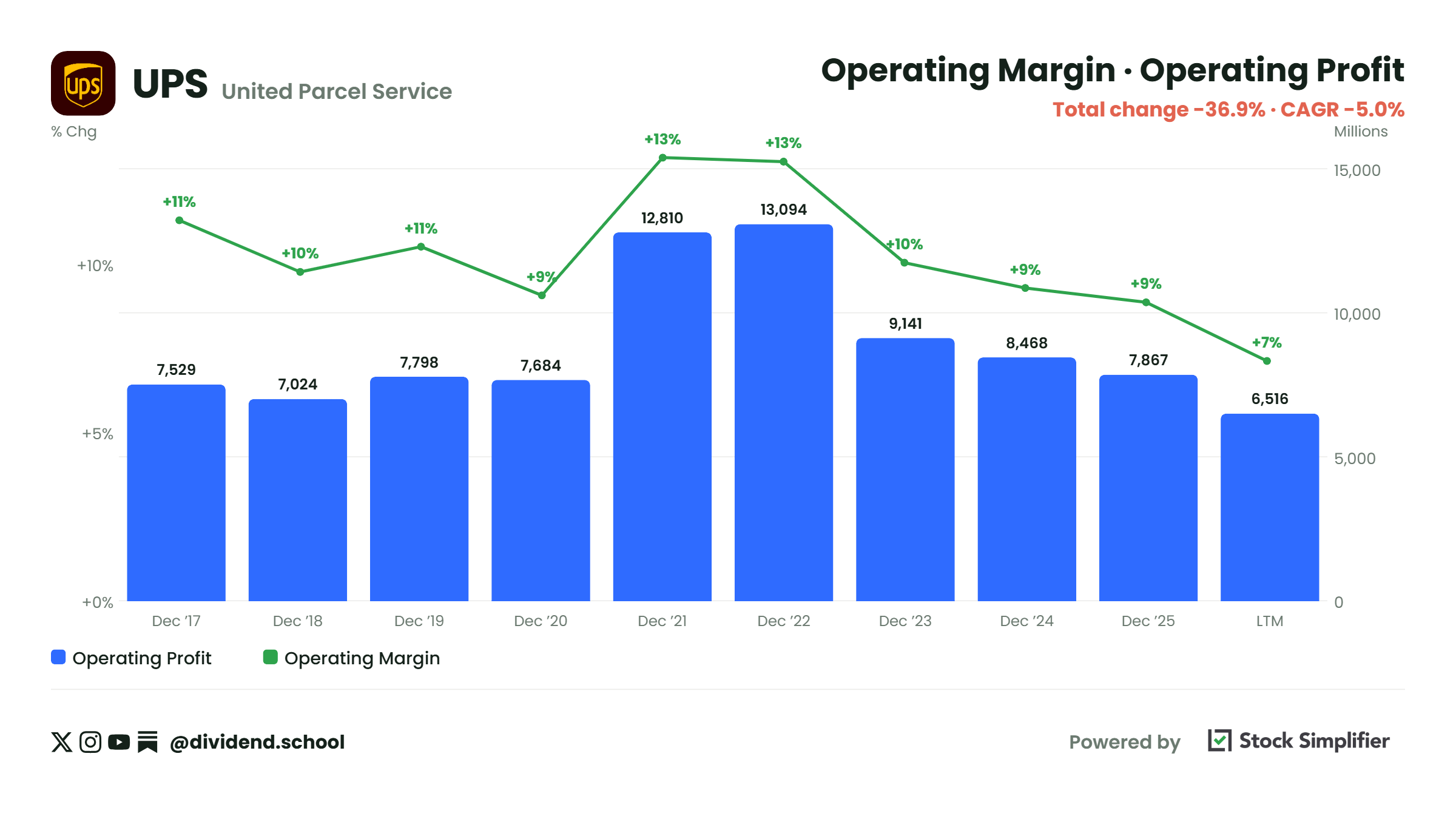
Big caveat here, and it comes first. UPS is not beaten down. It sits 8.7% below its 52-week high of $122.41 and 23% above its low. It’s on every cheap list for one reason: the yield.
So is a 5.87% yield from UPS a bargain?
Seven quarters at $1.64
UPS raised its dividend 16 years in a row through 2025. The last two raises were a penny each, from $1.62 to $1.63, then to $1.64.
In 2026, there was no penny. The $1.64 has gone out for seven straight quarters.
Why did the raises stop?
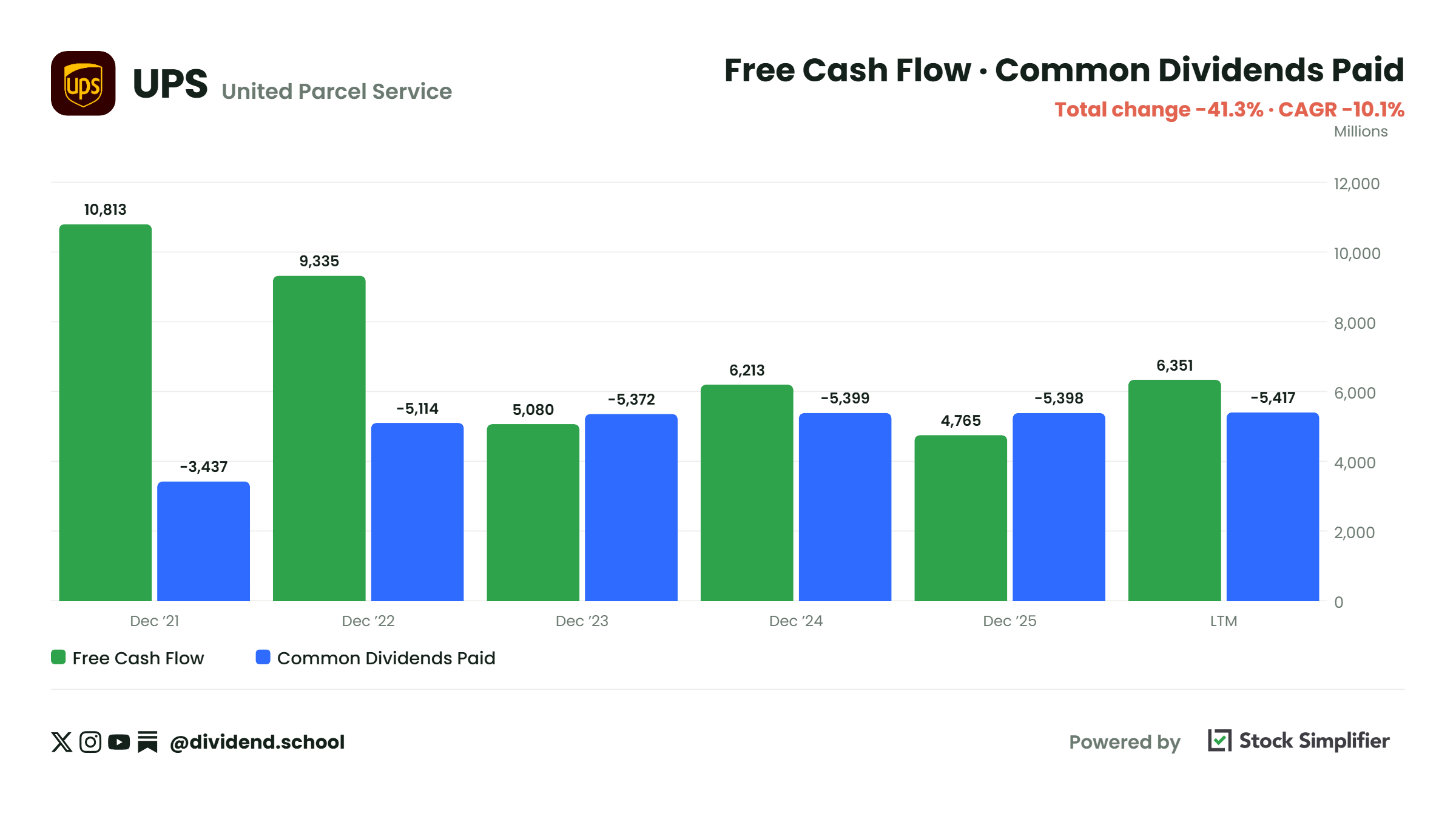
Because the dividend outran the cash. We can see it in three lines:
2022: free cash flow of $9,335 million, dividends of $5,114 million. 55%.
2025: free cash flow of $4,765 million, dividends of $5,398 million. 113%.
2026, nine months: free cash flow of $3,765 million, dividends of $4,064 million. 108%.
(Free cash flow here is the plain version: cash from operations minus capital spending.)
UPS paid out more than it brought in for two years running. Where did the difference come from? Debt went from $24.1 billion at year-end to $26.1 billion in September. The company also put $1.3 billion into the pension this year, and funded $450 million of that with new debt.
The business is getting better
This is the half the yield chasers get right.
UPS spent 2025 and 2026 walking away from its biggest customer. Amazon was 10.6% of revenue last year, and UPS chose to cut that volume by more than half by June. Low-margin boxes out, better boxes in.
It’s working. In the third quarter:
Revenue: $22.9 billion, up 6.7%
U.S. revenue per piece: up 6.1%
Adjusted operating profit: $2.1 billion
Full-year guidance: raised to $7.28 of adjusted EPS
Management also lifted its free cash flow target to $6.1 billion, on its own adjusted definition. Against $5.4 billion of dividends, that’s 89%.
Better. Not comfortable.
How it stacks up on all three
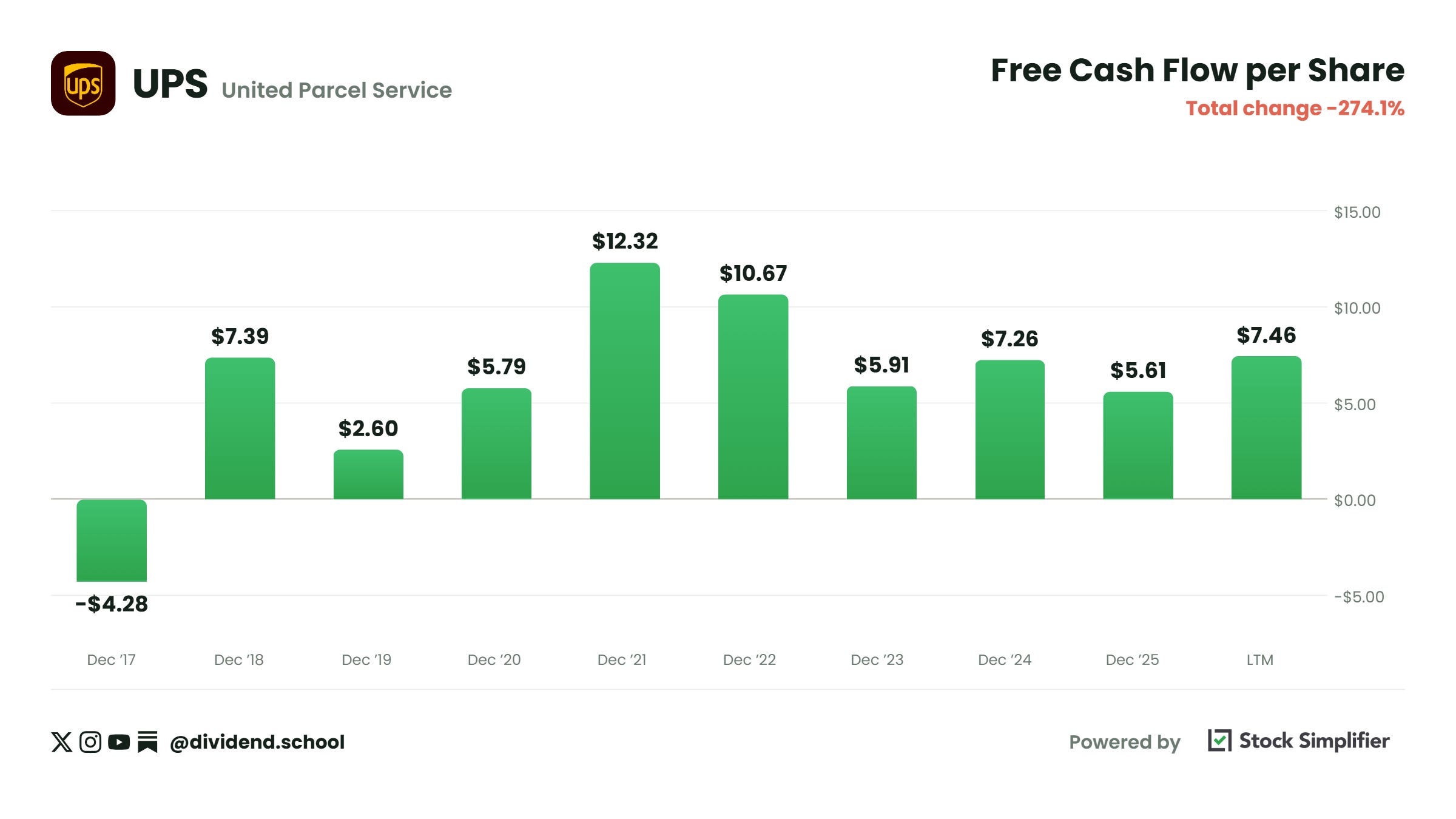
Against its own history: 15.6 times this year’s free cash flow target ($95.1B market cap / $6.1B), against a five-year average of 18.9. 17% cheaper.
Against its peers: 15.3 times guided earnings ($111.73 / $7.28). FedEx trades at 16.3. A small discount.
The paycheck: 5.87% today. The dividend takes 90% of adjusted earnings ($6.56 / $7.28).
How long until a raise? Earnings have to grow into the dividend first. At a 90% payout, a company that wants room to breathe doesn’t raise; it waits. For how long? My crystal ball is quite cloudy.
Verdict for our process: UPS is not a trap. The business is healing, and management raised guidance on October 27. But the stock has already noticed. It’s up 23% from its low, the discount to history is modest, and the paycheck is frozen at 90% of earnings.
For me, a pass at this price. Not a trap, and not cheap.
That’s two graded in full, free: what’s inside each yield, and the verdict.
Below the line, the other three, counting down to the one I’d buy first:
Number 3 lost 23.67% in one morning this month. It now trades at 5 times earnings and half its usual price to free cash flow, with a 6.02% yield covered more than twice. It also owes more than the whole company is worth on the stock market.
Number 2 yields 4.95%, covers it with 44% of free cash flow, and is buying back $10 billion of stock this year. Against its own history it isn’t cheap at all. Why I’d buy it anyway, and the one number that has to come down first.
Number 1 froze its dividend in 2025, then raised it 6% this year. It’s the only one of the five where the raises are back, and it trades 27% below its five-year price to free cash flow.
Plus the scorecard: all five on all three yardsticks.
The rest of this issue is for paid Dividend School Pro subscribers.
One thing before you join. Don’t do it today.
On Friday, November 27, Pro drops to $299 a year from $369, and that price stays locked for as long as you’re a member. Stock Simplifier Pro and The Forever Five are included.
Want it sooner? Tuesday, November 24, at 7 PM ET, I’m going live on Substack to break down Mastercard. Anyone on the Live can grab the offer that night.
This issue will be waiting when you join, all three names and the scorecard.
Members, keep scrolling.
