

Every REIT in the S&P 500 is down over the past two months.
Not most of them. All 28.
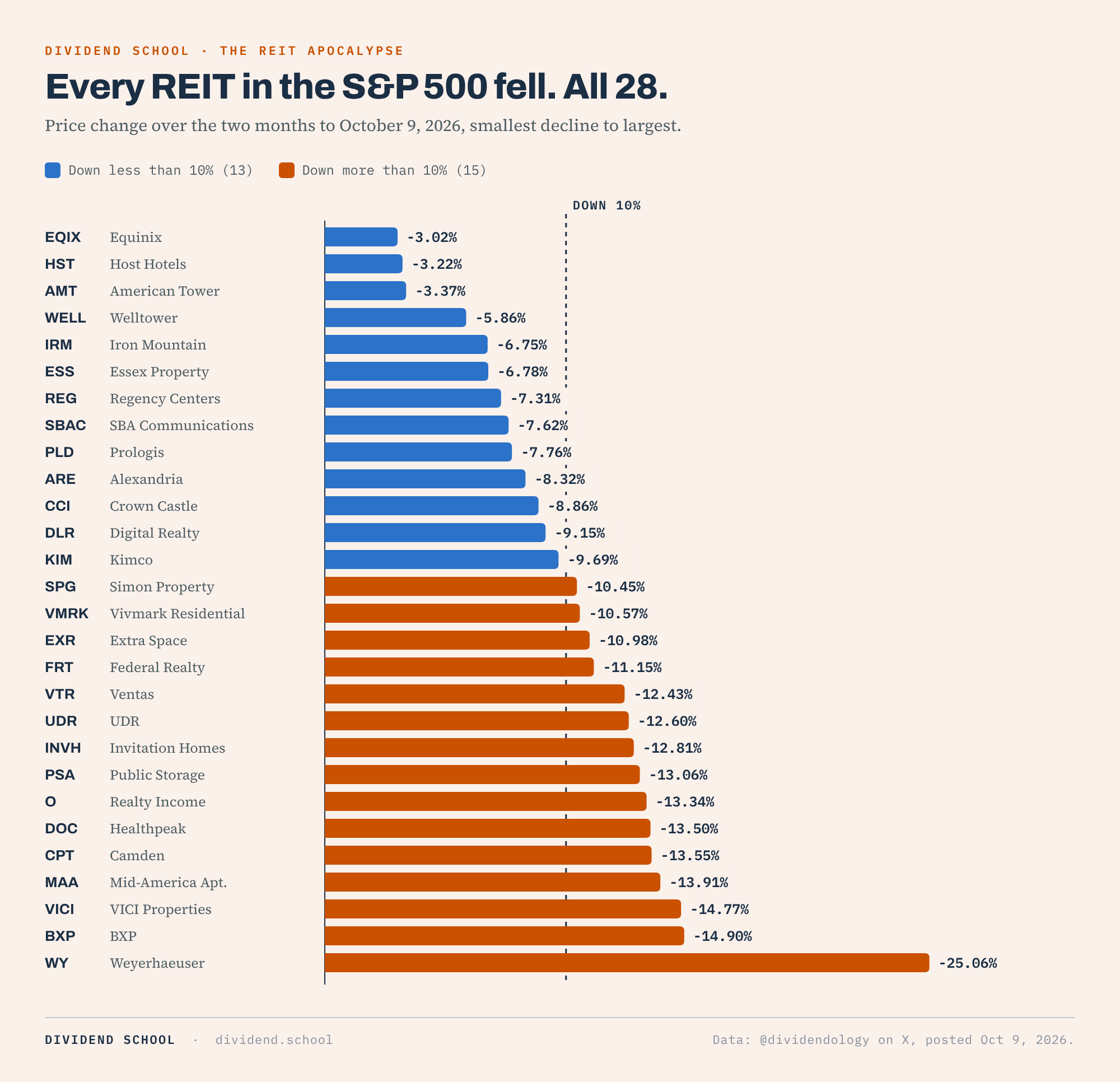
My friend at Dividendology posted the full list on X on October 9, and it is not pretty. A few from the top and bottom of the list:
Equinix (EQIX): -3.02%
Host Hotels (HST): -3.22%
American Tower (AMT): -3.37%
Realty Income (O): -13.34%
VICI Properties (VICI): -14.77%
BXP (BXP): -14.9%
Weyerhaeuser (WY): -25.06%
Fifteen of the 28 fell more than 10%.
Big caveat before we go any further. Apocalypse is a strong word, and I picked it for the headline. The FTSE Nareit All Equity REITs index was up 14.5% at the end of August and still up 7.9% at the end of September. This is not 2008.
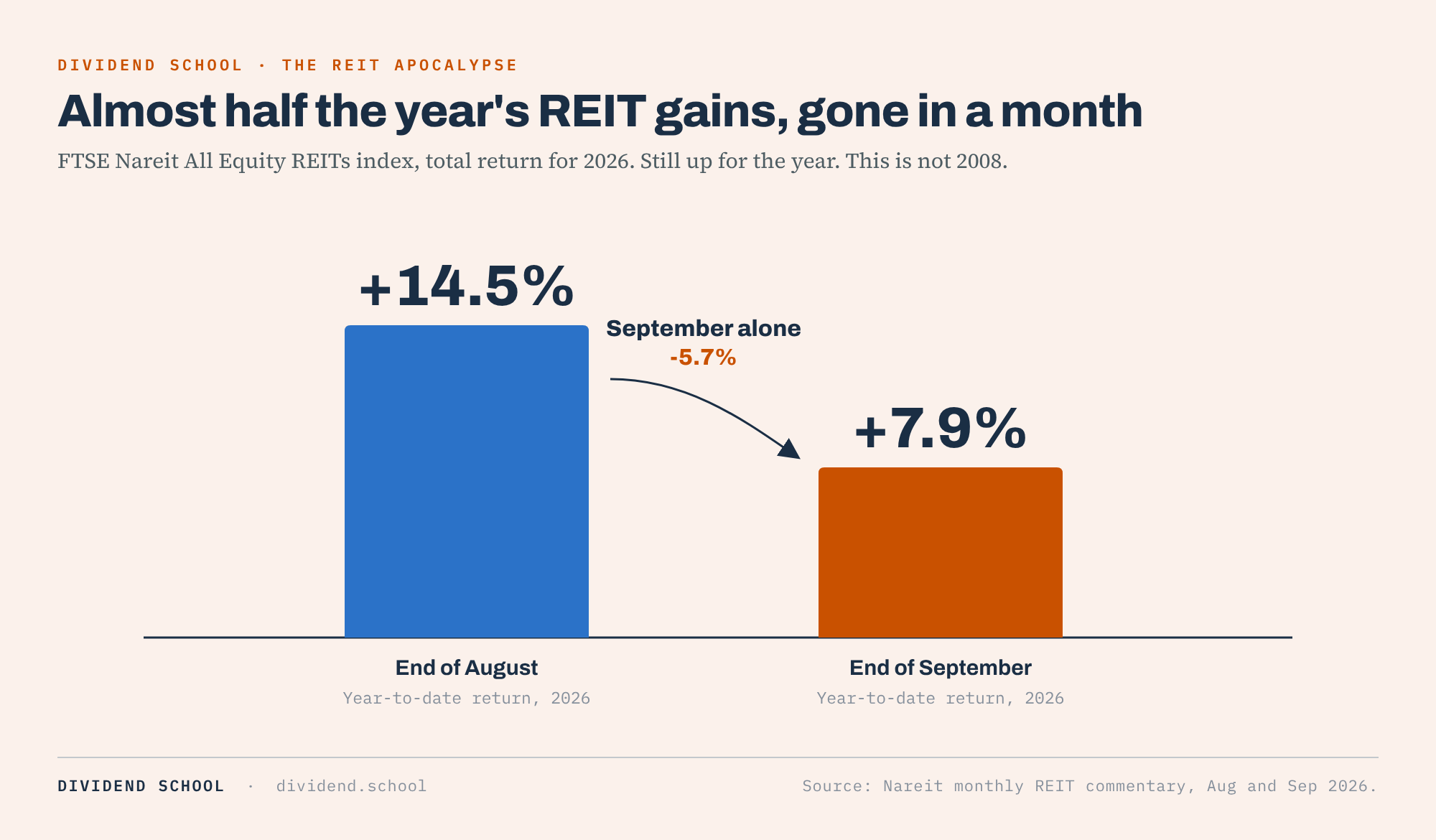
But giving back almost half the year’s gains in a single month caught my attention, especially since four names on that list (Realty Income, VICI, American Tower, and Equinix) sit in our Dividend School Universe. Three of them, Realty Income, VICI, and American Tower, are in my own portfolio too.
So what happened?
The short answer is interest rates. The longer answer is why rates matter so much more to a REIT than to Coca-Cola or Microsoft, and that comes down to how a REIT is built.
In today’s post, we will discuss:
How a REIT Works
How REITs Pay for Growth
How Interest Rates Squeeze REIT Growth
Why the Selloff Is Happening Now
How REITs Are Working Around It
What We Can Do About It
Okay, let’s dive in and learn why REITs are getting hit so hard.
How a REIT Works
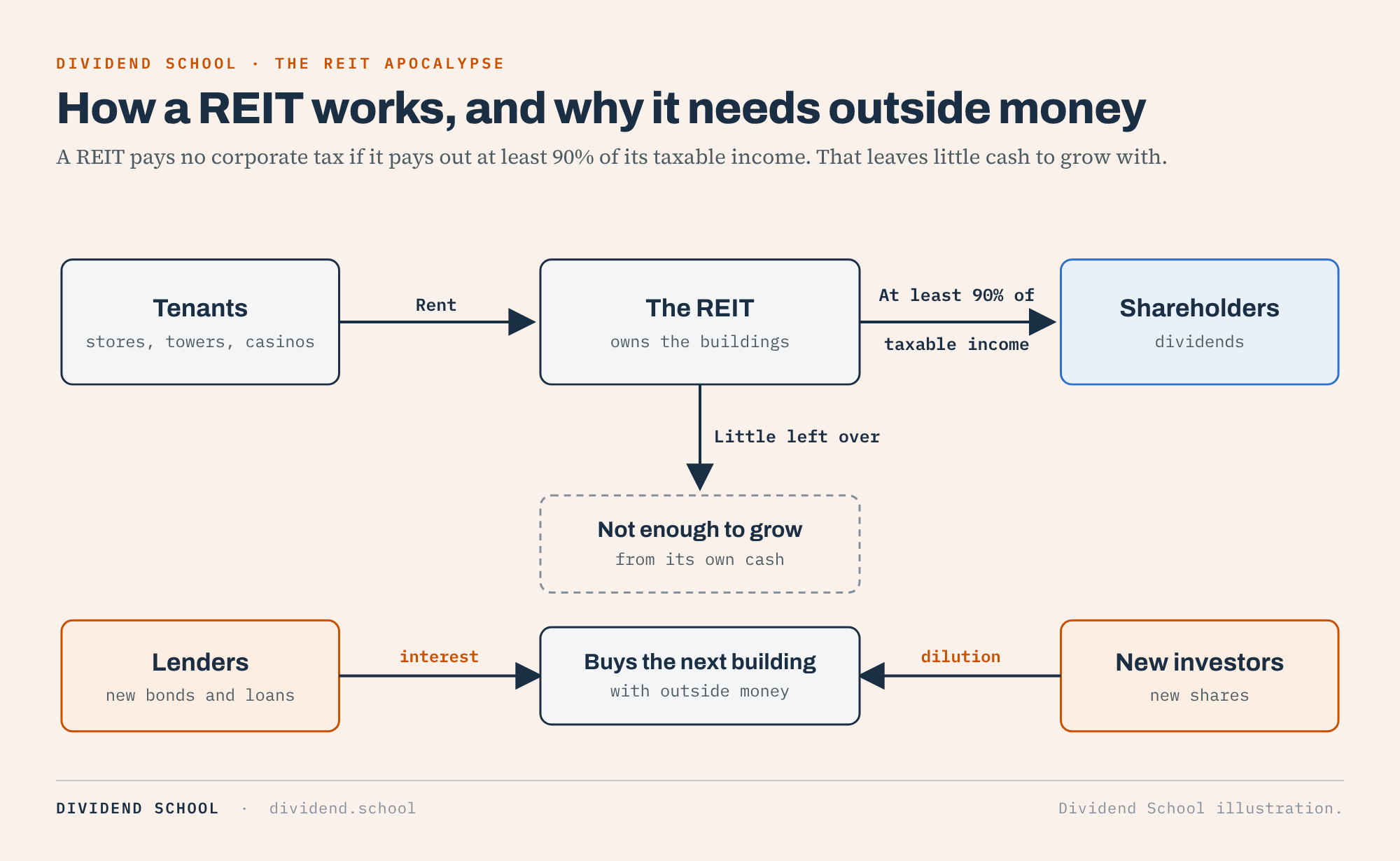
A real estate investment trust, or REIT, is a company that owns property and rents it out. Think of it as a giant landlord we can buy a piece of for the price of one share.
The properties come in all flavors. Think:
Realty Income holds interests in 15,588 properties, mostly the freestanding stores we drive past every day, plus a growing pile of warehouses
VICI owns casinos, including Caesars Palace
American Tower owns cell towers
Equinix owns data centers
Weyerhaeuser owns timberland
One rule makes a company a REIT, not just a real estate company. A REIT must pay out at least 90% of its taxable income to shareholders as dividends. In exchange, it pays no corporate income tax on that income.
That’s the deal, and it’s why REITs are such good dividend machines.
It is also why they struggle when rates rise.
Why? Because a business that has to hand out nearly everything it earns can’t save up to grow.
Coca-Cola can keep part of its profits and use it to build a new bottling plant. A REIT keeps very little. If it wants to buy the next building, it has to raise the money from somebody else.
One quick translation before we move on. REITs use a different language, so we need to understand that language.
Depreciation drags down a REIT's net income on buildings that often gain value over time. So REITs report funds from operations, or FFO, which is the equivalent of earnings. Adjusted funds from operations, or AFFO, goes a step further and is the equivalent of free cash flow for a “normal” business.
AFFO is the metric we care about most, because it’s the cash that pays the dividend.
How REITs Pay for Growth
So where does the growth money come from?
Three places:
Cash left over after the dividend
Debt, mostly bonds sold to investors
Equity, meaning new shares sold to investors
Let’s use Realty Income as our guinea pig. It’s the biggest name in net lease real estate and one we follow in the Universe. Here is what we find for 2025, straight from the cash flow statement in the 10-K:
Cash from operations: $3,994.8 million
Dividends paid to common shareholders: $2,920.9 million
Left over: $1,073.9 million
So $1.1 billion to grow with. Now let’s look at what they invested:
Property acquisitions: $4,647.9 million
Loans and credit investments: $1,613.3 million
Total: $6,261.1 million
$6.3 billion invested against $1.1 billion of leftover cash. Big difference.
Most of the gap came from Wall Street:
New shares sold: $2,364.1 million
New notes issued: $2,891.8 million
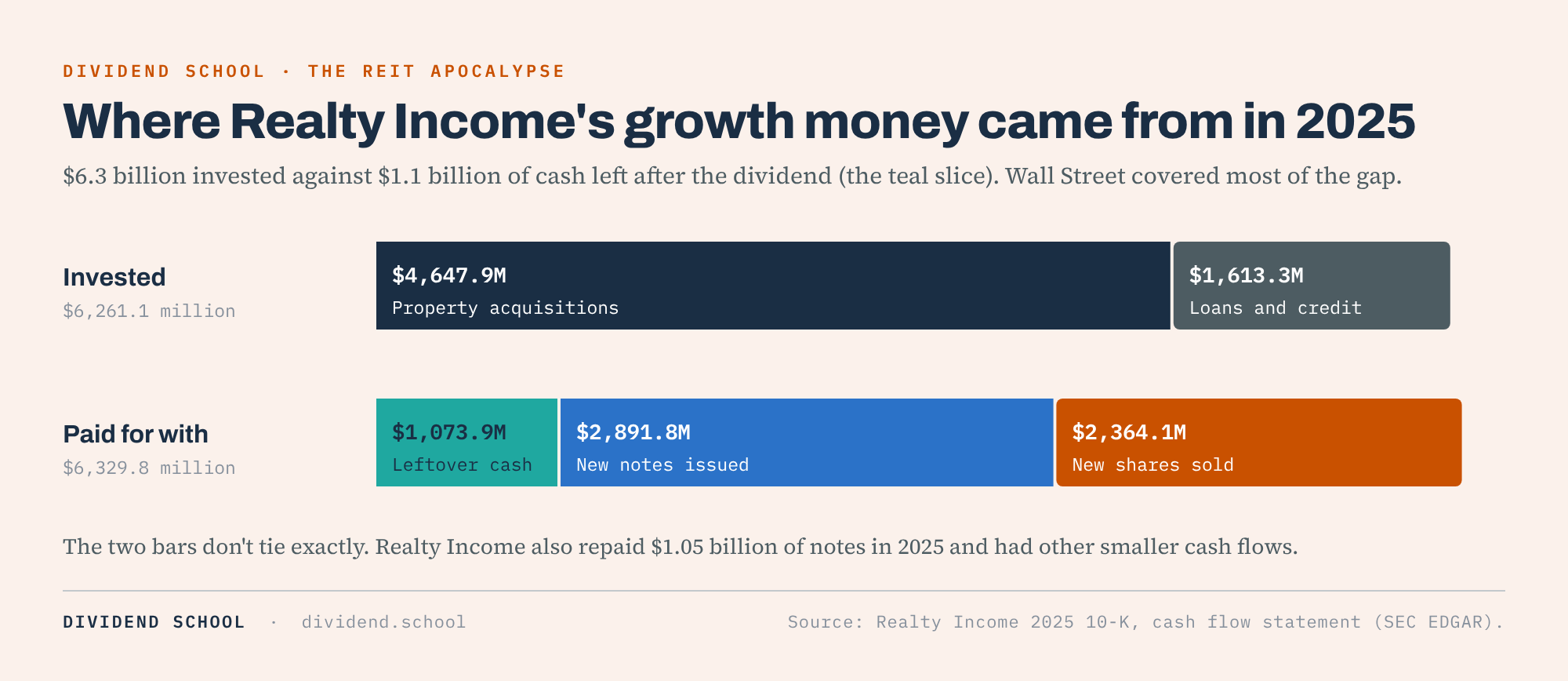
That’s the REIT growth model in a nutshell. Borrow some, sell some shares, buy property that earns more than the cost of the money, and keep the difference. Then do it again next year.
What does this tell us?
That REIT growth runs on the price of money. Two prices, to be exact:
The interest rate on new debt
The share price, which sets what new stock costs
When both are cheap, the machine hums along. When both get expensive at the same time, as they did over the last two months, the machine stalls.
Now let’s look at what the last five years did to Realty Income’s balance sheet:
Notes payable: $12.5 billion at the end of 2021, $25.0 billion at the end of 2025
Interest expense: $323.6 million in 2021, $1,134.9 million in 2025
Shares outstanding: 591.3 million at the end of 2021, 934.0 million at the end of 2025
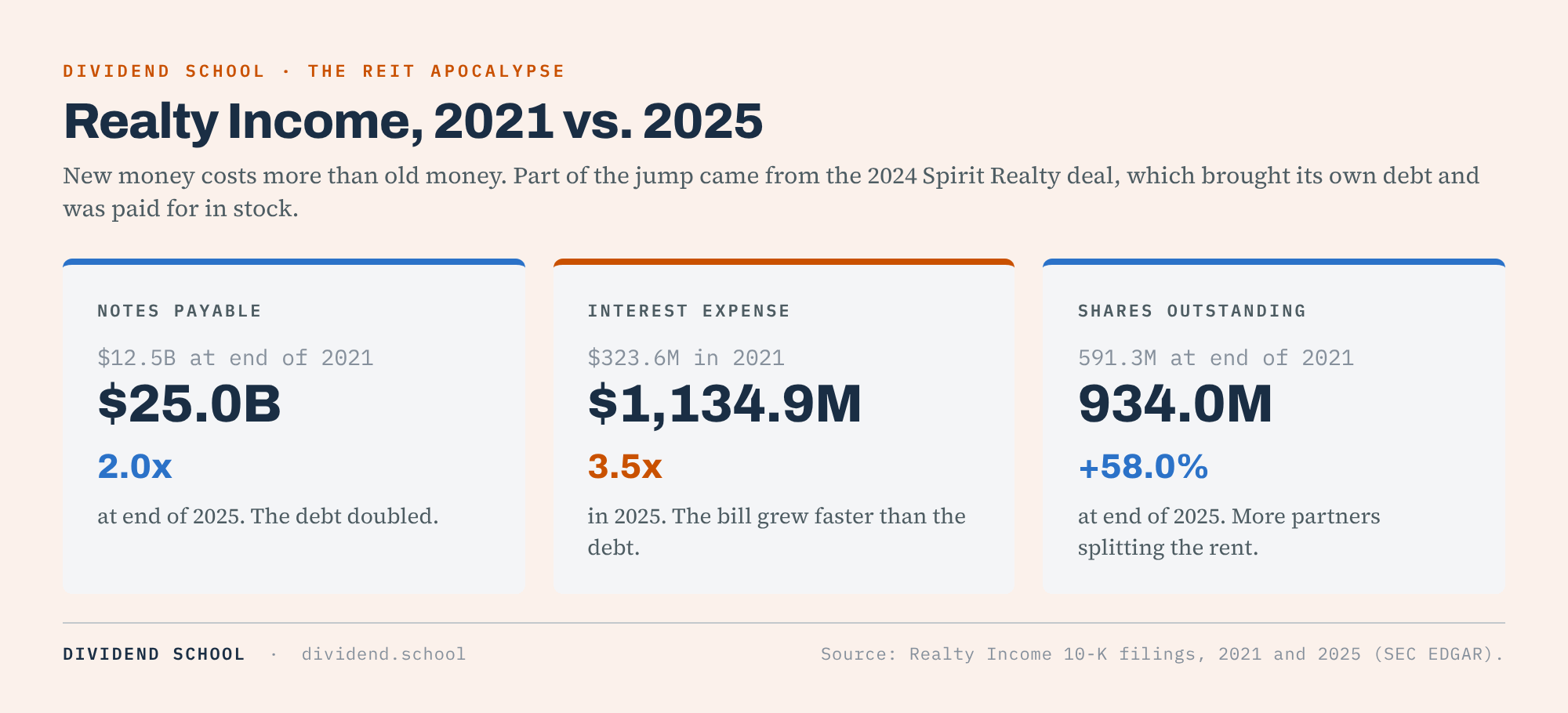
Part of this came from buying Spirit Realty in 2024, which brought its own debt and was paid for in stock. Still, look at the gap: the debt doubled while the interest bill grew 3.5 times. That’s what happens when new money costs more than old money.
The share count is up 58.0%. That’s a lot of new partners splitting the rent.
How Interest Rates Squeeze REIT Growth
Rising rates hit a REIT from three sides:
The spread
The share price
Property values
The Spread
Every REIT acquisition is a spread trade. The REIT buys a building that yields one rate and pays for it with money that costs another. The difference is the profit.
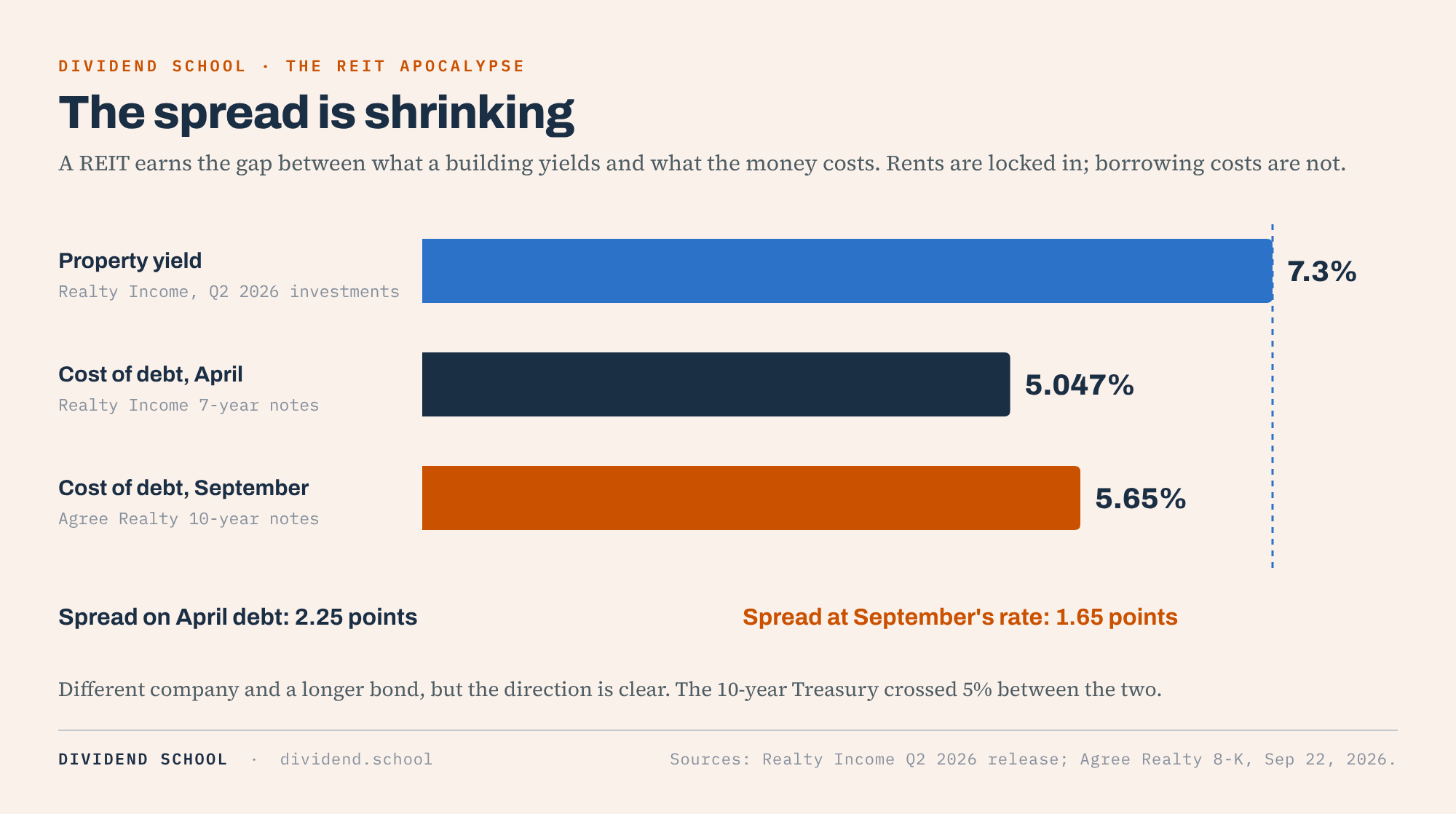
In the second quarter of 2026, Realty Income invested $2.1 billion (its share) at an initial cash yield of 7.3%. In April, it sold $800 million of seven-year bonds at an effective yield of 5.047%.
That’s a 2.25 percentage-point spread on the debt-funded portion. Healthy.
But that bond priced before the 10-year Treasury crossed 5%. Companies borrow at the Treasury rate plus a premium for their own risk, so when the 10-year climbs, every new bond a REIT sells costs more.
How much more? On September 22, Agree Realty (ADC), another net-lease landlord with an investment-grade balance sheet, sold $400 million in 10-year notes at 5.65%. That’s 0.6 percentage points more than Realty Income paid in April. Different company and a longer bond, but the direction is clear.
The rent doesn’t move nearly as fast. It’s locked into long leases, and Realty Income’s average remaining lease term is 8.6 years. So the rent stays put while borrowing costs rise, and the spread shrinks.
The Share Price
The second side is the share price, and it matters more than the bonds.
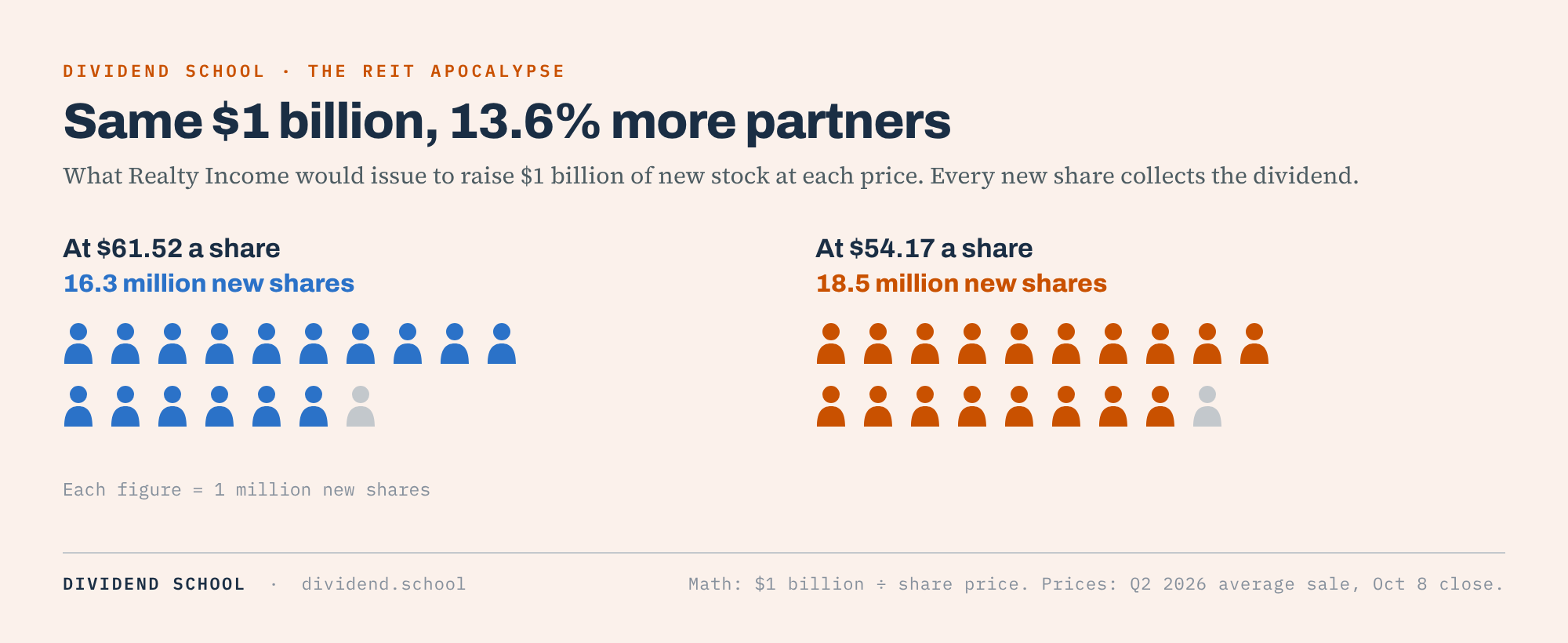
Start with the share count. Say Realty Income wants to raise $1 billion of new stock:
At $61.52, its average sale price in the second quarter: 16.3 million new shares
At $54.17, its October 8 close: 18.5 million new shares
Same $1 billion, 13.6% more new partners. And every one of them collects the dividend.
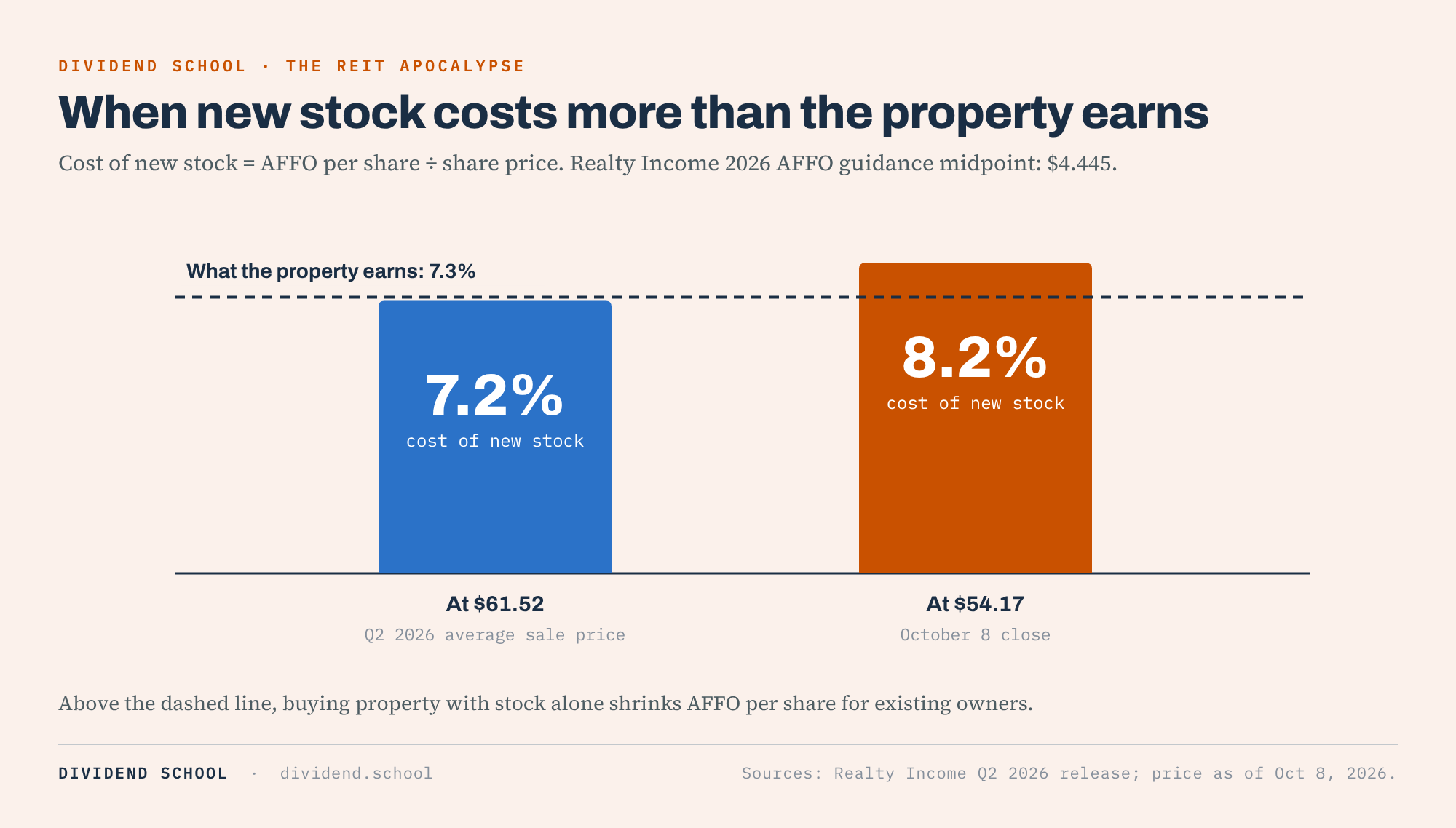
That’s why a REIT watches its share price so closely. When a REIT sells new shares, the cost of that money is the AFFO yield: AFFO per share divided by the share price. Every new share gets a cut of AFFO forever, so the building it pays for needs to earn more than that.
Realty Income guided 2026 AFFO to $4.44 to $4.45 per share. We’ll use the $4.445 midpoint:
In the second quarter, it sold stock at an average of $61.52: AFFO yield of 7.2% ($4.445 / $61.52)
On October 8, the stock closed at $54.17: AFFO yield of 8.2% ($4.445 / $54.17)
Consider what this tells us.
At $61.52, selling shares to buy 7.3% property barely works. At $54.17, funding a deal with stock alone doesn’t work. A new partner who costs 8.2% to buy a building that pays 7.3% shrinks AFFO per share for everybody already here.
Realty Income can mix in cheaper debt to make the math work, but debt has a ceiling. Net debt sits at 5.4 times EBITDAre (EBITDA for real estate), and the rating agencies watch that number closely.
This is the trap rising rates set. The stock falls because rates are up, and the lower stock price makes growth harder, which gives the market one more reason to sell. A vicious circle if there ever was one.
Property Values
The last side is the buildings themselves.
Property buyers also price real estate off their own cost of money. When rates rise, buyers demand higher yields, and the only way a building with fixed rent can yield more is for its price to fall.
Lower property values mean lower net asset values for every REIT, even if not a single tenant misses a payment. Deals slow to a crawl too. After Mizuho’s REIT conference this fall, its analyst said management teams described acquisitions as paused.
Why the Selloff Is Happening Now
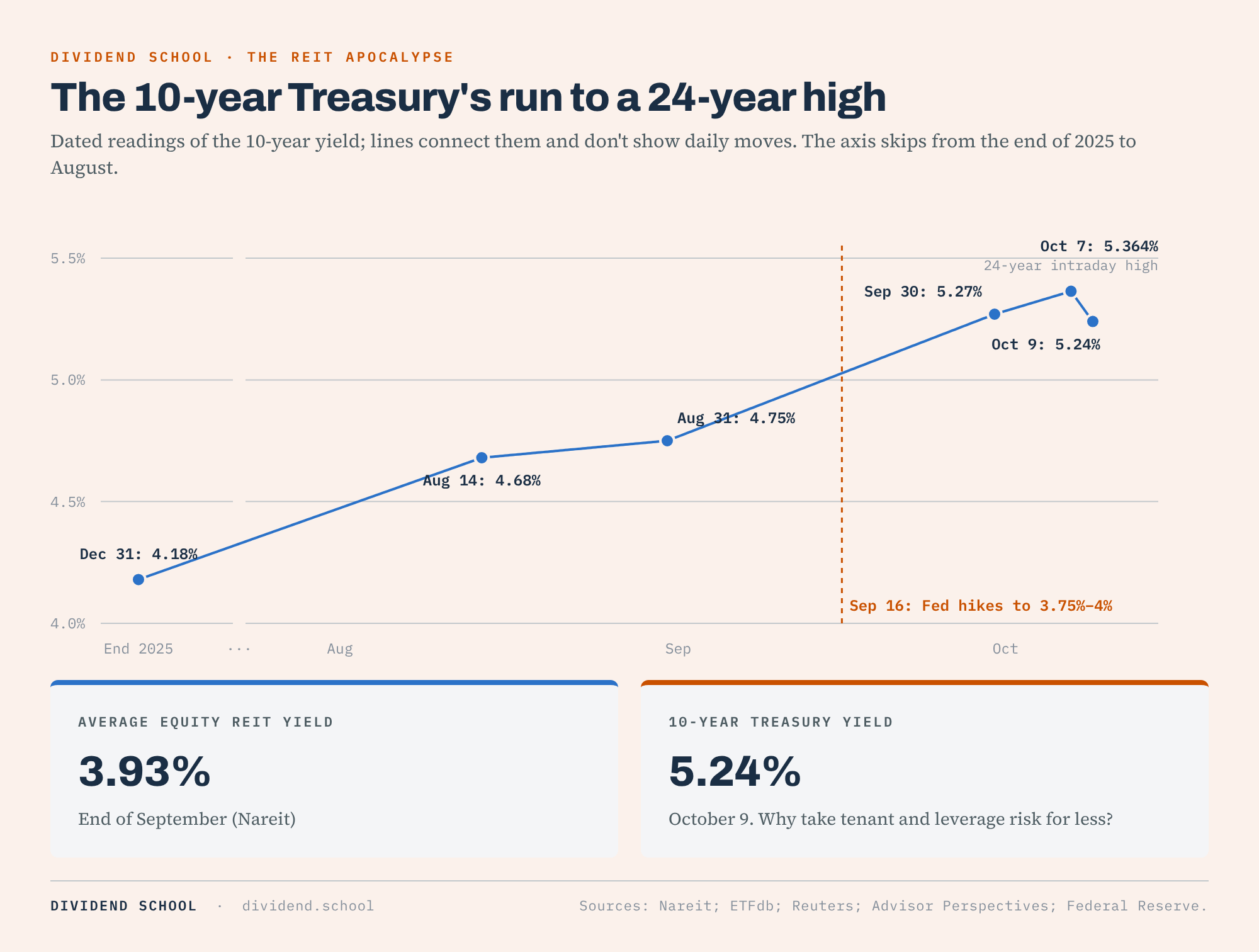
How fast did rates move? Here’s the timeline:
December 31, 2025: 10-year Treasury at 4.18%
August 14, 2026: 4.68%
September 16: the Fed raised its target range a quarter point to 3.75% to 4%, its first hike since 2023
End of September: 5.27%
October 7: 5.364% during the day, a 24-year high
October 9: 5.24%
Why are rates rising?
Inflation has not cooperated. The Fed’s own statement in September said “inflation remains elevated,” and it raised rates to push inflation back toward 2%. Oil climbing back above $100 a barrel in October didn’t help. Neither did heavy borrowing from Washington and from big companies, all competing for the same bond buyers.
And markets are now pricing in another quarter-point hike in December.
Here is the comparison income investors are making right now, us included:
Average yield on equity REITs, end of September (Nareit): 3.93%
10-year Treasury, October 9: 5.24%
Why buy a REIT yielding 3.93%, with tenant risk and leverage risk, when the US government pays 5.24% for ten years? For a lot of income money, that’s an easy question to answer, and REIT prices show it.
Were all REITs hit equally?
No. Here’s September by sector, per Nareit:
Lodging/resorts: +0.7%
Health care: -3.4%
Data centers: -3.8%
Telecommunications: -8.6%
Timberland: -15.5%
Mortgage REITs: -13.7%
Outside of hotels, the sectors with a growth story of their own held up best. The ones tied most closely to borrowing costs got hit hardest. Weyerhaeuser’s timber ends up in new houses, and the 30-year mortgage rate was 7.40% as of October 9.
Fun fact: we have seen this movie before. In 2022, the 10-year rose 2.43 percentage points and the FTSE Nareit All Equity REITs index fell 24.9%. Realty Income raised its dividend right through it.
That’s the why, free.
Below the line, we look at how the REITs on that list are fighting back: Realty Income’s $1.3 billion of stock already sold at $60.34, VICI’s smaller dividend raise, and Realty Income’s new fee business, which barely registers yet. Then what I’m doing with the three REITs I own.
The rest of this issue is for paid Dividend School Pro subscribers.
The first seven days are free, and everything unlocks on day one, including this issue. After that, membership is $369 a year or $35 a month, with a 30-day money-back guarantee. If Pro isn’t for you, email me within 30 days of your first payment and I’ll refund it.