

Hi everyone!
First, Issue #4 was promised for the first week of November.
It’s the second. Earnings season ran long, and I wanted every report in before we graded.
And it’s (almost) all in. 30 of our 35 names reported since Issue #4. Lowe’s reports next week, and four more report in December.
The machine kept paying. Zero cuts. Visa rose 16.4%, bigger than last year’s 13.6%, and Brown & Brown rose 9.1%.
Something new this issue, too. The Dividend Universe Portfolio, our Best Buys since June at $500 a month, has collected $17.17 in dividends so far. July paid us 45 cents. October paid us $6.71.
I know, I know, it’s not retirement money. But it’s a start, and it grows every month. The full breakdown is below.
And then there’s Brookfield, a name we own, which now pays out more than it earns.
In today’s issue, we will discuss:
Brookfield: graded in full
What the portfolio has paid us so far
The raises: Visa and Brown & Brown
Report cards: all 30
The scorecard
The Buy Below watch
Three dates for your calendar
Okay, let’s dive in.
Brookfield: paying more than it earns
Some backfill for newer readers.
Brookfield Asset Management (BAM) runs other people’s money. Pension funds and insurers hand it capital for infrastructure, renewable power, real estate, and private credit, and BAM charges a fee on it. It owns very little of the assets itself. That makes it about as asset-light as a business gets, with almost no capex.
It’s also in our Universe portfolio, and I own it personally.
A few things to understand before the numbers. One, we don’t grade an asset manager on GAAP earnings. This quarter’s GAAP EPS was $1.64, up from $0.44, and almost all of that jump is a $2 billion non-cash gain from folding Oaktree into the books. Two, the numbers that matter are:
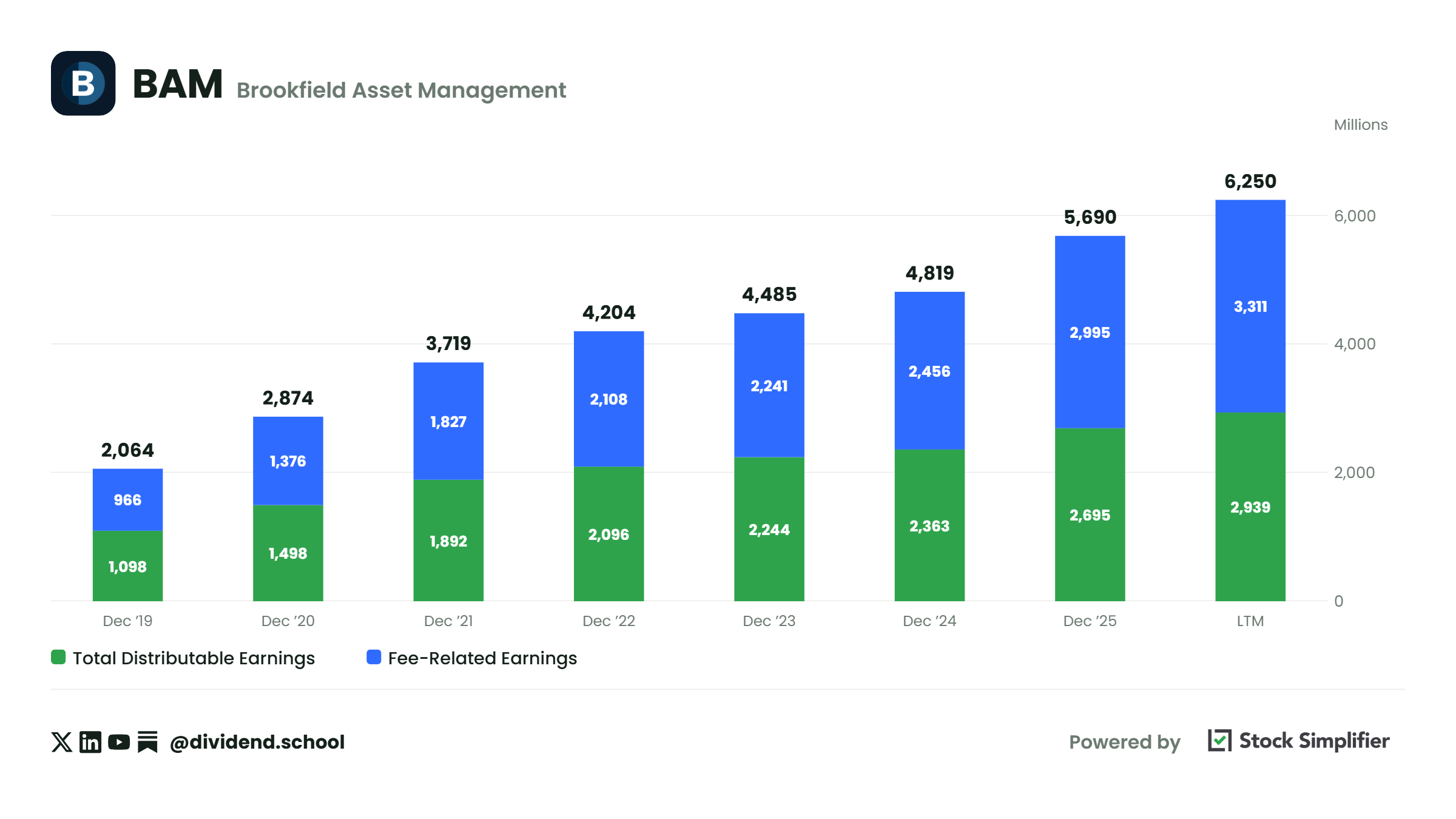
Distributable earnings (DE): the cash profit available to pay us
Fee-related earnings (FRE): the steady part, the management fees minus the cost of earning them
Okay, the quarter, reported November 6:
Distributable earnings: $0.47 a share, up 15%
Fee-related earnings: $864 million, up 15%
Fee margin: 53.2%, up from 51.7%
Fundraising: $25 billion in the quarter, $123 billion so far this year
Fee-bearing capital: $682 billion, up 13%
Wonderful growth. So what’s the problem?
The dividend is bigger than the earnings
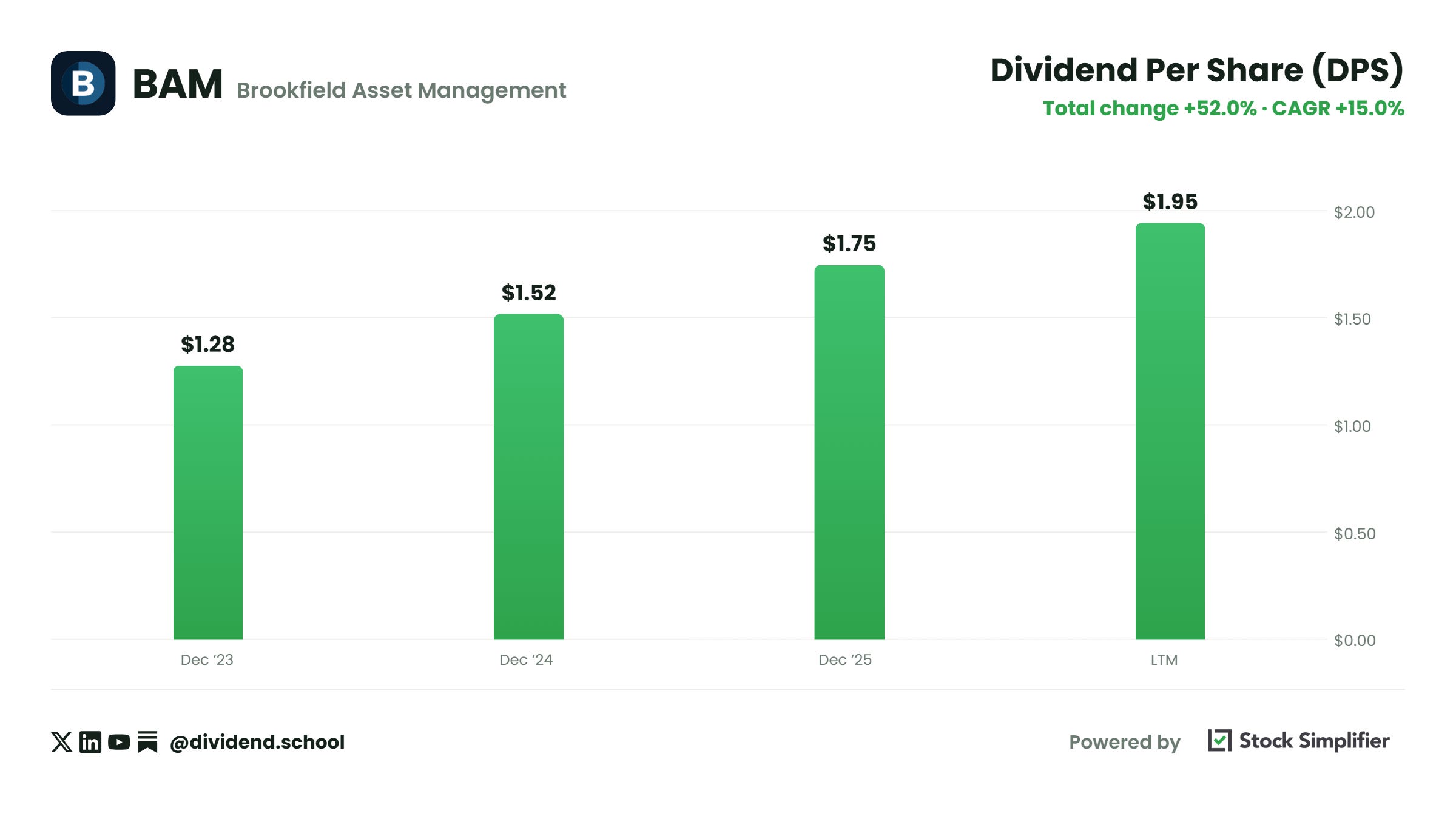
BAM pays $0.5025 a quarter, $2.01 a year. Over the last twelve months, it earned $1.82 a share of distributable earnings.
Payout ratio on DE: 110% ($2.01 / $1.82)
This quarter alone: 107%
Distributable earnings covered dividends paid 0.95 times this quarter and 0.90 times so far this year
WARNING: a payout over 100% means the dividend is running ahead of the business. That can’t last forever. It never does.
Now the exception, and it matters. Measured against fee-related earnings, the steadier number is 98% ($2.01 / $2.05). And there’s $68 billion of committed capital that doesn’t pay fees yet. Once it’s invested, it does.
So the bet is that the earnings catch up to the dividend.
The catch: management sounded more cautious about 2026 than earlier in the year, with the fees on its new infrastructure fund starting in January. So the catch-up gets pushed out.
The five questions
Did free cash flow cover the dividend with room to spare? No. Distributable earnings covered it 0.95 times. No room.
What did guidance do? Softened for 2026. Long-term targets held.
Where is the payout ratio headed? Up, until the new fees arrive in 2027.
Are margins holding? Yes. 53.2%, up from 51.7%.
Is capex crowding the payment? No. There’s barely any capex. The squeeze is the dividend itself.
The tripwire
So, how do we handle a company paying more than it earns?
We give it a tripwire. BAM raises every February. The last two raises were 15% and 14.9%.
A February raise well below 15% means management sees the gap too. That’s our signal to reassess.
Verdict for our process
The business is growing 15% a year. The dividend got out in front of it.
Brookfield stays a Hold. At $54.09 it sits 34.0% above its $40.37 Buy Below, so there’s no reason to add here anyway. I’m holding my shares and the portfolio’s, collecting $0.5025 a quarter, and watching February.
That’s Brookfield, graded in full. The same treatment for every name that reported is below.
That’s Brookfield, free.
Below the line, the other 29 report cards, graded the same way. Visa’s raise, graded against its own history, and Brown & Brown’s, which came the week its stock fell 5%. Every dollar the portfolio has collected since June, month by month and by company. And the scorecard for all 35 names, with the 11 that sit below their Buy Below today.
One of our utilities spent $35.7 billion on capex in nine months. I would read that card first.
The rest of this report is for paid Dividend School Pro members. Members, keep scrolling. Everyone else, seven days free.
$369 a year or $35 a month. Thirty-day money-back guarantee either way.