

A 6.2% yield from a household name sounds like a gift. So does a 51-year streak of raises.
Only one of them passes all four layers of the screener or filter we’re building today, and surprise it isn’t the one with the biggest yield.
In today’s article, we will cover:
Where the Four Layers Come From
Layer #1: The Business
Layer #2: Dividend Safety
Layer #3: Management
Layer #4: The Price
How to Use the Filter in Your Process
Common Mistakes to Avoid
The template is free.

If you already run every dividend stock you buy through a checklist, you don’t need this newsletter.
If you’ve been meaning to build one and haven’t gotten around to it, that is what we do here. One company a week, filings open, math shown.
Okay, let’s dive in and build a filter we can run on any dividend stock.
Where the Four Layers Come From
In his 1977 letter to shareholders, Warren Buffett laid out how Berkshire picks stocks:
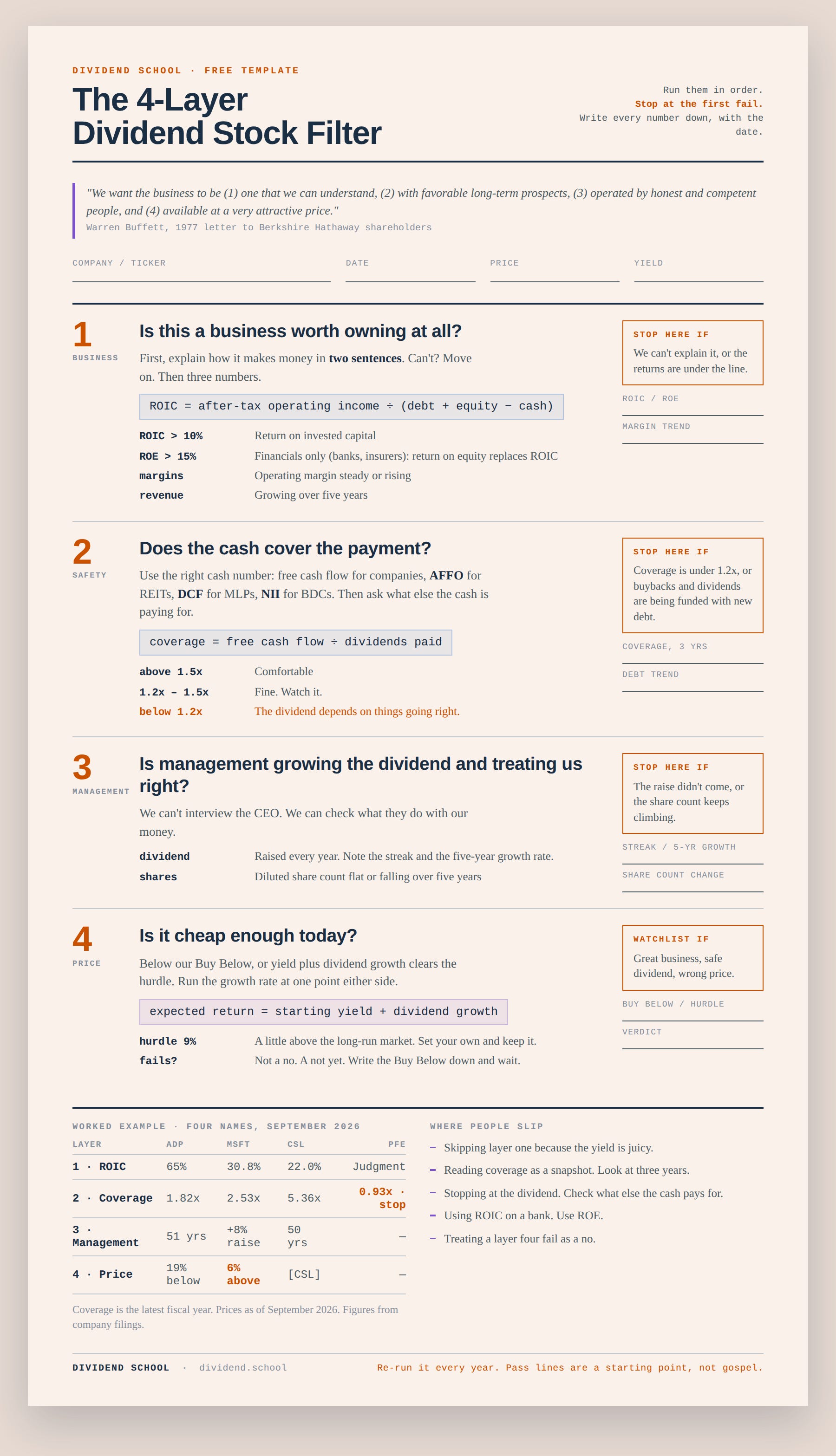
“We want the business to be (1) one that we can understand, (2) with favorable long-term prospects, (3) operated by honest and competent people, and (4) available at a very attractive price.”
Four filters, one sentence. In 2022, I built my own stock-buying checklist around those four filters and called them pillars: business, management, financials, and valuation.
When I wrote that piece, Mohnish Pabrai’s checklist ran 95 to 100 questions and took him 20 minutes to work through. I love the idea. Most of us won’t do it every time.
So what does a checklist look like when we’re buying for the dividend?
Same four filters, adjusted for what a dividend investor needs to know:
The business: is this a business worth owning?
Dividend safety: does the cash cover the payment?
Management: is management growing the dividend and treating shareholders right?
The price: is it cheap enough today?
We run them in that order, and we stop at the first fail. No point checking the price on a business we don’t want to own.
Four guinea pigs today:
Automatic Data Processing ($ADP)
Carlisle Companies ($CSL)
Microsoft ($MSFT)
Pfizer ($PFE)
One caveat up front. Every pass line below is a starting point, not gospel. A bank, a REIT, and a software company don’t look alike on paper, and the trick is knowing which metric fits which business.
Layer #1: The Business
Can we explain how the company makes money in two sentences? If not, we move on. That is Buffett’s first filter, and we don’t need a spreadsheet to figure it out.
Then three numbers:
ROIC above 15%. Return on invested capital tells us how much profit the company squeezes out of every dollar tied up in the business (after-tax operating income ÷ debt plus equity, minus cash).
Operating margins steady or rising.
Revenue growing.
Big exception here: banks, insurers, and other financials. Debt is their raw material, so ROIC tells us very little. For financials, we swap in return on equity, and the pass line goes up to 15%.
Now our guinea pigs.
ADP runs payroll and HR for businesses of every size. Revenue grew from $15.0 billion in fiscal 2021 to $21.9 billion in fiscal 2026, 7.9% a year. Pre-tax margins were 26.1% ($5,730M pre-tax income ÷ $21,947M revenue). ROIC comes in at 65% ($4,414M of after-tax profit ÷ $6,765M of invested capital).
That ROIC is a little inflated. ADP holds client payroll money before it goes out the door and earns interest on it, $1.35 billion in fiscal 2026. Remove the interest-income boost, and it equals 41.3%. Either way, it clears 10% with plenty of room to spare.
Microsoft sells software and cloud computing to just about everyone. Revenue went from $168.1 billion to $331.8 billion over the same five years, 14.6% a year. Operating margin of 46.8% ($155.2B ÷ $331.8B), and it has risen three years running. ROIC of 30.8% ($125.1B after-tax operating income ÷ $405.8B invested capital). Easy pass.
Carlisle makes commercial roofing and building envelope products. ROIC of 22.0% ($784.5M after-tax operating income ÷ $3,564.9M invested capital). Operating margin of 20.0% ($1,002.5M ÷ $5,019.9M).
Carlisle passes, with a caveat. Organic revenue fell 2.9% in 2025 and another 5.0% in the first quarter of 2026, and the operating margin slipped from 22.8% the year before. Management blames “continued softness in residential and non-residential new construction markets.” Construction runs in cycles, so I’m giving it a pass, but it’s a pass we will keep an eye on.
Pfizer is the judgment call. Revenue went from $100.3 billion in 2022 to $62.6 billion in 2025 as COVID vaccine and treatment sales rolled off. Pre-tax income fell from $34.7 billion to $7.5 billion.
Does that make it a bad business?
Not necessarily. A lot of that 2022 revenue was never coming back, and everyone knew it. So let’s give Pfizer the benefit of the doubt and move it to layer two.
Layer #2: Dividend Safety
Does the cash cover the payment? If you read “Don’t Chase High Yields” on September 22, this is step one of that test.
We use the coverage ratio:
Coverage = free cash flow ÷ dividends paid
Above 1.5x: comfortable
1.2x to 1.5x: fine, watch it
Below 1.2x: the dividend now depends on things going right
Free cash flow is cash from operations minus capital expenditures. For REITs, swap in AFFO (the REIT version of free cash flow), for MLPs, distributable cash flow, and for BDCs, net investment income.
ADP: 1.82x ($4,776M of free cash flow ÷ $2,626M of dividends). One adjustment worth knowing: ADP reports a second spending line beside capex, “additions to intangibles,” so we subtract both. Comfortable.
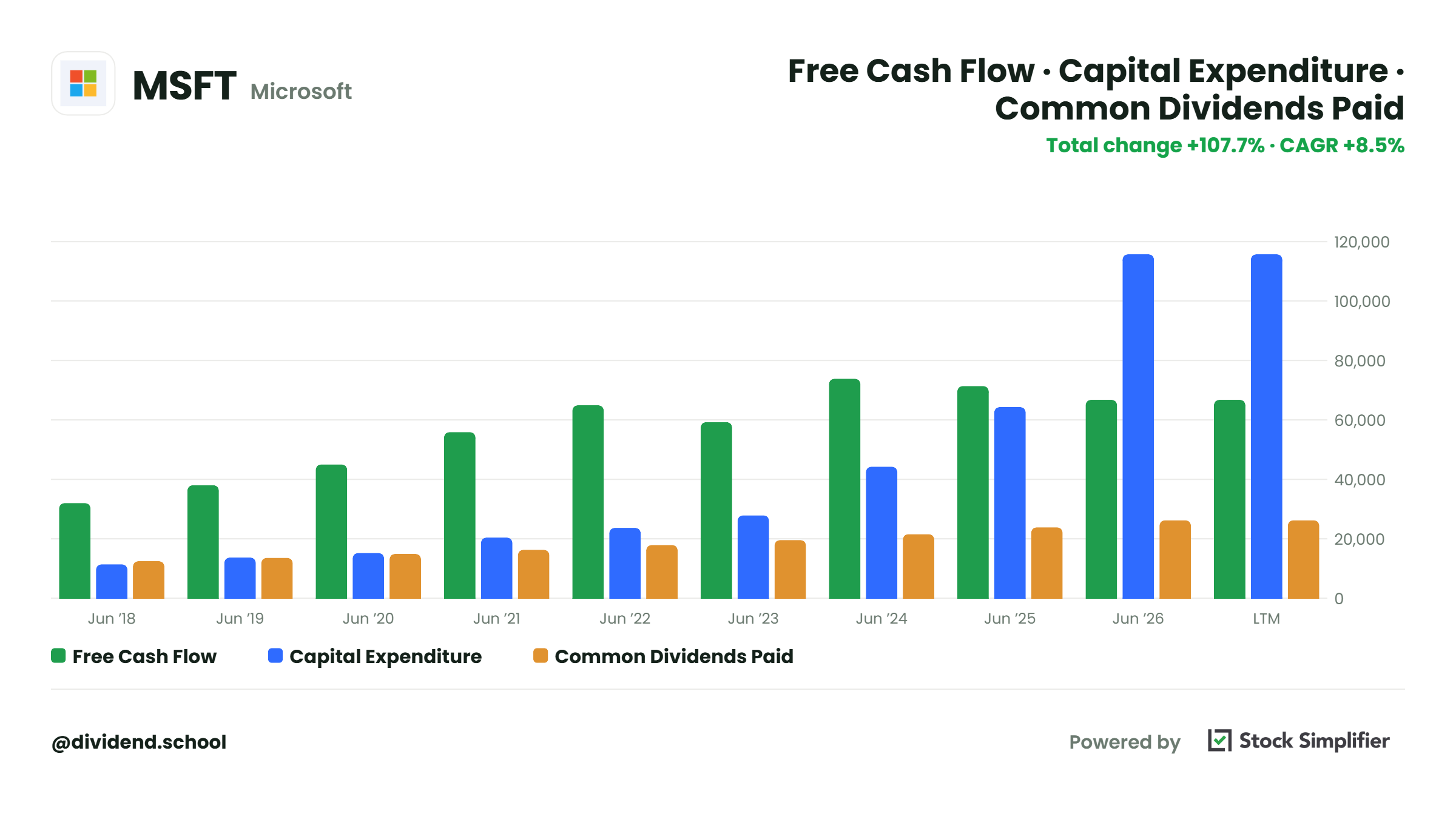
Microsoft: 2.53x ($66,987M ÷ $26,445M). Comfortable, but look at the trend:
Fiscal 2024: 3.4x
Fiscal 2025: 3.0x
Fiscal 2026: 2.5x
What happened?
The AI build-out. Capital expenditures went from $44.5 billion in fiscal 2024 to $115.9 billion in fiscal 2026. Cash from operations rose 54% over those two years, and free cash flow still fell 9.6%. Management says capex grows again in fiscal 2027. Microsoft passes easily, but coverage is a trend, not a snapshot, and this one is heading the wrong way. The big payout needs to come in the next few years or the Capex hit was a waste.
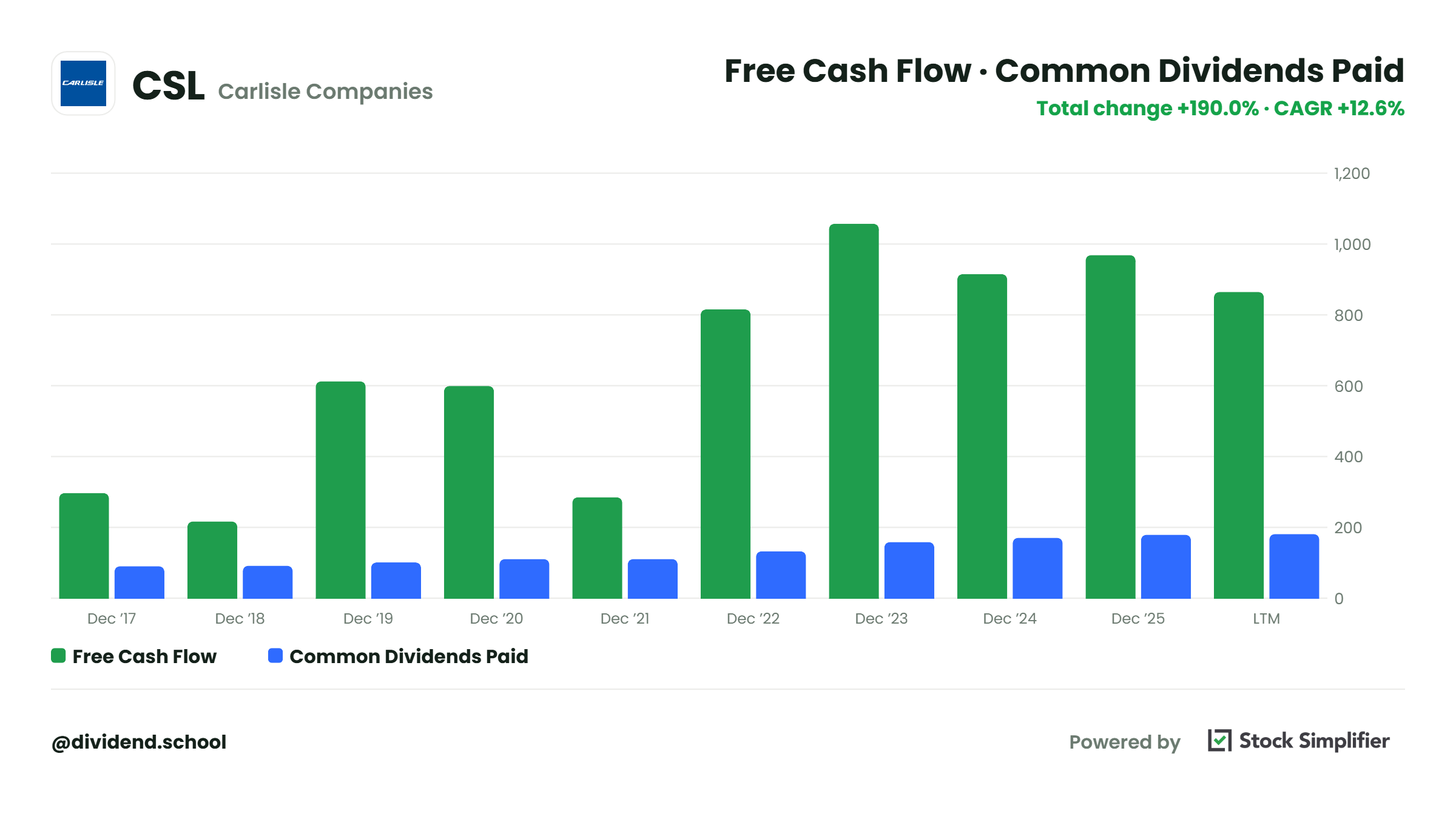
Carlisle: 5.36x ($970.6M ÷ $181.1M). The dividend is the safest of the four by a mile.
Where the rest of the cash goes is another matter. Carlisle spent $1.3 billion buying back its own stock in 2025, plus $181 million on dividends, against $971 million of free cash flow. The difference came from borrowing; long-term debt went from $1.9 billion to $2.9 billion during 2025. The dividend is safe. The buyback is funded by debt, and that works for a while, but not forever. So this layer includes one more question: what else is the cash paying for?
Pfizer stops here.
2025: 0.93x ($9,075M ÷ $9,771M)
Trailing twelve months through June: 1.12x ($10,985M ÷ $9,785M)
Under 1.2x both ways. On top of that, Pfizer carries $63.2 billion of debt, much of it from the $31 billion it borrowed in 2023 to help pay for Seagen, and management says buybacks wait until the balance sheet comes down.
To be clear, Pfizer hasn’t cut. The third-quarter payment was its 351st consecutive quarterly dividend. But a 6.2% yield on 1.12x coverage is a dividend that needs things to go right.
And if it had made it to layer three, it would’ve failed there too. In December 2023, Pfizer called its raise “the fifteenth year of consecutive dividend increases.” It raised again in December 2024, to $0.43 a quarter. In December 2025 the board declared $0.43 again. The word “increase” is nowhere in the release. A streak of more than 15 years ended, and it happened quietly.
You just watched a raise streak of more than 15 years end with no announcement at all. The only way to catch that is to line up the December releases side by side.We do that every week on a different company. Free, same as this.
Layer #3: Management
Buffett wanted “honest and competent people.” We can’t interview the CEO, but we can check how management uses our money.
Two questions:
Is the dividend growing every year? Raises tell us management believes the cash will keep coming.
Is the share count flat or falling? A company that issues more shares every year is diluting our ownership, and the dividend bill grows right along with it.
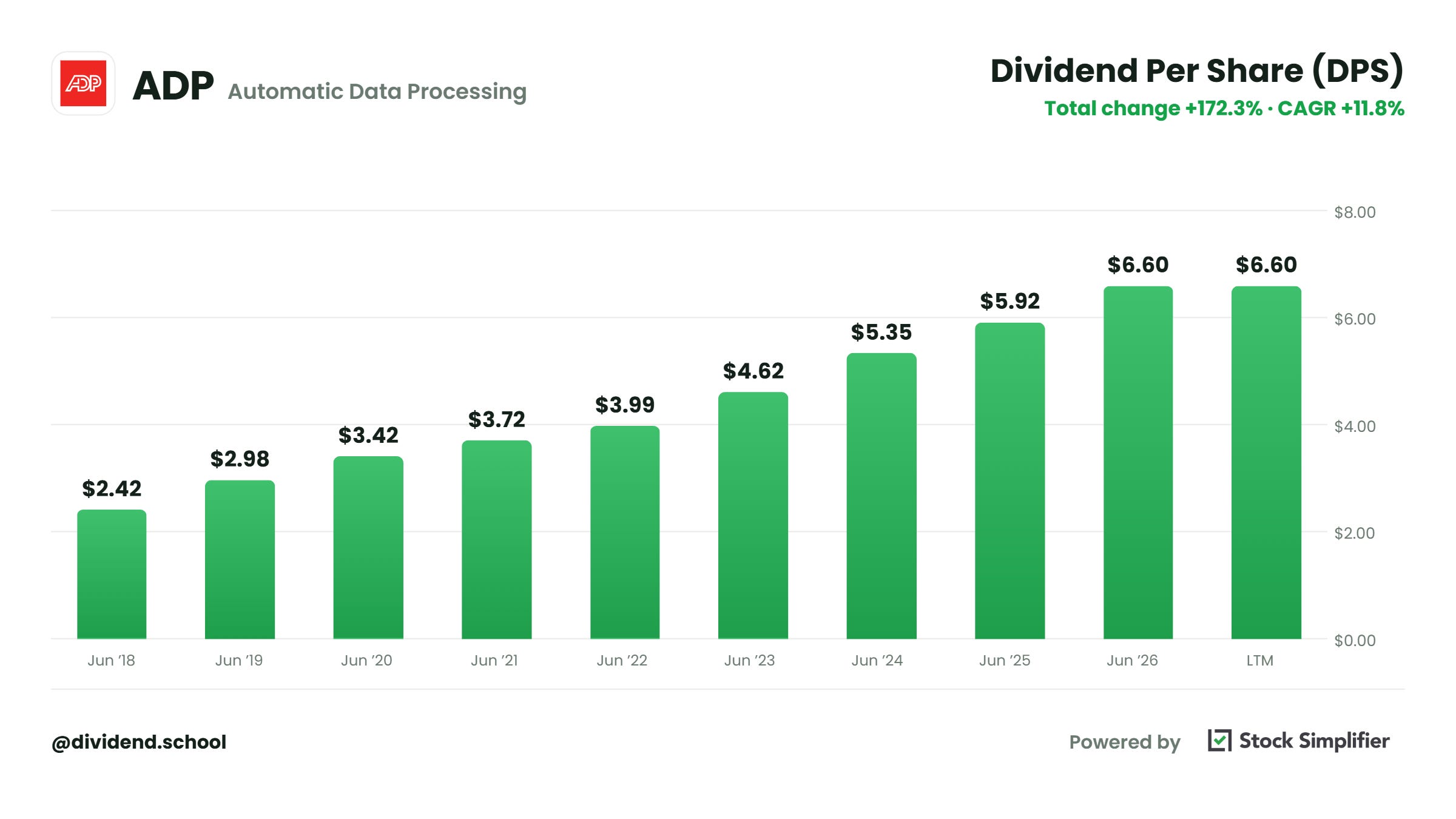
ADP: 51 straight years of raises. The latest came in November 2025, from $1.54 a quarter to $1.70 (+10%). Dividends per share grew from $3.70 in fiscal 2021 to $6.64 in fiscal 2026, 12.4% per year. Diluted shares fell 5.8% (428.1 million to 403.3 million). Love the consistency.
Microsoft: raised the dividend 8% on September 15, from $0.91 a quarter to $0.98. Dividends per share grew from $2.24 to $3.64 over five years, 10.2% a year. Diluted shares fell 2.0%, which isn’t much for a company that spent $22.3 billion on buybacks in fiscal 2026.
Carlisle: raised 14% in August, from $1.10 a quarter to $1.25, its 50th consecutive year. Dividends per share grew from $2.13 in 2021 to $4.20 in 2025, 18.5% a year. And the share count fell 23.9%, from 53.2 million to 40.5 million.
That is shareholder-friendly with a capital S. It is also where the debt from layer two went. Carlisle passes, and we check the balance sheet again next quarter.
Layer #4: The Price
Great business, safe dividend, good management. Is it cheap enough today?
Two ways to answer it:
The Buy Below. Every name in the Dividend School Universe carries one, a price we’ve already decided is worth paying. It is public on the Universe table at dividend-table.vercel.app.
The hurdle. Starting yield plus dividend growth should clear 9%. This is step three of the “Don’t Chase” test, and it works on any stock, Universe or not.
ADP: $269.94 against a Buy Below of $333.81, 19.1% below. The yield is 2.5% ($6.80 ÷ $269.94). Add a 9% growth rate, under both the dividend’s five-year pace and the latest raise, and we get 11.5%. Passes both ways.
Microsoft: $501.61 against a Buy Below of $473.52, 5.9% above. The yield is 0.8% ($3.92 ÷ $501.61). The hurdle gives two different answers depending on the growth rate we pick:
With 10.2% growth (the five-year pace): 0.8% + 10.2% = 11.0%, passes
With 8% growth (the latest raise): 0.8% + 8% = 8.8%, fails
When one point of growth decides the answer, the answer is “not yet.” Microsoft fails layer four.
Carlisle: $314.70 against a Buy Below of still to be determined. The yield is 1.6% ($5.00 ÷ $314.70). Add the 1.6% yield to the 14% dividend growth, and you get 15.6%. Easy pass, with the buy below still to be calculated next month.
Failing layer four isn’t a no. It’s a not yet. Microsoft is a wonderful business at the wrong price. Write the Buy Below down, put it on the watchlist, and wait. Patience is a virtue.
How to Use the Filter in Your Process
Here is how our four guinea pigs came out:
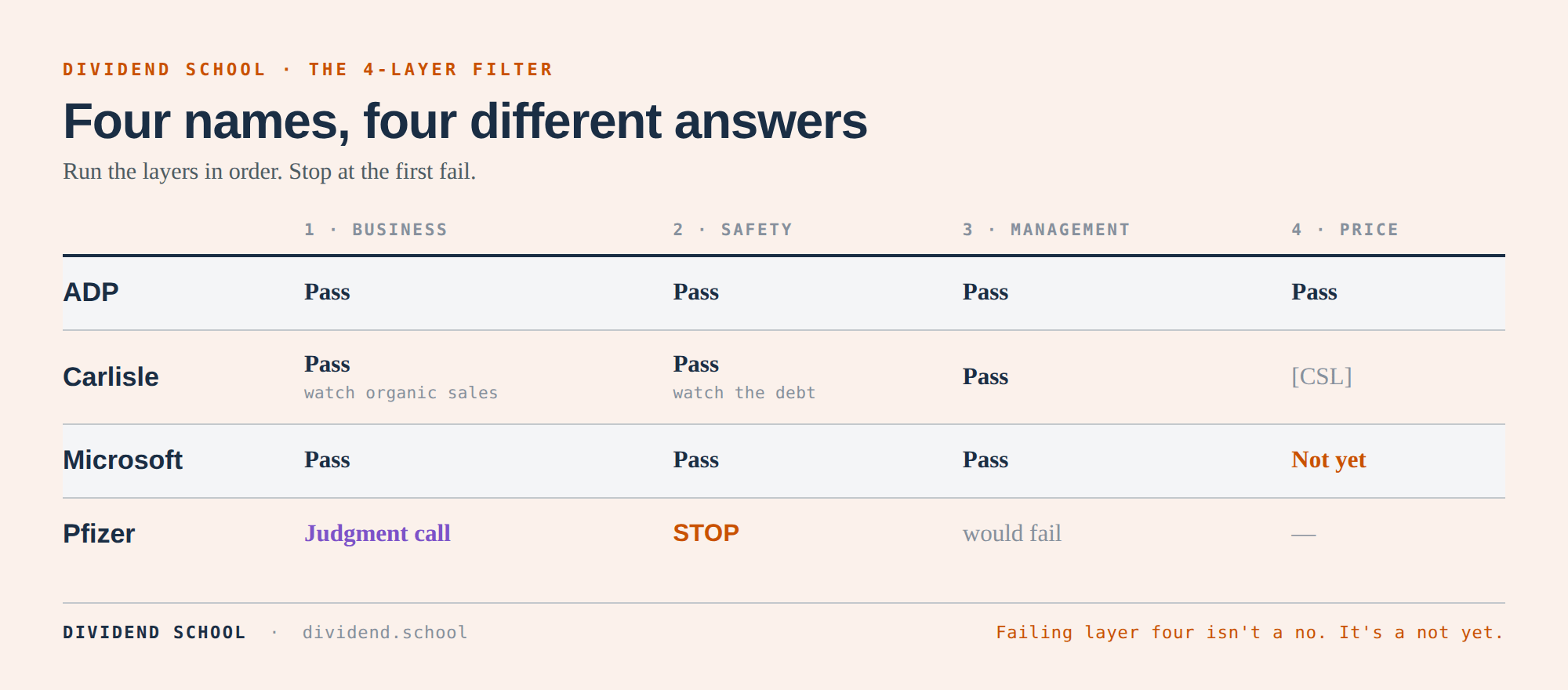
Print the template and run it on the next dividend stock you’re thinking about buying. Start with a company you already own. It’s humbling, trust me.
A few things I’ve learned doing this:
Go in order. Layer one takes the longest, but it saves the most time, because we never value a business we don’t want to own.
Write the numbers down. Every pass line, every result, and the date. Six months from now, we check whether anything moved.
Re-run it every year. Carlisle and Microsoft both pass today with an asterisk, and next year we check the asterisks first.
Common Mistakes to Avoid
A few traps to avoid:
Skipping layer one because the yield is juicy. Pfizer’s 6.2% is the whole reason people look at it.
Treating coverage as a snapshot. Microsoft at 2.5x is fine; the trend from 3.4x is the story.
Stopping at the dividend. Carlisle’s dividend is covered five times over; the buyback is the part funded with debt.
Using ROIC on a bank. Use return on equity instead.
Treating a layer four fail as a no. It means not yet.
Dying Business or Generational Opportunity: Is McDonald’s a Buy? (16 min)
My answer turned out to be neither. Three things I found:
It’s cheap on paper. At $238, McDonald’s trades at 19.3 times earnings against a historical average of about 26. Margins are excellent, it throws off plenty of free cash flow, and the dividend is in no danger.
Growth is the problem. Global same-store sales grew just 1.3% last quarter, below inflation. The moat is real, but I rate it thinner than most people assume. Fast-casual chains and GLP-1 drugs are both chipping at it.
A 10-year Treasury pays about the same. Low-single-digit growth plus a dividend of about 3.2% works out to roughly a 5% return. The 10-year Treasury pays about 5.2% right now, with a lot less risk.
The price where I’d actually start buying is at 14:03. Watch on YouTube →
Disclosure: I don’t own McDonald’s. I do own Domino’s, which comes up in the video.
Final Thoughts
Buffett’s filters work for dividend-paying stocks. Follow the steps to filter for your next great idea.
Understand the business, check the cash, watch what management does with it, and only then decide what we’re willing to pay.
If you have any questions or would like me to cover something in particular, please don’t hesitate to reach out.
Until next time, take care and be safe out there,
Dave