

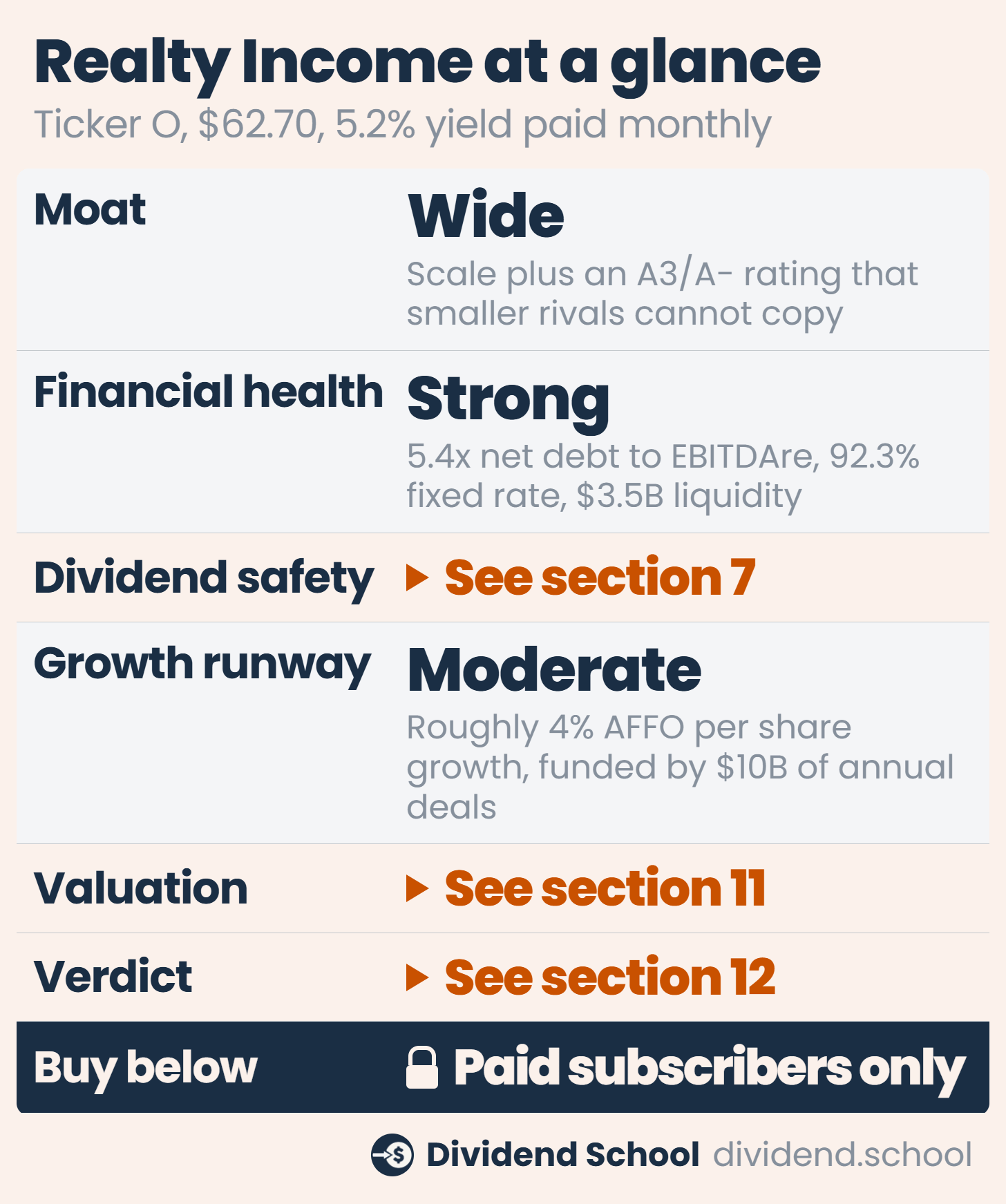
Realty Income has humble beginnings, from collecting rent from a single fast food restaurant to owning Las Vegas casinos and now hyperscale data centers. The company pays a monthly dividend with 673 consecutive payments plus a growing annual dividend of 31+ years.
Today we will dive deep into whether the payment is safe and what a good price is to own Realty Income, among other things.
Here is what we will discuss:
One Taco Bell in 1969
The Bet
What the Company Does and Triple Net Lease 101
How Realty Income Makes Money
Moat and Competition
Financials, and the metric that sent a man to prison
Dividend Deep Dive
Growth Prospects
Management and Capital Allocation
Risks
Valuation
Decision
1. One Taco Bell in 1969
Bill and Joan Clark bought one Taco Bell in Northridge, California in 1969, straight from Glen Bell himself. Humble beginnings, as I mentioned.
The business model simple, and remains the same today.
They leased the Taco Bell back to the operator, collected monthly rent, and paid themselves every month. That single transaction is the whole business model, and the company still runs it today at a scale of 15,588 properties.
Realty Income remained private for its first twenty-five years. In 1994, they listed on the NYSE under the ticker “O.” A fairly confident decision to choose “O.”
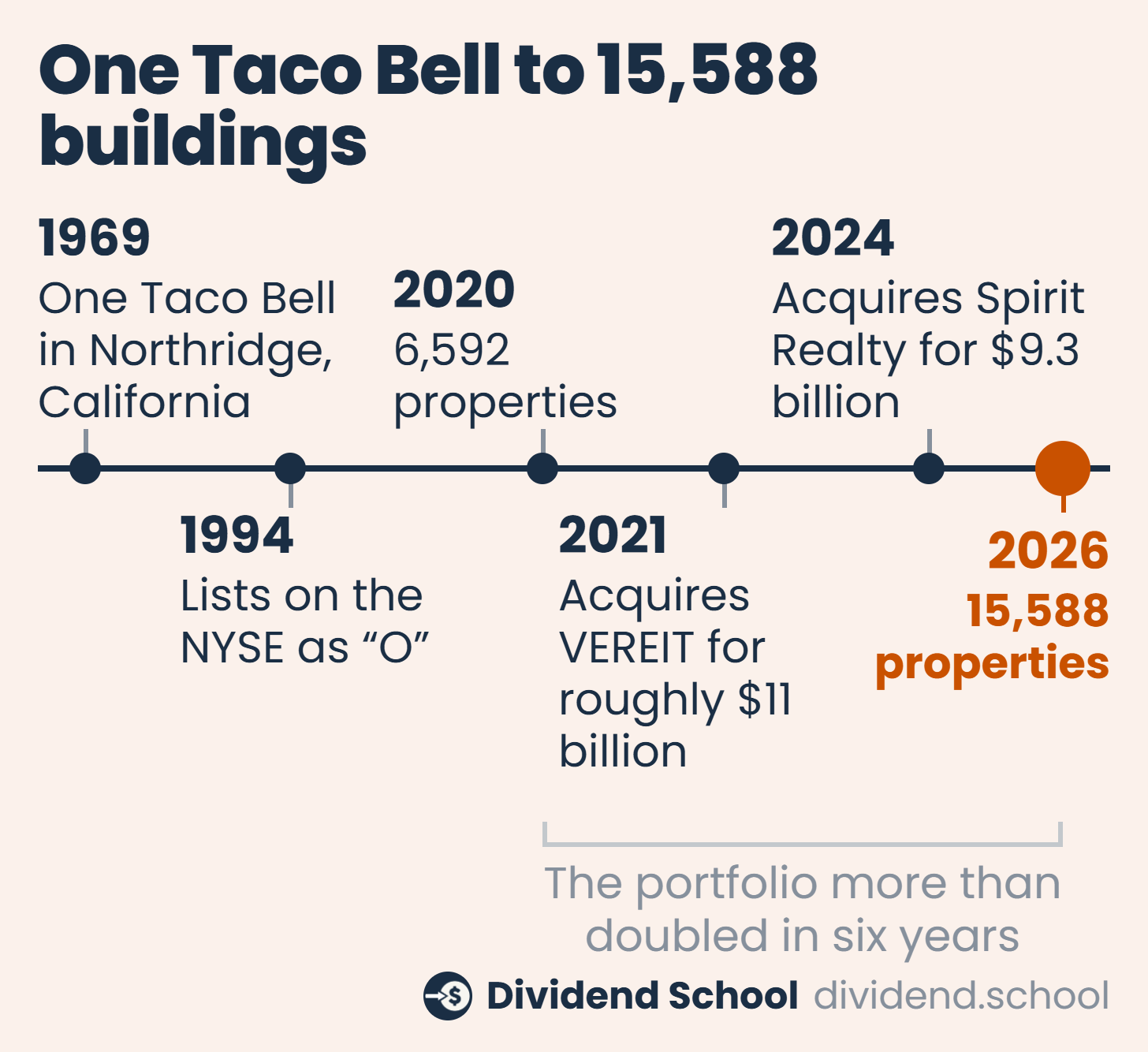
That first monthly rent check became a monthly dividend check. Along with the 673 consecutive monthly dividends, the company has also raised the payout 135 times since the IPO. That performance has allowed them to join the list of Dividend Aristocrats with their more than 31 straight years of dividend increases.
Thirty-one years of raises can create a kind of lull or apathy about checking the dividend safety, which is why we want to dig deeper into that dividend and its safety. Remember, a long streak tells us the company has survived and prospered, but tells us nothing about what could happen now or into the future.
For example, this A3/A- credit rated company carries $31 billion of debt from a cheaper interest rate environment. they also have a retail tenant based with some troubled names in, along with a new bet on data centers with its execution risk and zero history behind it.
2. The Bet
We are betting on boring, and that boring Realty Income will continue to compound.
We are betting the company continues to collect rents from the thousands of its leases for decades. And continue to pass along at least three-fourths of its cash to us as a monthly dividend, which it has done for over 31+ years.
Currently, the company yields 5.3% based on the stock price of $62.56 (as of this writing). If we add dividend growth in the low single digits and AFFO growth around 4%, we get a potential return of 8-10% from a boring company.
This bet works if two things stay true.
The dividend continues to remain safe
Realty continues to find good places to invest with good returns.
Simple. Let’s dig into both questions and see if they will come true.
3. What the Company Does, and Triple Net Lease 101
Before we can dig into Realty Income, we need to spend a few minutes (10 or so) on how REITs work. If you already understand REITs and triple net leases, skip to section 4.
If you don’t, let’s dig in.
What is a REIT?
Simple, a REIT, or real estate investment trust, is a tax deal with the government. It works like this.
The REIT pays no corporate taxes on its earnings
In exchange, it must pay out at least 90% of its taxable income to shareholders as a dividend
Congress created REITs in 1960 so “normal” people could own commercial real estate without the burden and stress of buying land and buildings. Who knew they could get something done?
The practical impact for us, the normal people: REITs are legally required to be dividend machines. The dividend is the point of the REIT structure, which is why most REIT analysis focuses on the dividend, not the business.
Not all REITs are the same
The REIT covers a wide range of businesses, many of which don’t behave the same. And those differences matter.
Here are some examples:
Apartment REITs re-lease every unit every year or two. Rents reset with the market fast, in both directions.
Office REITs sign long leases and then spend heavily to keep tenants, because an office tenant expects the space rebuilt for them.
Mall REITs own big boxes with rents tied to retail sales, and they carry high running costs.
Industrial REITs own warehouses, usually on medium leases, with rents driven by shipping and logistics demand.
Net lease REITs own single-tenant buildings on long leases where the tenant pays almost every cost of running the property.
Two things separate net leases from other REITs. The leases are long, typically 10+ years or more, meaning revenue is contractual instead of market-driven. And the landlord’s costs remain close to zero, meaning almost every dollar of rent hits the bottom line.
That combination enables the monthly dividend. A landlord whose revenue resets annually and whose costs move with inflation can’t offer or promise a dividend payment 673 months in a row. Realty Income, with a decade of signed contracts, can.
That’s their structural advantage.
The net lease, explained with a dollar store
Let’s illustrate the net lease using an example: Dollar General.
Picture Dollar General; the company has thousands of stores, with every store sitting in its own building. Dollar General could own those buildings, which was common back in the day, but not now. Consider that owning ties up capital that earns Dollar General nothing; the building sits there while the money tied up in ownership could be used to open new stores. And those stores earn 20% returns.
So Dollar General sells the building to Realty Income and signs a long lease to rent it back.
This transaction has a name: the sale-leaseback, and we should think of it as a financing deal wearing a real estate costume. The retailer (Dollar General) converts a dead asset into growth capital. The landlord (Realty Income) gets a decade-plus of contractual rent from a tenant that needs the building to run its business.
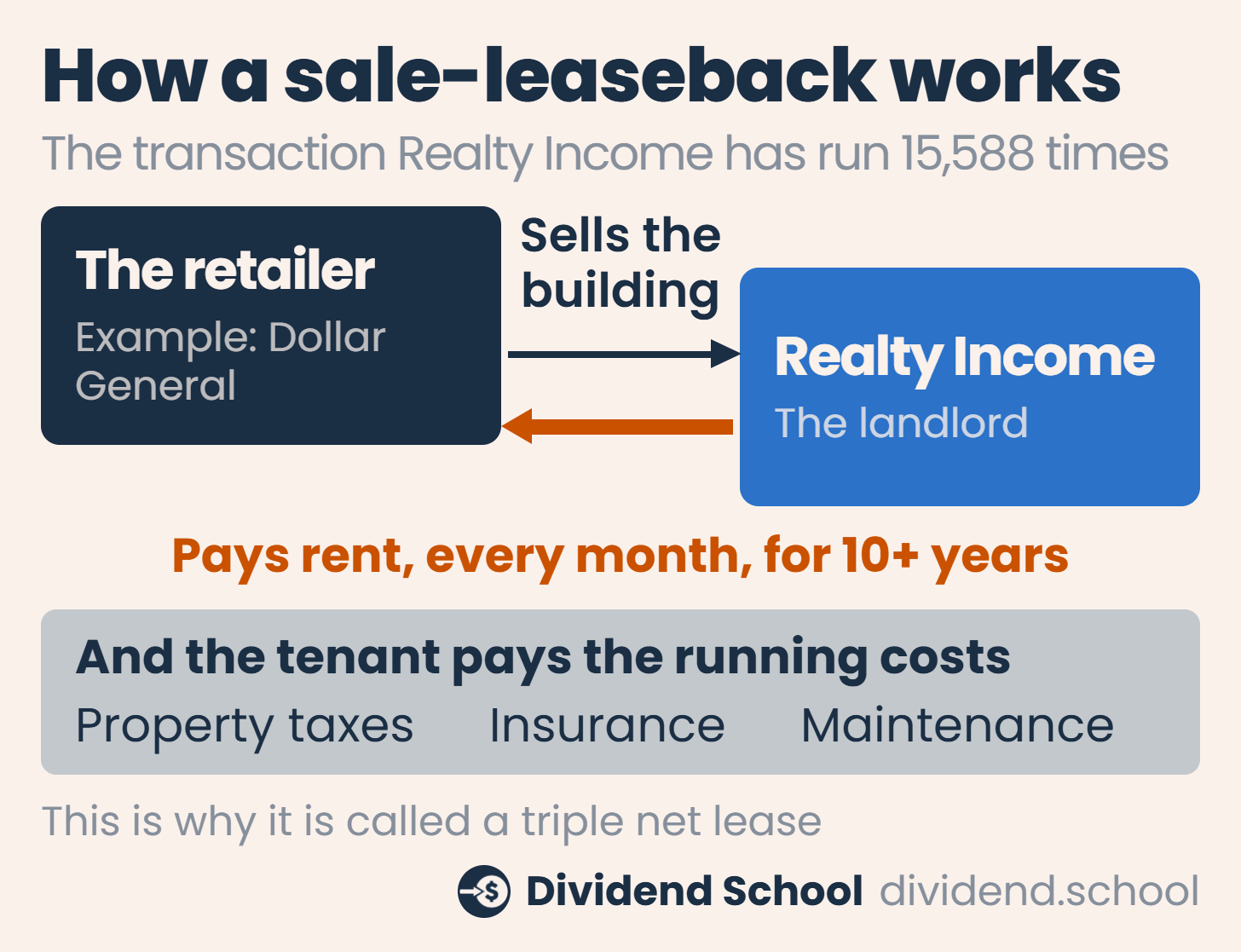
The lease that governs the deal is a triple net lease, and the three “nets” are the tenant’s obligations:
Property taxes: tenant pays
Insurance: tenant pays
Maintenance: tenant pays
Compare this to the nightmare of owning an apartment building or an Airbnb. The landlord has to eat taxes, insurance, repairs, and the nightmare: the 2 a.m. plumbing call.
As opposed to that scenario, a triple net landlord’s operating costs are almost nothing.
Realty Income’s job comes down to two things:
Buy good properties with reliable tenants
Collect the rent
One last term to understand: the cap rate. The formula is the property’s annual rent divided by its purchase price. For example, Realty Income buys a building for $1 million that it rents out for $73,000 a year. That equals a 7.3% cap rate. Remember this idea; we will come back to it in section 4.
What you are underwriting
Here is the part that trips up new REIT investors.
When you buy a net lease landloard like Realty Income, the main bet is not only on the real estate. We are also betting on the tenats’ ability to continue paying rent for ten years or more on a contract they can’t walk away from. At least not very easily or cheaply.
Think for a moment what that lease represents.
A signed obligation from a company to pay a fixed amount every month for a decade or longer, with annual increases written in. Strip away the real estate and now it looks a lot like a corporate bond, with the exception that the collateral is a building the tenant needs to operate.
That framing changes what matters and what we need to understand.
The building’s value matters far less that whether Walmart remains solvent in 8,10, or 20 years.
Which is why Realty Income’s company disclosure reads like a credit analysis:
How many tenants
How many different industries
Tenants with investment-grade ratings
There are two ways a net lease landlord loses money, and neither one is a property crash.
The tenant stops paying, through bankruptcy or a store-closing program
The lease expires, and nobody wants the building at the old rent
Everything Realty Income reports about occupancy, lease term, tenant count, and rent recapture is measuring those two risks. Keep those in mind, because the company tracks them and so should we.
From one restaurant to 15,588 buildings
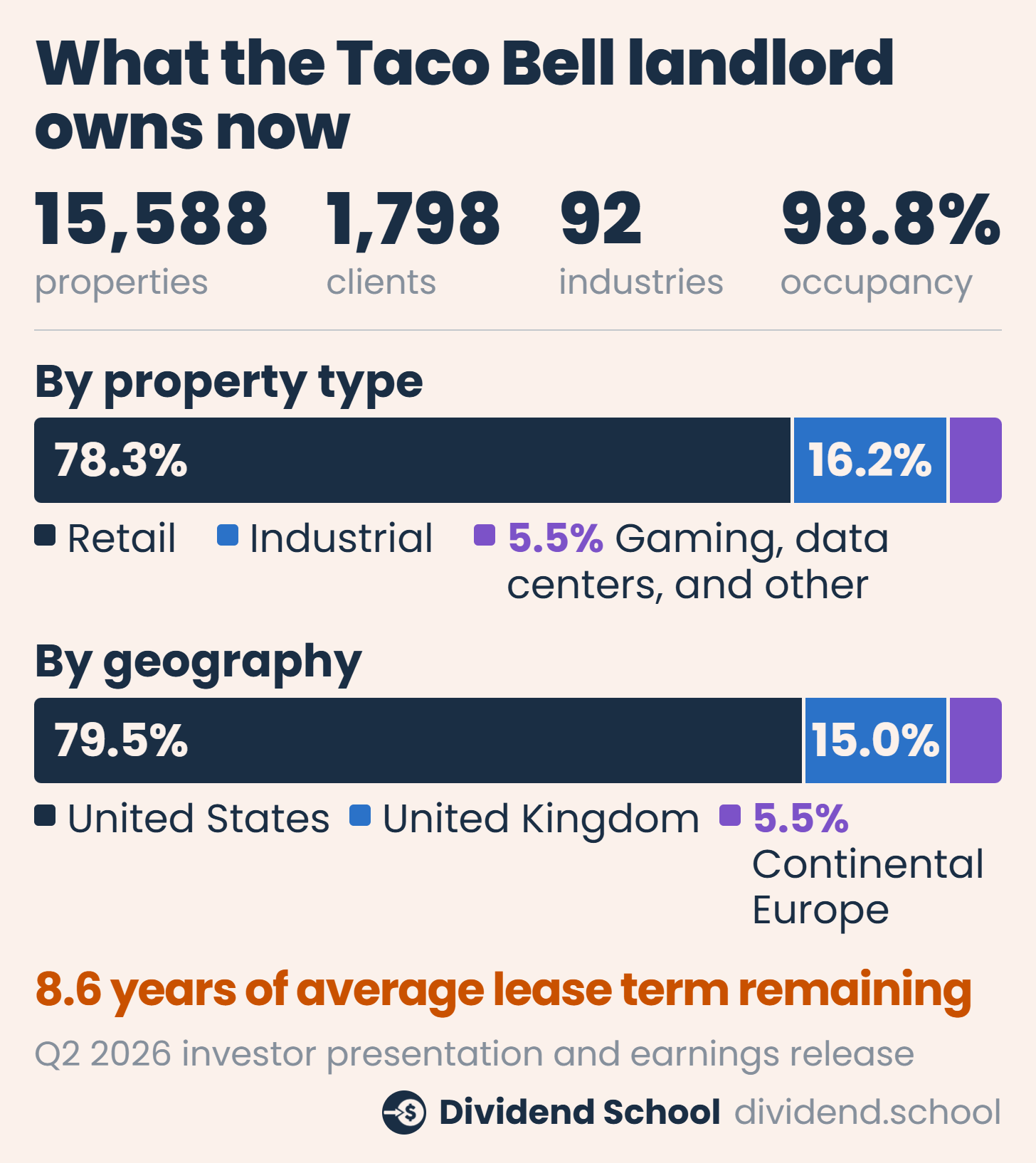
Realty Income’s scale came in stages, and two giant mergers did the heavy lifting:
1969: one Taco Bell
1994: NYSE listing
End of 2020: 6,592 properties
November 2021: acquires VEREIT for roughly $11 billion in stock
January 2024: acquires Spirit Realty Capital for $9.3 billion in stock
Q2 2026: 15,588 properties
The portfolio more than doubled in six years with those two mergers. Here is what the one-time Taco Bell landlord owns now, from the Q2 2026 investor presentation:
Retail: 78.3% of annualized base rent
Industrial: 16.2%
Gaming, data centers, and other: 5.5%
United States: 79.5% of the book
United Kingdom: 15.0%
Continental Europe: 5.5%
Largest tenants include Dollar General, 7-Eleven, Walgreens, Wynn Resorts, and the British grocery chains Asda and Sainsbury’s, along with some Walmart’s sprinkled in for good measure. The portfolio spans 1,798 clients across 92 industries, with occupancy at 98.8% and a weighted average lease term of 8.6 years, per the Q2 2026 earnings release.
This is important. Notice what kind of retail. Convenience stores, dollar stores, drug stores, and grocery. The vast majority are places you drive to for things you need, now. Things Amazon has a hard time replacing.
Realty Income screens for tenants with a service aspect, necessity component, or a low price point. Which their tenant list covers perfectly.
We’ll discuss this more in the growth section. But Realty also runs a $1.7 billion private capital fund, a $1.5 billion build-to-suit program with Singapore’s GIC, and a $6 billion hyperscale data center venture in Virginia with Cloud Capital. And finally, a JV partnership with Digital Realty, one of the leading data center REITs.
4. How Realty Income Makes Money
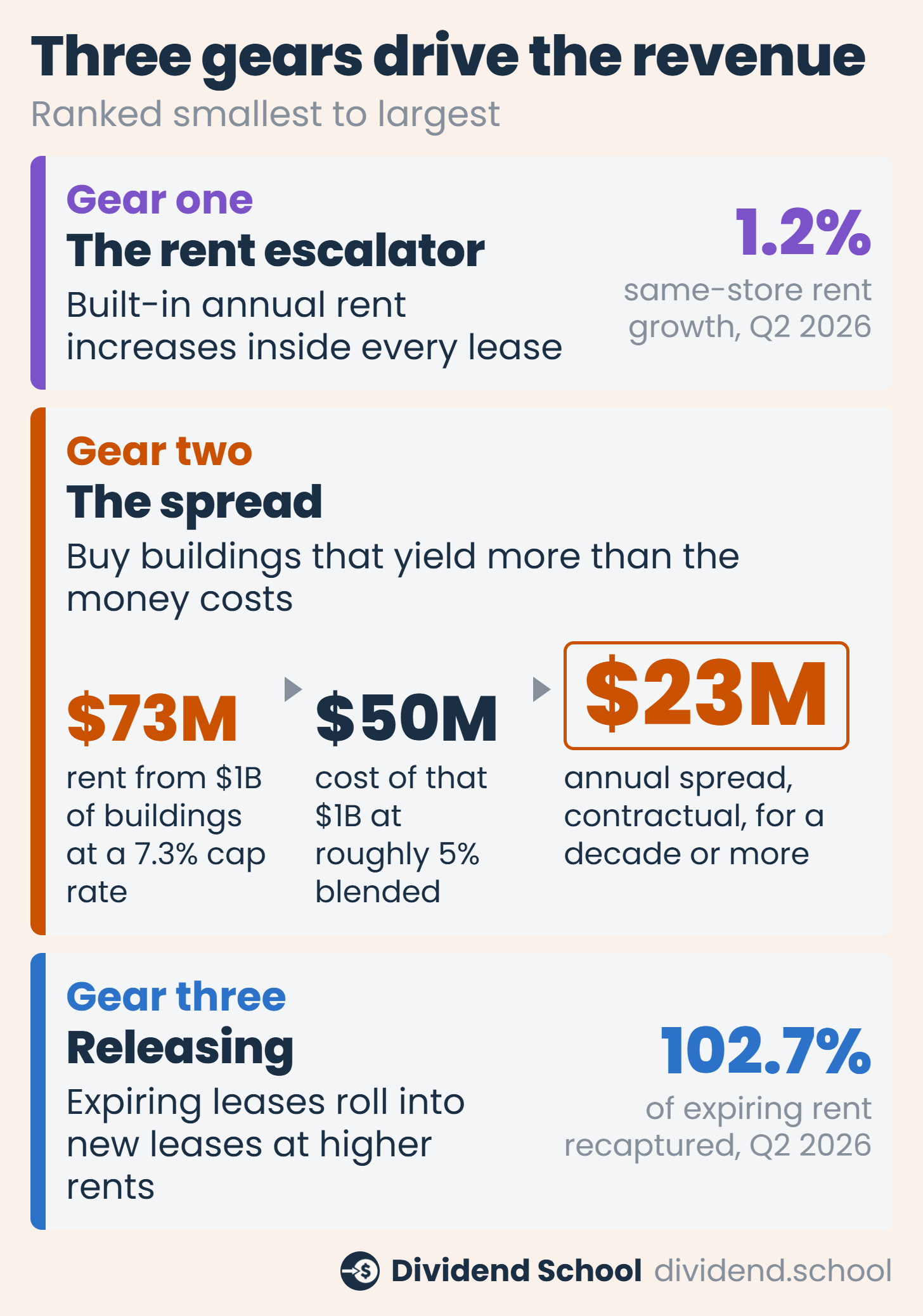
The revenue model has three gears, and you can rank them by size.
Gear one: the rent escalator
Long leases come with built-in annual rent increases, typically around 1% for investment-grade tenants and higher for others. In Q2 2026, same-store rent growth ran 1.2%.
This gear helps build a monthly dividend. It is slow and contractual-based and grows slower than inflation.
Gear two: the spread
Realty Income raises in two ways, by issuing stocks and/or bonds. They then buy buildings which yield more than the cost of capital (equity or debt). That difference is the spread, and the spread is the bread and butter of Realty Income.
For example, let’s put some numbers to it. In Q2 2026 Realty invested $2.6 billion at a 7.3% initial cash yield. On the funding side (raising money), it issued 600 million euros of senior notes (debt) in July 2026 at a 3.625% coupon.
Let’s follow the money on a single billion dollars:
Buy buildings at a 7.3% cap rate: $73 million of new annual rent
Fund it with capital costing around 5% blended: $50 million of annual cost
Spread: roughly $23 million a year, contractual, for a decade or more per lease
Run this math on the $10 billion of investment volume management guides to for 2026 and this spread becomes real money. This is why the balance sheet and the great credit rating matter so much. The math only works while capital remains cheap, and capital only remains cheap while the ratings agencies stay happy.
Gear three: releasing
When a lease expires, the company re-rents or sells the building. In Q2 2026 it recaptured 102.7% of expiring rent on releases. Old leases roll into new leases at higher rents. Meaning they are capturing higher rents on new leases on older buildings.
That’s pricing power.
The company also prunes. In the first half of 2026 it sold 177 properties for $348.6 million in net proceeds, recycling capital out of weaker buildings and into the acquisition pipeline.
2nd Quarter 2026 Results
Here are the numbers from the August 5 earnings release:
Revenue: $1.55 billion, up from $1.41 billion a year ago
Net income per share: $0.37
AFFO per share: $1.09, up 3.8% year over year
Occupancy: 98.8%
Investment volume: $2.6 billion at a 7.3% initial cash yield
2026 AFFO guidance: raised to $4.44 to $4.45 per share
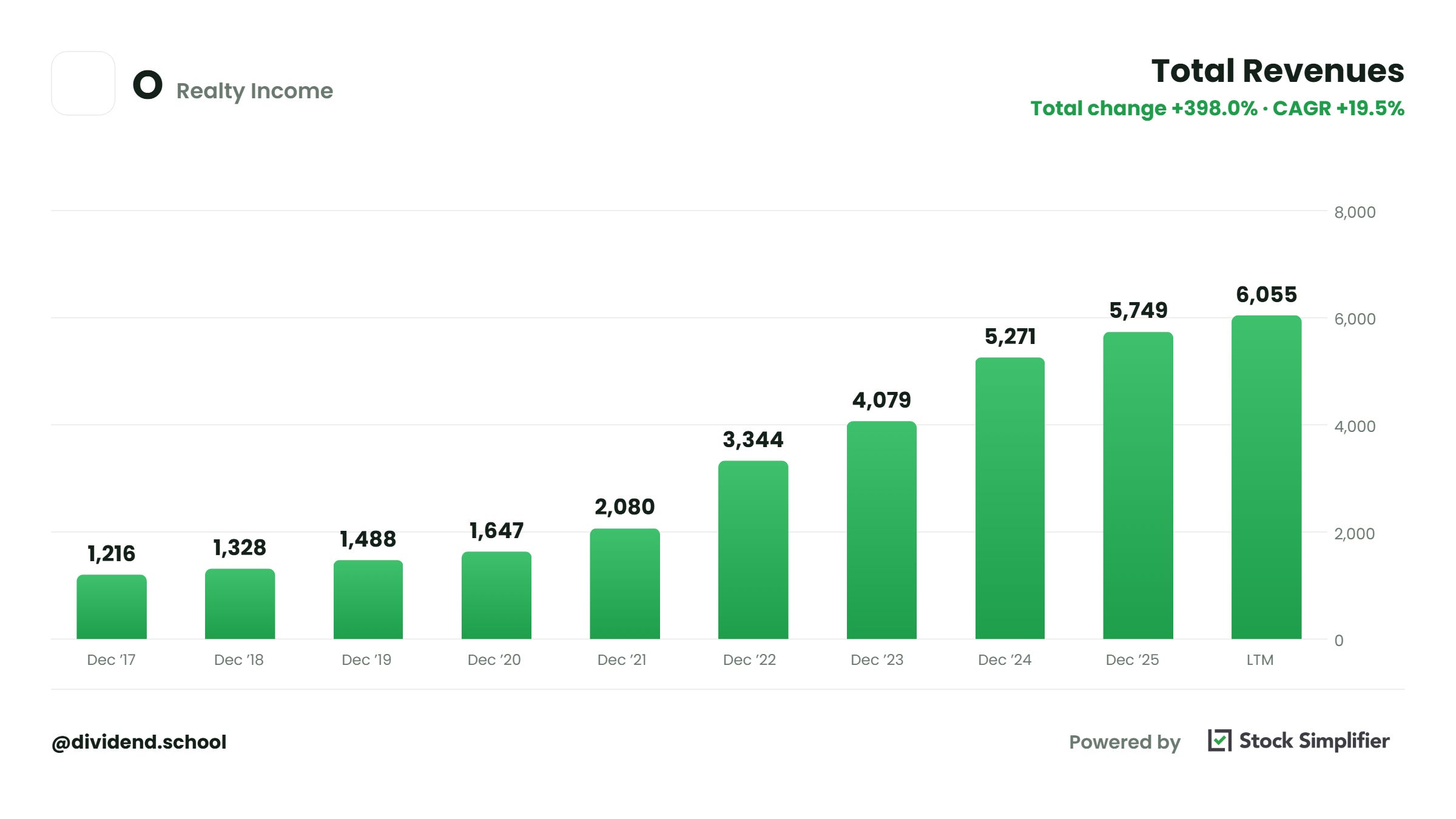
Notice the gap between $0.37 of net income and $1.09 of AFFO.
That gap is the single most important thing to understand and what separates it from a “normal” company like Walmart. And why analyzing REITs is different, and this is where the paid section starts.
Already a paid subscriber? Skip ahead; the full breakdown starts below.
The rest of this deep dive is for paid subscribers of Dividend School.
Below the line:
The accounting metric that makes a 200% payout ratio look conservative, and the CFO who went to federal prison for inflating it by five percent at a company Realty Income later bought
The dividend safety math, including what happened to rent collection in 2020 when governments closed the tenants, and the three numbers that tell you when a thirty-year streak is in trouble
My valuation across three lenses, the buy-below price, and the one change that would make me sell