

NextEra is two businesses under one ticker: Florida’s biggest regulated utility and, by its own count, the world’s largest generator of power from wind and sun. It’s about to become three, because it’s buying Dominion Energy, and the market has knocked 20% off our stock since the announcement.
In today’s post, we will discuss:
Why NextEra is at a 52-week low
The bet
What NextEra does
How NextEra makes money
The moat and the competition
The financials
Is the dividend safe?
Where the growth comes from
Management and the Dominion deal
The risks
What NextEra is worth
The decision
Okay, let’s dive in and figure out whether a utility that slowed its dividend growth and is buying a company a third its size still belongs in an income portfolio.
1. Why NextEra is at a 52-week low
On October 1 we published the 5 Best Buys Now list for October. NextEra was a candidate, and I passed on it. The reason was one word: Dominion.
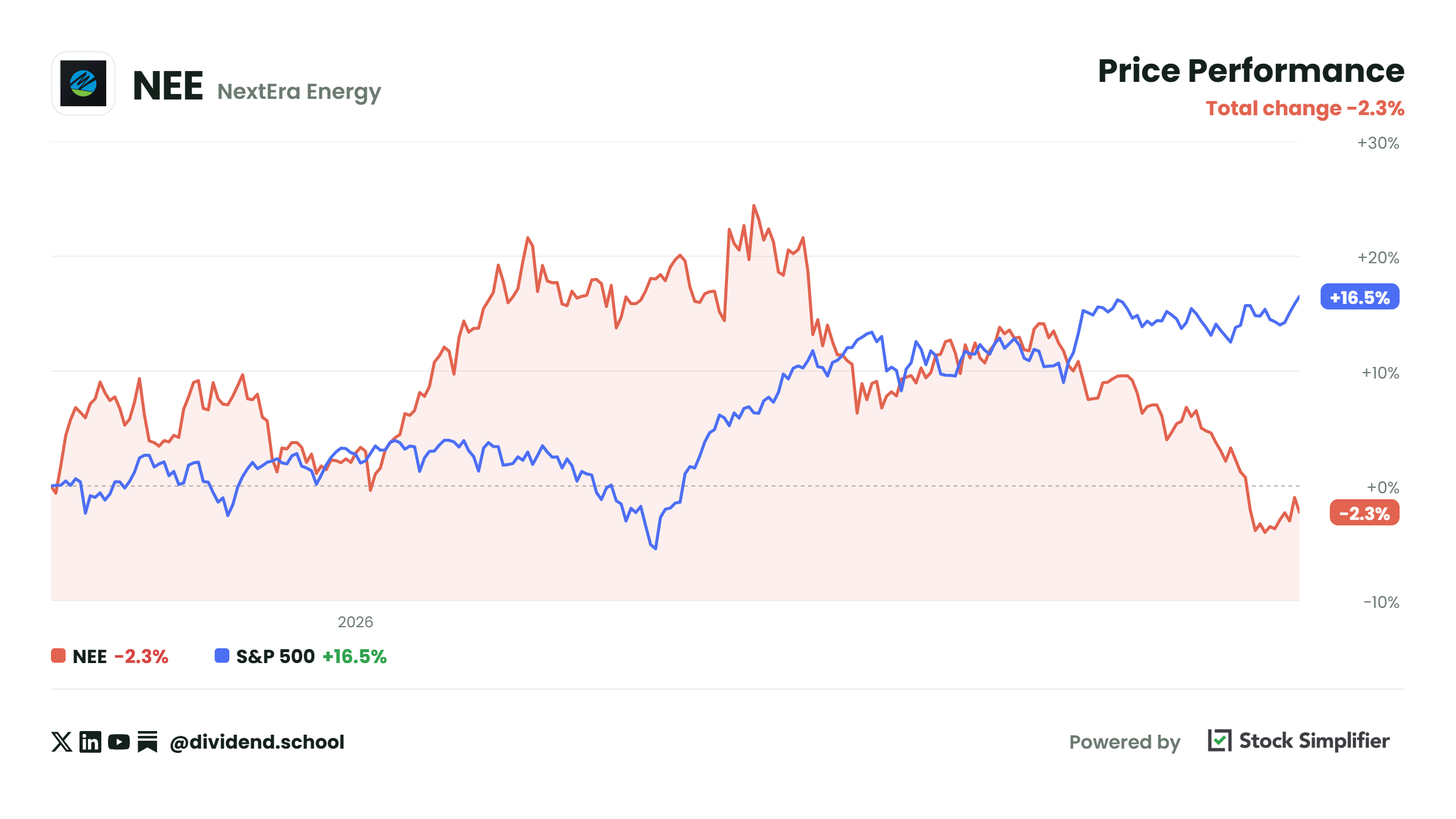
Same day, the stock hit $74.74, a new 52-week low.
Some backfill:
On May 18 NextEra agreed to buy Dominion Energy in an all-stock deal. The stock closed at $93.36 the trading day before, and that’s our starting line. It fell 4.6% the day of the announcement, to $89.04, and it hasn’t found the bottom yet.
Here’s where we stand:
Price: $74.74 (as of writing)
Down 19.9% since the deal was announced
Down 24.3% from the 52-week high of $98.75
Dividend: $0.6232 per quarter, $2.49 a year
Yield: 3.34%
What’s going on?
Three things are weighing on the stock at the same time:
The Dominion deal and the fight over it in Virginia
The dividend growth rate dropping from 10% to 6% after this year
A build-out so big the company spends twice what it brings in
We unpack all three below. The short version: none of them is new to anyone who’s been reading the filings, and all of them are now priced in.
And the price has given us a yield this stock rarely offers. Stock Simplifier puts NEE’s 10-year range of trailing yields at 1.65% to 3.64%, with a median of 2.45%. At 3.34% forward we’re closer to the top of that range than the middle.
NextEra is also in both our personal portfolio and the Dividend Universe.
So the question for us this month is personal: does a utility in the middle of a $67 billion merger still deserve a spot, and at what price?
2. The bet
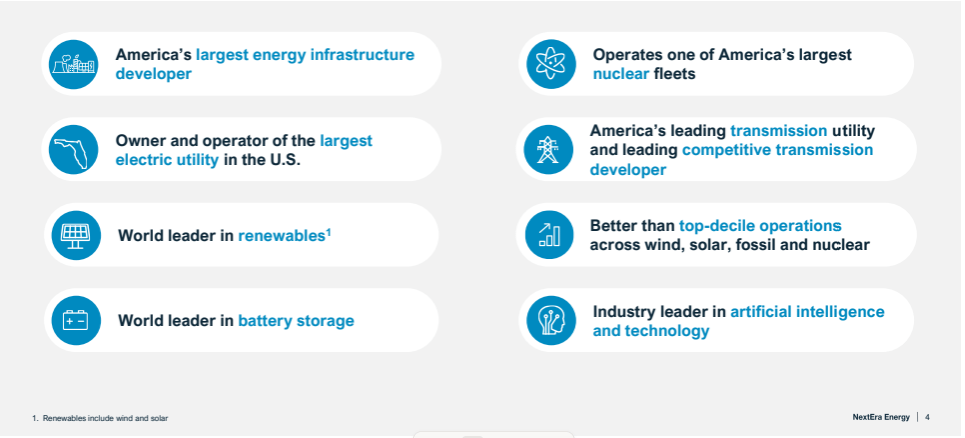
NextEra owns Florida Power & Light, which the company describes as the largest electric utility in the US. It also owns NextEra Energy Resources, which builds and runs wind farms, solar farms, batteries, nuclear plants, and gas pipelines, and sells the power under long-term contracts.
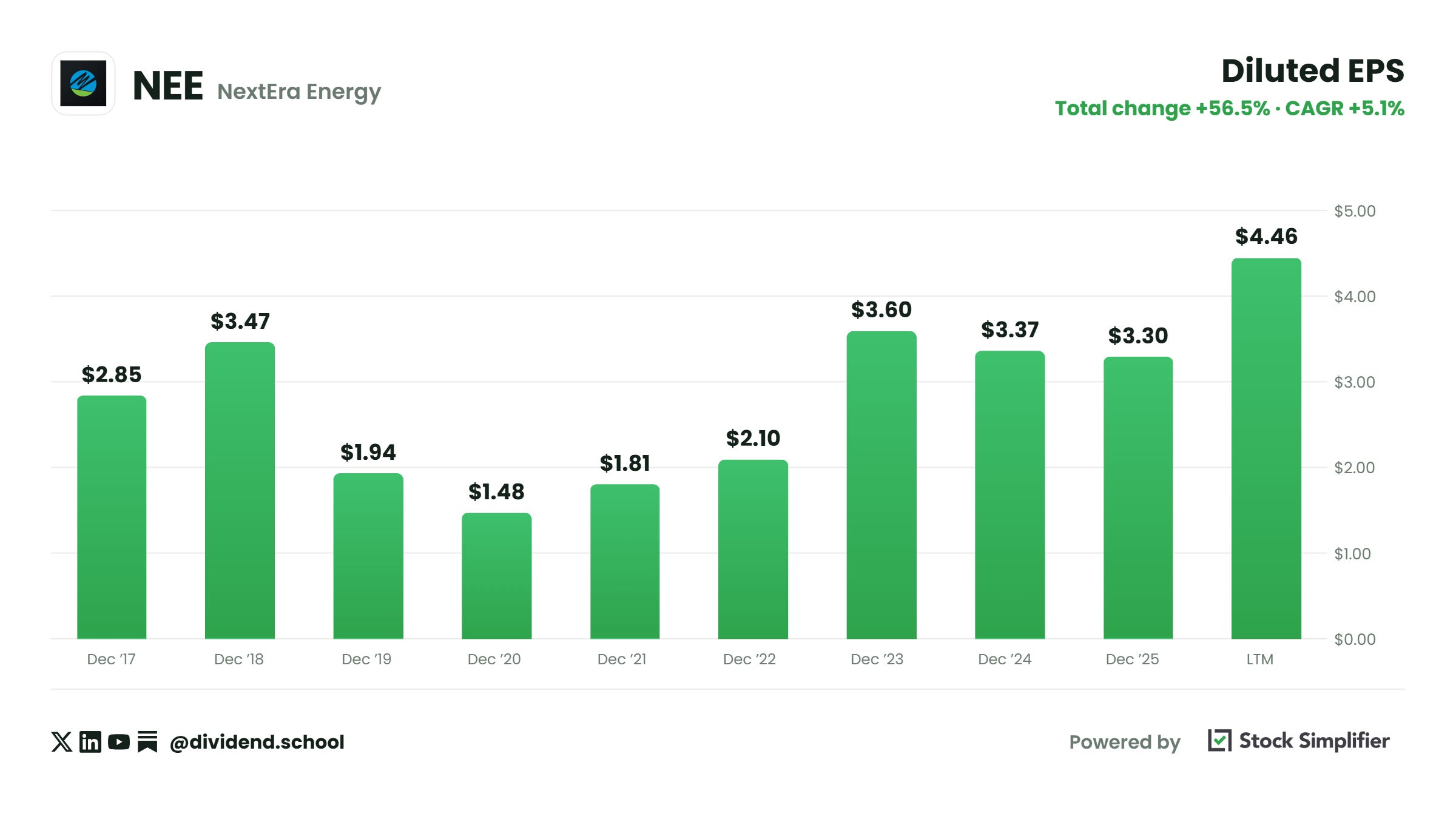
Our bet is that both halves keep growing earnings at 8% a year or better, one because Florida keeps adding people and the regulator lets FPL earn a return on what it builds, the other because data centers need more electricity than the grid has. We collect a dividend growing 6% a year on top of that while the payout ratio comes down.
The merger adds Virginia, North Carolina, and South Carolina to the regulated side. Whether that’s a good trade for us at this price is what we work out in the rest of the article.
3. What NextEra does
Think of NextEra as a landlord with two kinds of buildings.
The first kind is rent-controlled. That’s FPL. A state regulator sets the rent, and it's designed to give FPL a fair return on what it spent to build the place. Steady, boring, and it goes up when the landlord builds more.
The second kind is leased to big tenants on long contracts. That’s NextEra Energy Resources, which most people shorten to NEER. A utility in Iowa or a tech company in Texas signs up to buy power from a NEER solar farm for 15 or 20 years at a set price, and NEER builds the farm.
Let’s look at FPL by the numbers:
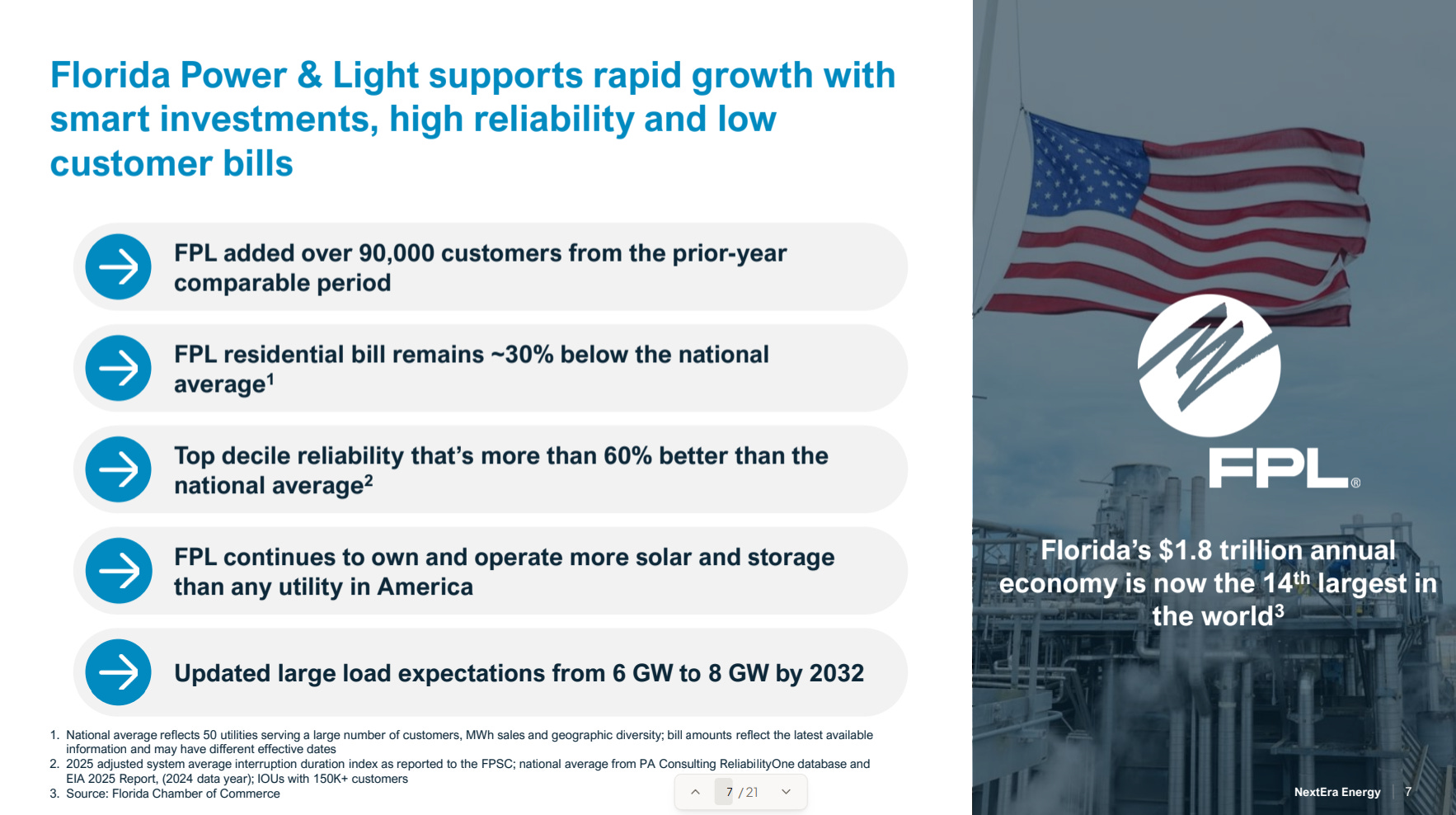
100,000 new customers in the first quarter of 2026, per the company
90,000-plus more customers in the second quarter than a year earlier
Typical residential bill 30% below the national average, per the company
8.5 gigawatts of solar on the system
$12 billion to $13 billion of capital spending planned for 2026
Florida keeps growing, and every new house needs a meter.
And here’s what we get with NEER:
35.1 gigawatts of contracted projects waiting to be built, its backlog, as of June 30
13.5 gigawatts added to that backlog in 2025, a record for the fourth year running
7.2 gigawatts of new renewables placed in service in 2025
A 25-year contract with Google to restart the Duane Arnold nuclear plant in Iowa, back online no later than the first quarter of 2029
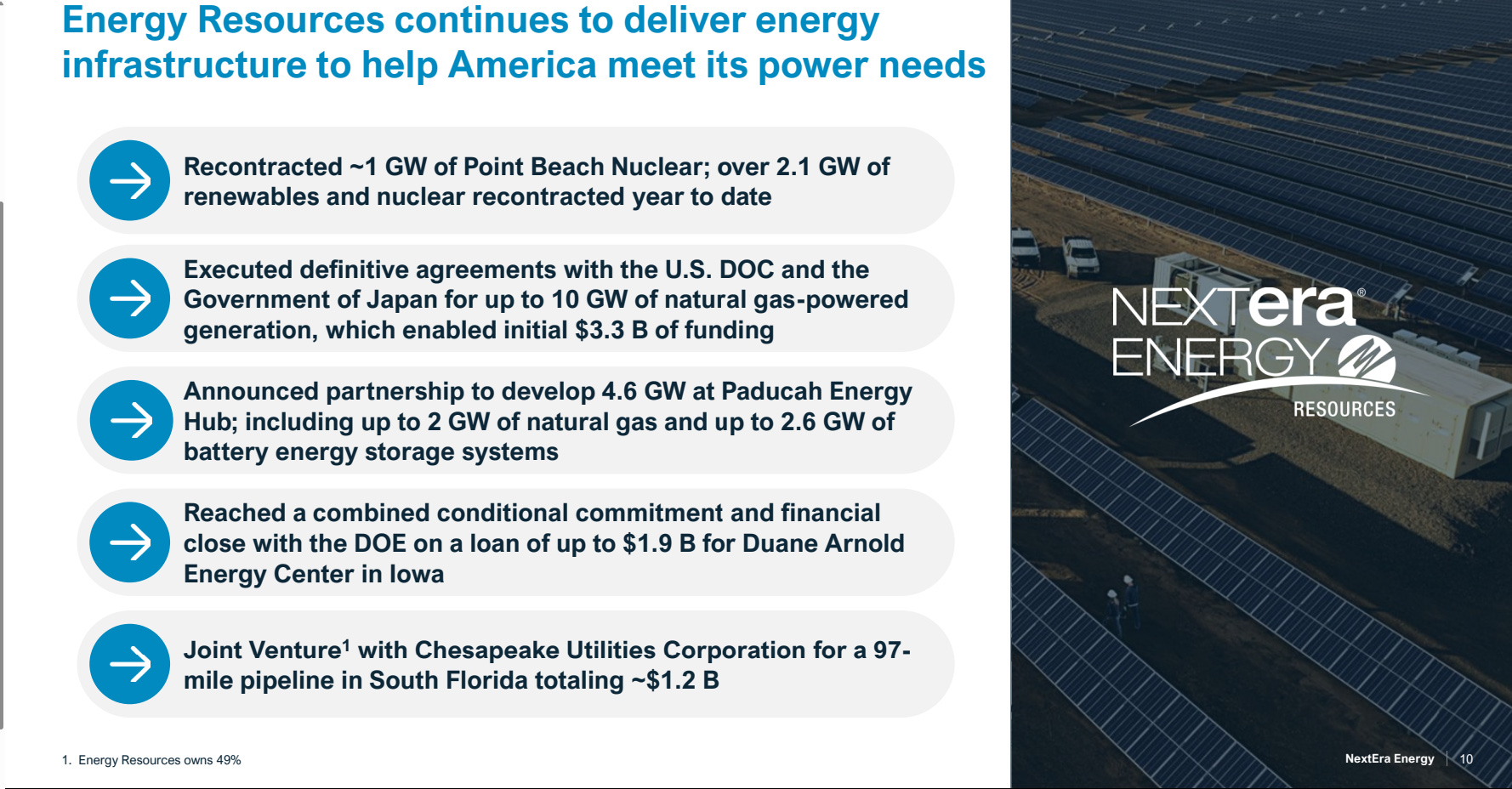
Then there’s the new stuff, and we’ve covered some of it before. In December, NEE signed deals with Google for three data center campuses with power plants attached, with Meta for 2.5 gigawatts of solar, and with Exxon for a 1.2-gigawatt gas plant with carbon capture. In August, as we covered on August 27, it locked in the first $3.3 billion of a gas build in Texas and Pennsylvania funded through Japan’s US investment commitment.
So we have a company that built its name on wind and solar now building gas plants and restarting nuclear reactors. Why the shift?
Two reasons. Data centers want power around the clock, which the sun and wind can’t promise. And the 2025 tax law cuts off the wind and solar credits for projects that start construction after July 4, 2026, unless they’re running by the end of 2027.
NextEra says it safe-harbored its pipeline through 2029. After that, the renewables business runs without its subsidy, and the company wants other legs to stand on. Smart planning if you ask me.
Regulated utilities 101: how rate base becomes earnings
Before we can judge NextEra’s dividend, we need to know how a regulated utility earns its money. It’s different from almost every other business we cover, and it explains most of what we see NextEra doing.
A normal company earns what customers are willing to pay. A regulated utility earns what the regulator allows it to earn. Florida Power & Light is a monopoly in its territory, so nobody else can run power lines to your house. In exchange, the Florida Public Service Commission, the PSC, decides what FPL can charge.
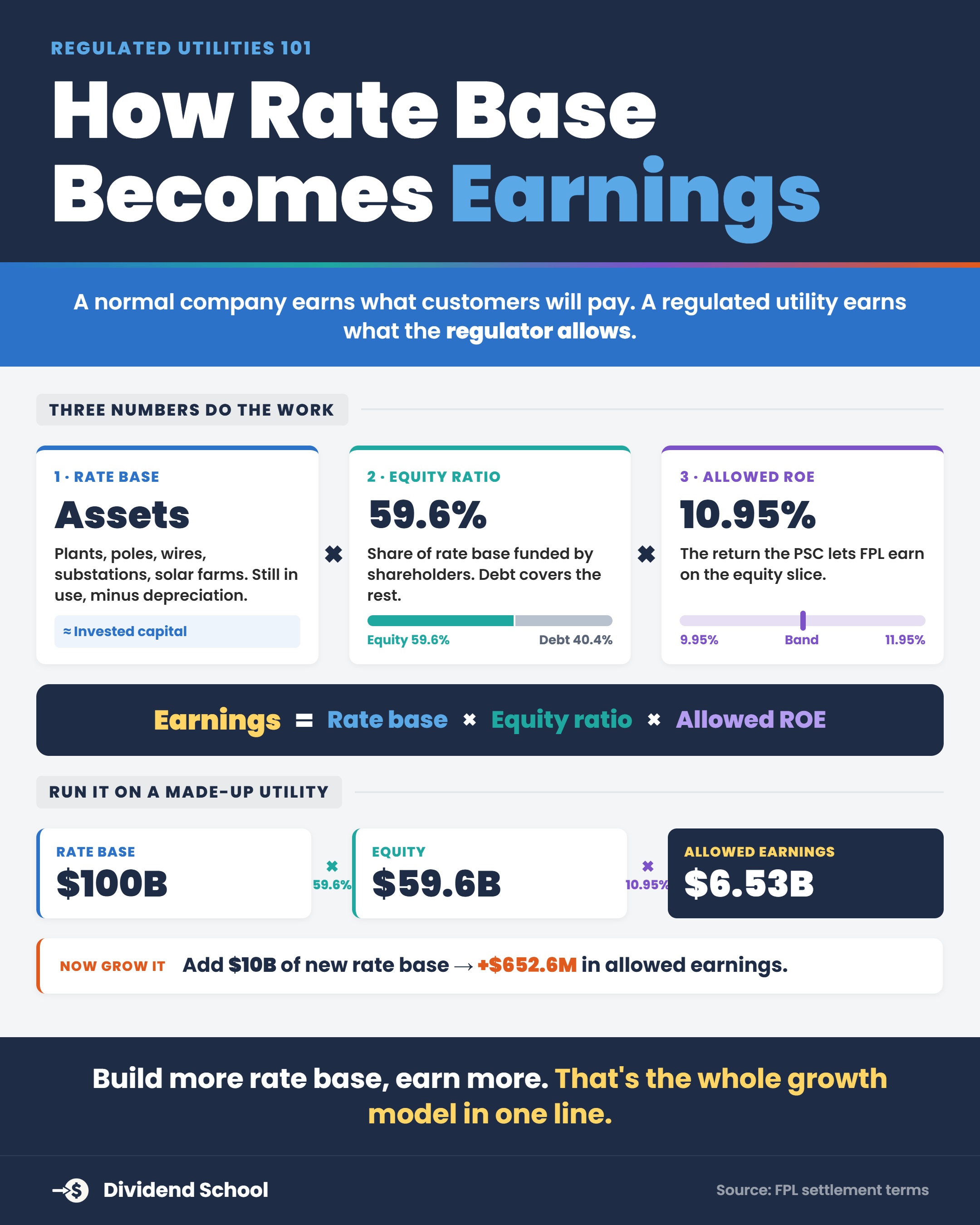
The PSC doesn’t set prices the way a store does. It sets a return. Three numbers do the work:
Rate base. Everything the utility has built and still uses (power plants, poles, wires, substations, solar farms), minus depreciation. FPL calls it “regulatory capital employed.”
Equity ratio. The share of that rate base funded with shareholders’ money, with debt covering the rest. FPL’s is 59.6%.
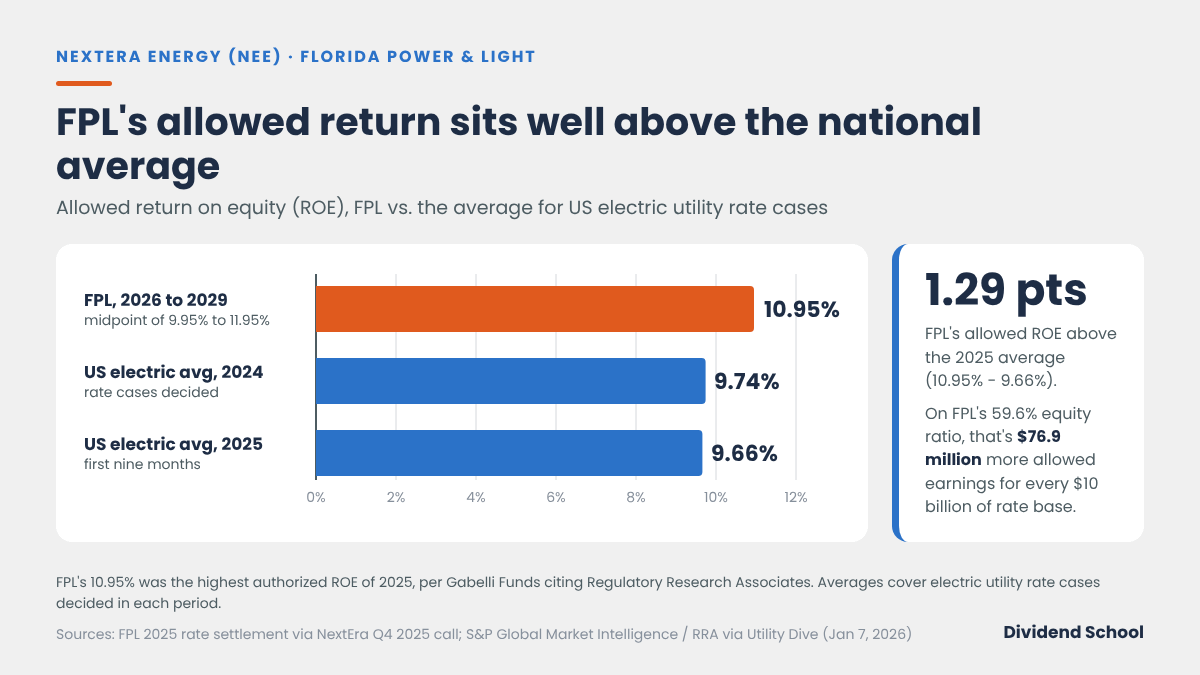
Allowed return on equity, the ROE. The return the regulator lets FPL earn on the equity slice. FPL’s is 10.95%, inside a band of 9.95% to 11.95%.
For those of us used to analyzing normal companies, rate base is the utility’s version of invested capital, and allowed ROE is a ceiling on return on equity that the regulator writes into the rates. Multiply the three together, and we get a good idea of the earnings the utility is allowed to make:
Earnings = rate base x equity ratio x allowed ROE
Let’s run it on a made-up $100 billion rate base, using FPL’s terms:
$100 billion x 59.6% = $59.6 billion of equity
$59.6 billion x 10.95% = $6.53 billion of allowed earnings
Now let’s add $10 billion of new rate base. The same math gives $652.6 million more in allowed earnings. That’s the whole growth model in one line.
So what does that tell us?
A regulated utility grows earnings by growing rate base. Every new substation, every new solar farm, every hardened power line, once the regulator approves it, becomes part of the base the utility earns on. That’s why utilities spend so heavily, and why their earnings move so predictably.
Here’s how fast FPL’s rate base has been growing:
2025: 8.1% growth
Q1 2026: 8.8% growth from a year earlier
Q2 2026: 9.3% growth from a year earlier
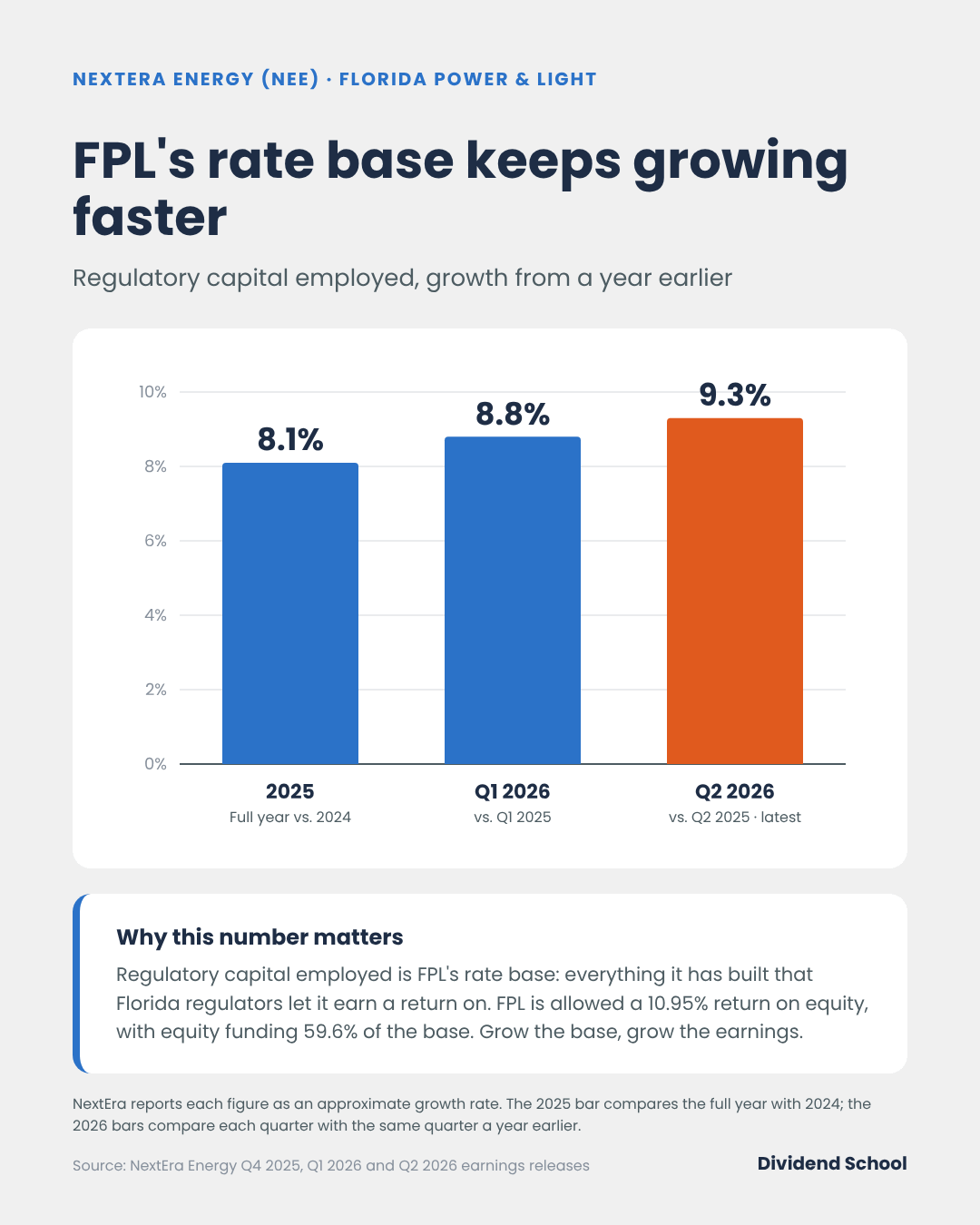
Plenty of utilities would love those numbers, and so do we. Florida keeps adding customers, and they all need power.
The catch, and it’s a big one: the regulator also has to protect customers. Every dollar of rate base shows up on somebody’s power bill. So a utility lives or dies by its relationship with its regulator.
FPL’s current deal is a four-year settlement the PSC approved on November 20, 2025, running through 2029. The terms:
Allowed ROE of 10.95%, band of 9.95% to 11.95%
Equity ratio of 59.6%
Base rate increases of $945 million in 2026 and $766 million in 2027
A rate stabilization mechanism of $1.5 billion, a cushion FPL can draw on to keep earnings inside the band when costs or weather move against it
A four-year deal means FPL, and we as owners, know the rules until 2029.
Not everyone liked it. Florida’s Office of Public Counsel, which represents customers, and three advocacy groups appealed the settlement to the Florida Supreme Court after the PSC turned down their request to reconsider in April. The case is still open.
Should that worry us?
Some. The Florida Supreme Court has heard this case before. It sent FPL’s 2021 settlement back to the PSC once, asking for a better explanation, and the PSC approved it again. A remand would delay things more than it would undo them. That’s my read.
Three questions we ask about any regulated utility, NextEra included:
How fast is the rate base growing, and does the regulator keep approving the spending?
What ROE and equity ratio does the regulator allow, and for how long?
How do customer bills compare to neighbors’ bills? A utility with cheap bills has room to grow. A utility with expensive bills has a regulator about to say no.
FPL scores well on all three. We’ll come back to the third one when we get to Virginia in section 9.
4. How NextEra makes money
NextEra reports three segments. FPL, NEER, and a Corporate & Other line that mostly holds the interest on debt borrowed at the parent company.
Here’s 2025, from the fourth-quarter release:
FPL net income: $5,012 million, $2.42 a share
NEER adjusted earnings: $3,523 million, $1.70 a share
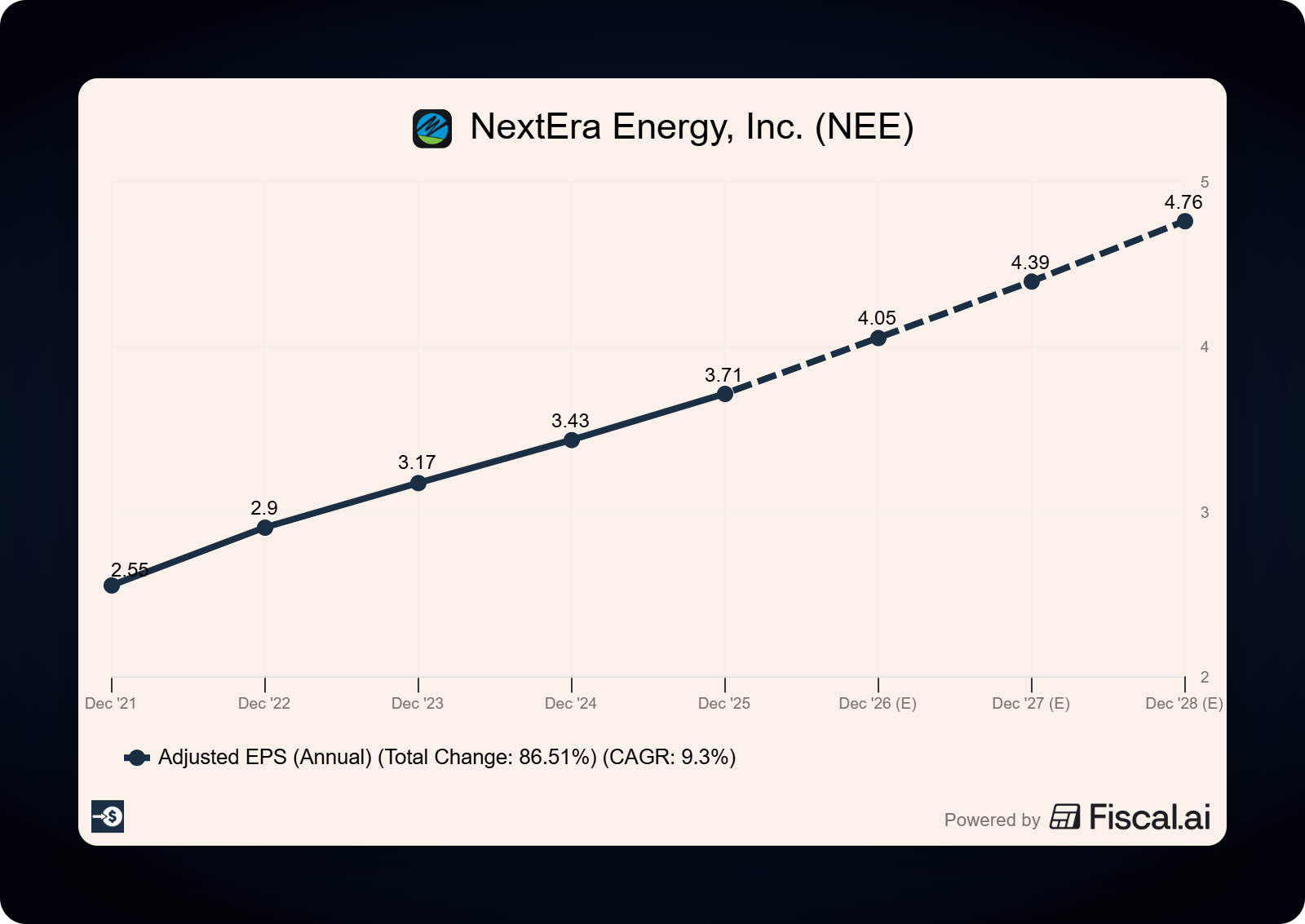
Total adjusted earnings: $7,683 million, $3.71 a share
FPL is the bigger half by earnings, and it’s the half we lean on. Its $5,012 million is 65.2% of the $7,683 million total. The two segments add up to more than the total because the corporate line subtracts from both.
FPL makes money on the rate-base math we just walked through, and NEE is where we see the deal-making.
NEER makes money on contracts. It signs a long-term deal to sell power at a fixed price, builds the project, and collects. Those contracts are getting better for us: NEE said on its second-quarter call that it recontracted older projects at $20 per megawatt-hour above recent pricing, on 15-year terms.
Why do NextEra’s GAAP and adjusted earnings differ so much?
NEE hedges a lot of its power sales and fuel costs. Some of those hedges don’t qualify for hedge accounting, so every quarter they’re marked to market, and the gain or loss lands in GAAP net income even though nothing changed in the business.
The company also holds investment funds to pay for shutting down its nuclear plants someday (decommissioning, in the filings), and those funds’ gains and losses run through GAAP too. Adjusted earnings strip both out.
In the second quarter, the swing went one way. In 2025 it went the other.
Q2 2026 GAAP EPS: $1.50
Q2 2026 adjusted EPS: $1.15
2025 GAAP EPS: $3.30
2025 adjusted EPS: $3.71
Management gives its guidance in adjusted earnings, so that’s the number we use. I check the GAAP line every quarter anyway, because a gap that keeps going one direction is a gap worth asking about. This one goes both ways.
Here are our headline results:
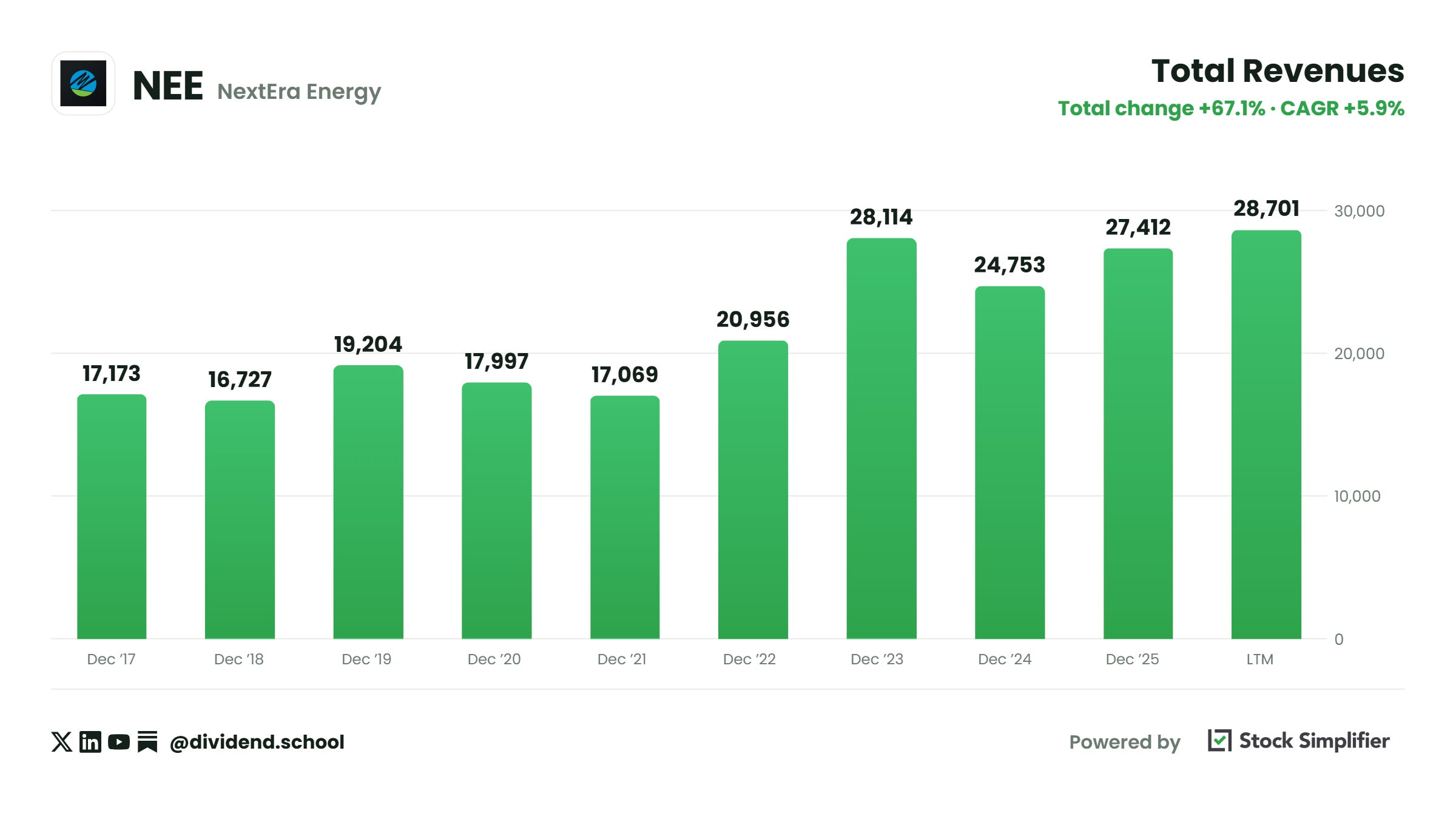
2025 revenue: $27,412 million, up 10.7% from $24,753 million
2025 adjusted EPS: $3.71, up 8.2% from $3.43
Q2 2026 revenue: $7,534 million, up 12.4% from $6,700 million
Q2 2026 adjusted EPS: $1.15, up 9.5% from $1.05
First half 2026 adjusted EPS: $2.24, up 9.8% from $2.04
2026 guidance: $3.92 to $4.02 adjusted EPS, with management targeting the high end
9.8% growth in the first half, from a utility. Not bad for a “boring” business.
5. The moat and the competition
NextEra gives us two moats, one for each part of the business.
FPL’s moat is the law. It holds the franchise to deliver power across most of Florida, and nobody else is allowed to string wires to those houses. Competition inside the territory is close to zero. The only real competitor is a homeowner putting solar panels on the roof, and so far that’s been a slow leak.
NEER’s moat is size. Building wind, solar, and batteries at scale needs land, permits, transmission access, turbine and panel supply, tax equity partners, and a balance sheet that can fund it all. NEER has 35.1 gigawatts of contracted projects in line and turbine slots reserved with GE Vernova for 4 gigawatts of gas plants. A smaller developer can’t buy that kind of position, and we don’t expect one to. The tax credit phase-out widens the gap. NextEra says it’s safe-harbored through 2029, and Ketchum has said smaller developers will struggle with the earlier deadlines.
Who does NEER compete with?
Brookfield Renewable and AES on contracted renewables
Constellation on nuclear power for data centers
Other utilities, including Dominion until the merger closes, building their own generation
Does the moat show up in the returns?
2025 return on equity, GAAP: 12.5%
2025 return on equity, adjusted: 14.1%
FPL’s allowed ROE: 10.95%
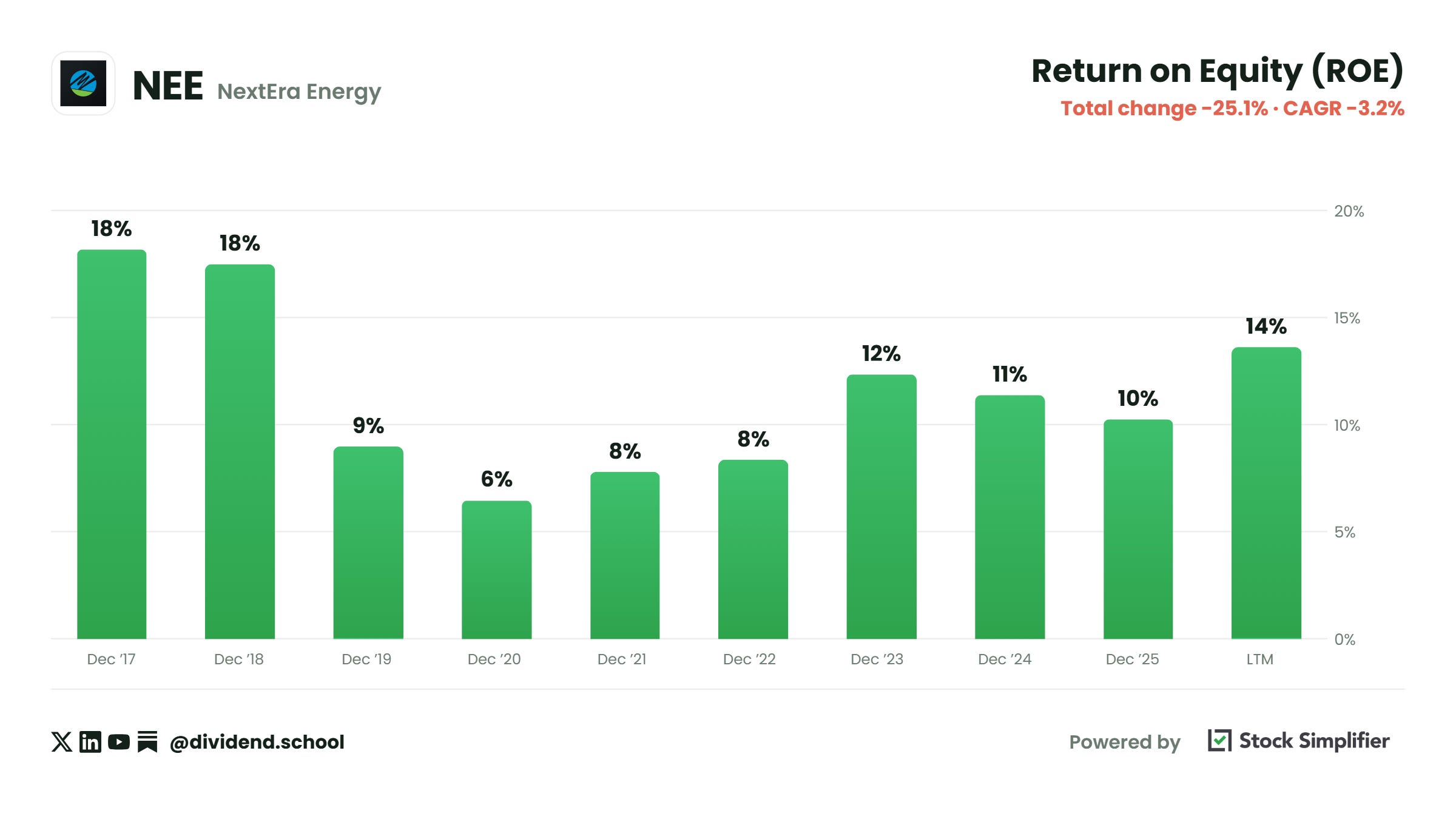
Double-digit returns on equity for a utility, year after year, is what we want a moat to look like in this industry. We used year-end equity figures, so they run a touch low against an average.
6. The financials
Is this a high-quality business? We use four questions to answer that question.
Is it growing?
Revenue: $24,753 million in 2024, $27,412 million in 2025, up 10.7%
Adjusted EPS: $3.43 in 2024, $3.71 in 2025, up 8.2%
First half 2026 adjusted EPS: up 9.8%
Does it generate cash?
Yes, and it spends every penny of it and then some. Here’s what we found:
2025 operating cash flow: $12,485 million, down from $13,260 million in 2024
2025 capital spending: $24,606 million (FPL $8,719 million, NEER $15,332 million, the rest corporate)
2025 free cash flow: negative $12,121 million
First half of 2026:
Operating cash flow: $7,276 million, up from $5,958 million
Capital spending: $19,118 million (FPL $5,780 million, NEER $13,338 million)
Free cash flow: negative $11,842 million
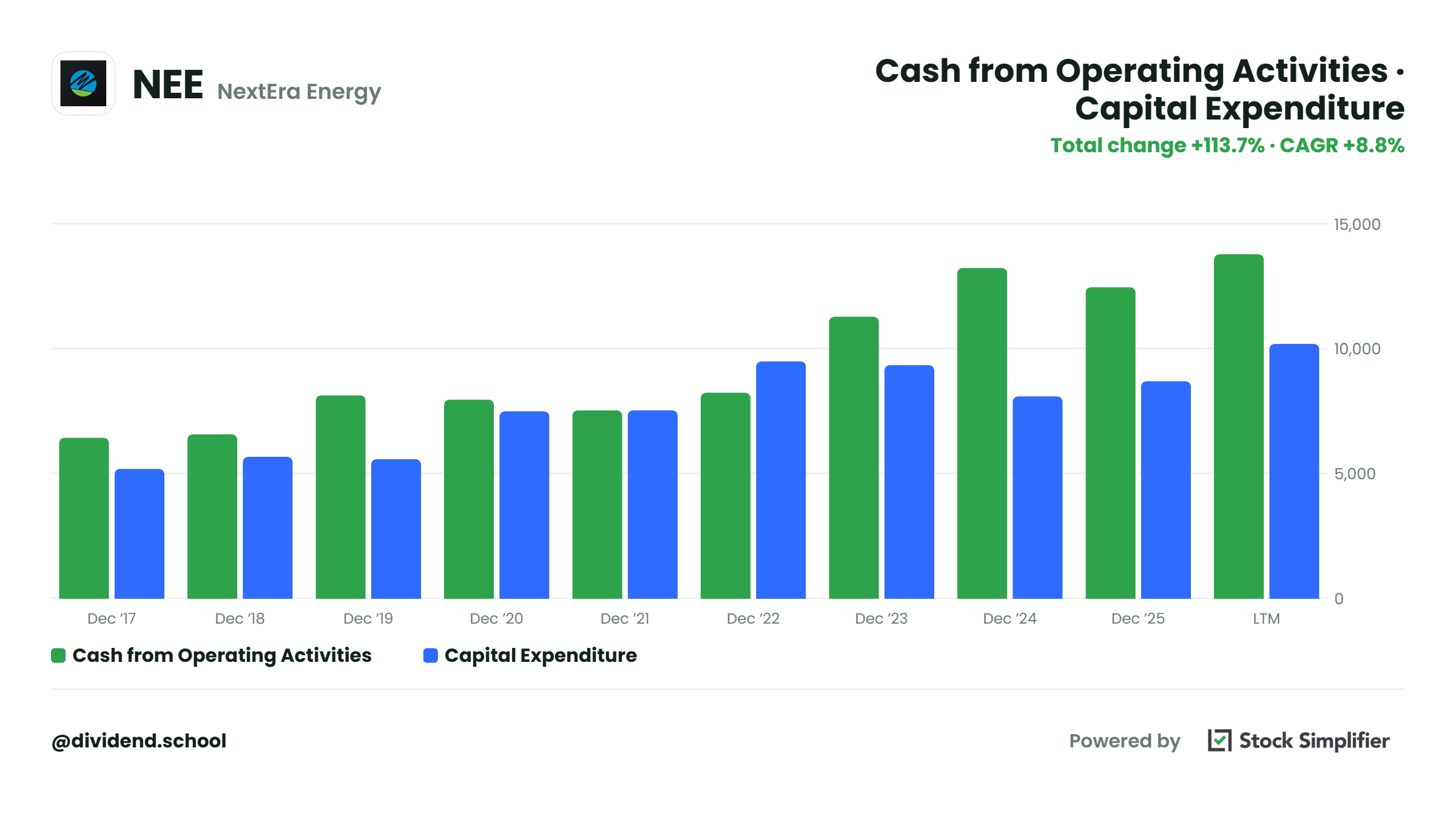
Six months in, NextEra has already spent 77.7% of last year’s full-year capital budget. That’s a lot of building.
Negative free cash flow sounds alarming to most of us. For a utility in a building cycle, it’s normal, and it’s the most important thing for us to understand about owning one. We dig into how the dividend gets paid in section 7.
How much debt?
Total debt at June 30, 2026: $110,197 million ($98,790M long-term + $5,413M current portion + $5,994M short-term)
Total debt at December 31, 2025: $93,056 million
Debt to equity: 1.93
2025 interest expense: $4,572 million
Operating cash flow covers interest 2.7 times ($12,485M / $4,572M)
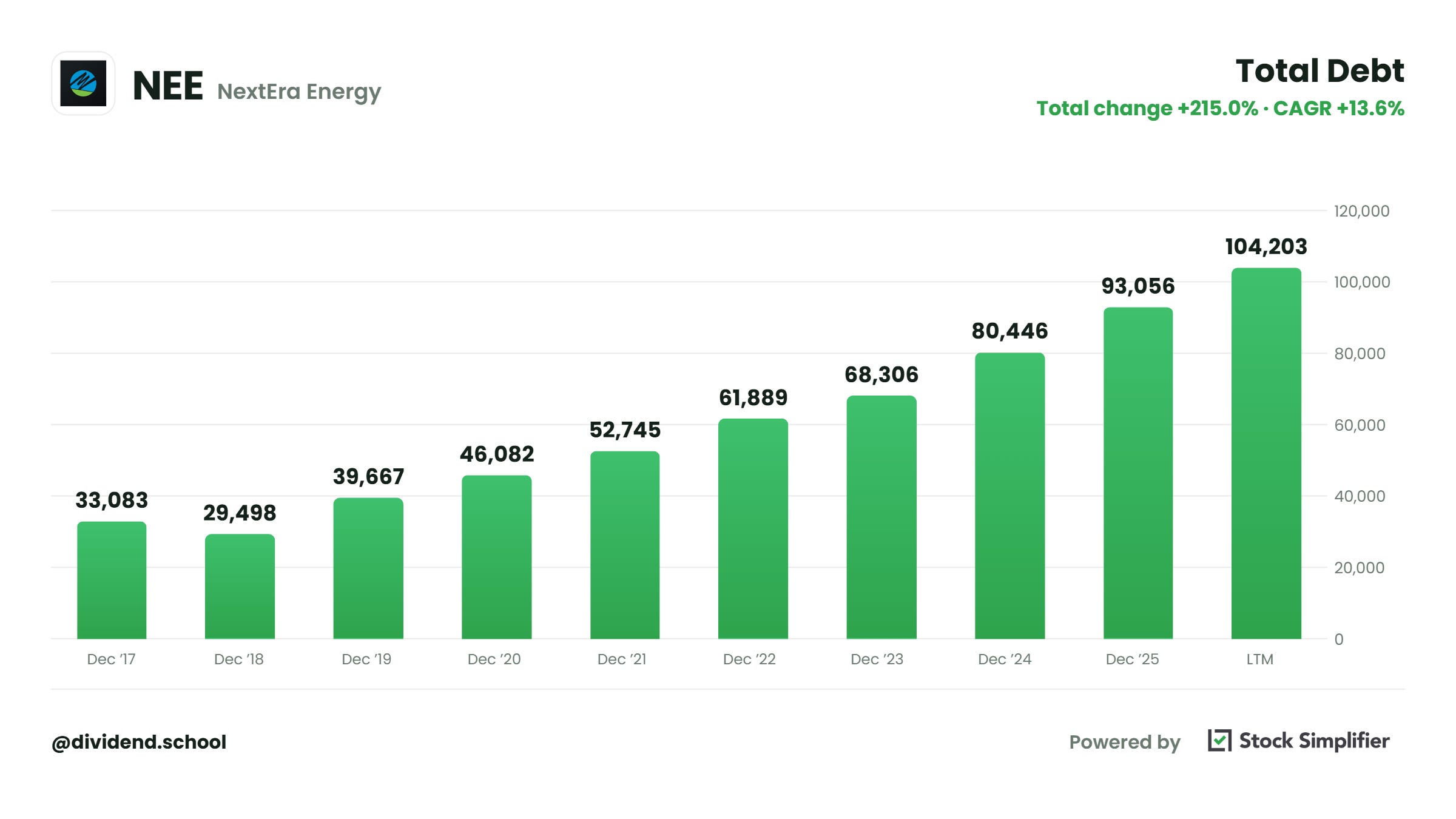
Debt grew $12.7 billion in six months. That’s the build-out we just saw hit the balance sheet.
What do the credit agencies say?
For a company that borrows to grow, this is the question we care about most, because borrowing costs depend on the rating. All three agencies affirmed NextEra on May 18, the day the Dominion deal was announced:
S&P: A-, stable
Moody’s: Baa1, stable
Fitch: affirmed, stable
S&P expects NextEra’s funds from operations to debt, its main health check for a utility, to dip to 14.5% in 2027 from 18%, then get back above 17% starting in 2028. After the merger closes, S&P will lower the line where it would consider a downgrade to 17% from 18%. So 2027 is the year for us to watch. Mark it on the calendar.
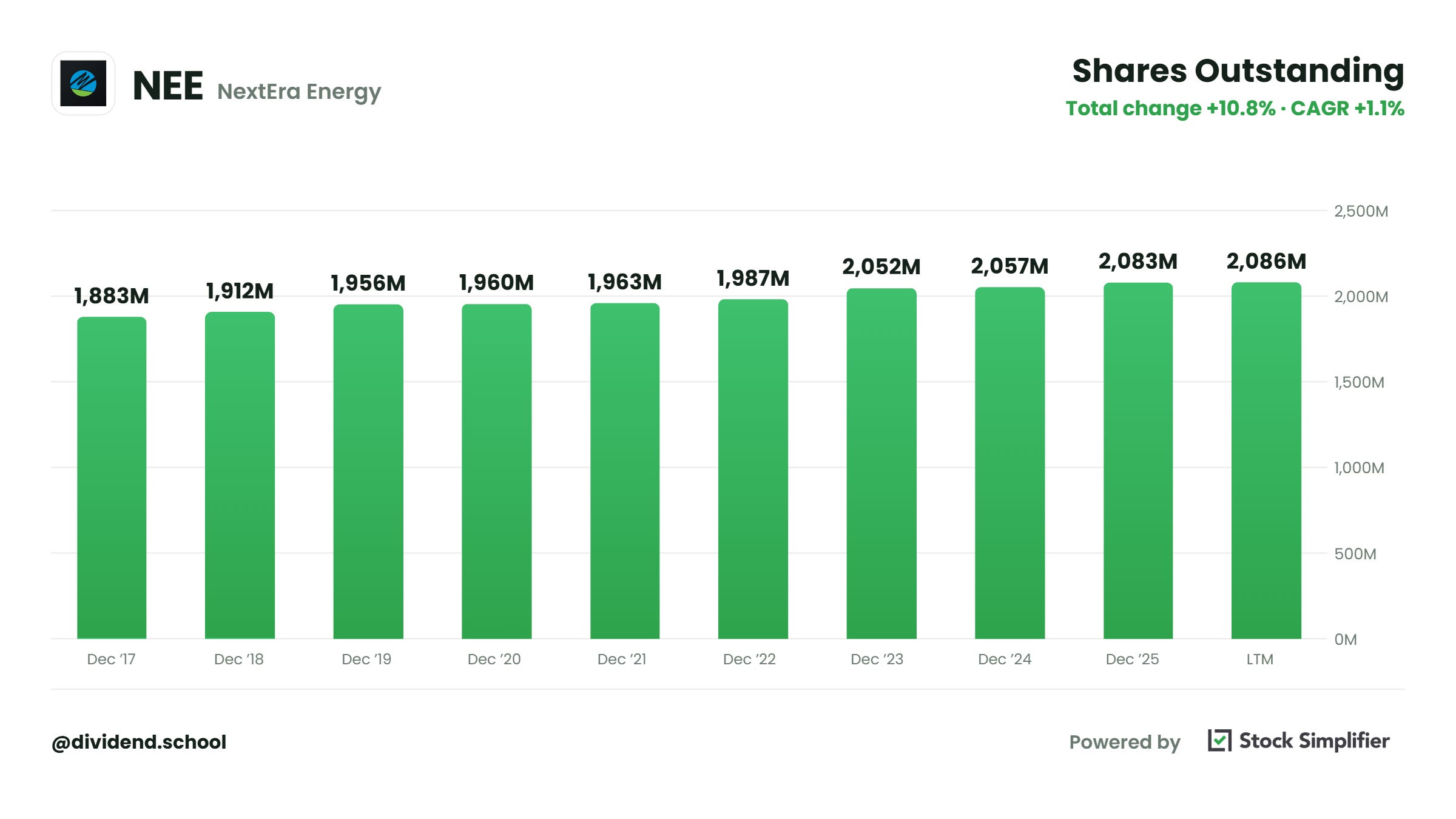
Share count. Diluted shares went from 2,071 million in 2025 to 2,093 million in the second quarter of 2026. NextEra issued $2,038 million of new stock and equity units in 2025. Steady, slow dilution (new shares) is part of how a utility funds itself, and we’ll need it for our dividend math.
Already a paid subscriber? Keep scrolling. The dividend safety read, the fair value, and the Buy Below price are below.
The rest of this deep dive is for paid Dividend School Pro subscribers.
That’s the business, free. How FPL earns its money, what NEER builds, where the cash goes, and how much they’ve borrowed to do it.
The part I can’t give away is what it all means for the dividend and the price. Below the line:
How a company with negative $12 billion of free cash flow pays a $4.7 billion dividend, and what the drop from 10% to 6% raises does to the payout ratio through 2028
What the Dominion deal costs NextEra shareholders, including the 716 million new shares and the Virginia fight that could push the decision into March
The fair value, three ways, the Buy Below price, and where NextEra sits against the $96.27 trigger on our Universe board today
Membership is $369 a year or $35 a month, and a 30-day money-back guarantee.