

There is no easy way to identify a moat. We need to use a combination of qualitative and quantitative methods (numbers and narrative).
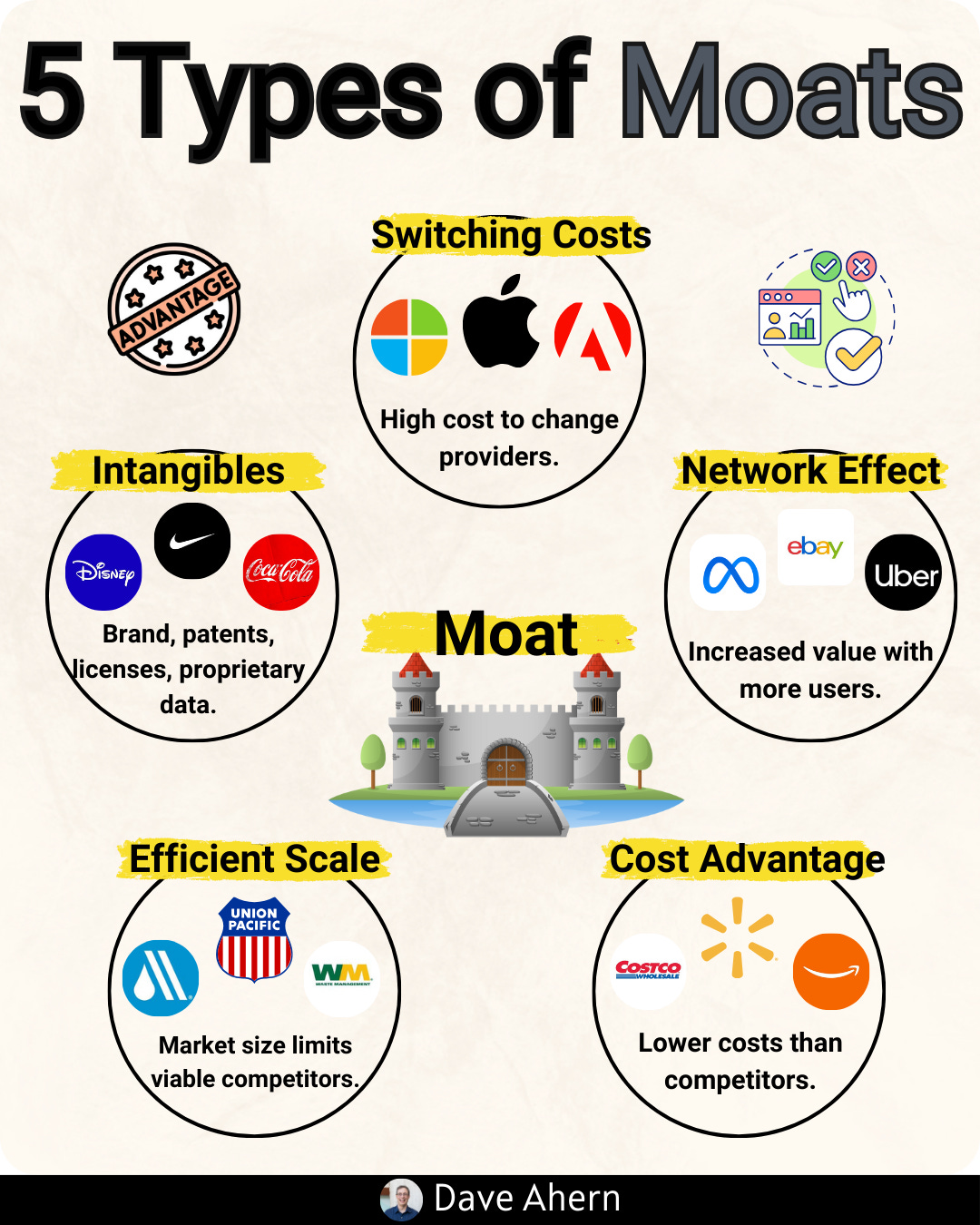
Here’s a step-by-step process to help you evaluate whether a company has a sustainable competitive advantage:
1. Analyze the Industry
Evaluate the competitive landscape. Is the industry highly competitive, or does it favor a few dominant players?
Identify barriers to entry. Are there significant costs, regulations, or other challenges that prevent new competitors from entering the market?
2. Evaluate Financial Metrics (Use 10k or Fiscal.ai)
Return on Invested Capital (ROIC): Companies with wide moats tend to generate high and consistent ROIC (above 15%) over 5-10 years.
Gross Margins: High gross margins indicate pricing power and cost efficiency. Warren Buffett loves gross margins > 40%, but look for industry averages and compare.
Free Cash Flow: Life blood of every company. Strong and consistent free cash flow suggests the company can reinvest in its moat and maintain its competitive position.
3. Examine Intangible Assets
Look for patents, trademarks, and proprietary technologies that give the company a unique edge.
Evaluate brand strength by considering customer loyalty, pricing power, and market share. Brand isn't always the strongest moat and can be breached, look at what's happening with Nike.
4. Assess Customer Stickiness
Determine whether customers face high switching costs. For example, does the company offer a product or service deeply ingrained into its customers’ operations or lives?
5. Study Management and Strategy
Evaluate the company’s leadership. Are they reinvesting in the business to strengthen the moat or prioritizing short-term gains? Study management's incentives; the strategy will follow closely behind.
Look for evidence of strategic decisions that expand the company’s competitive advantage. This sets managers apart, Satya Nadella, Mark Zuckerburg, Jensen Huang are great examples.
6. Look for Real-World Evidence
Identify examples of competitors failing to replicate the company’s success.
Check for regulatory situations or unique market positioning that protect the company from competition.
Real-World Examples of Moats
To illustrate these concepts, let’s look at a few companies with well-known moats:
Apple: Apple’s ecosystem of devices and services creates high switching costs, while its brand strength allows it to charge premium prices. Customers who own an iPhone are more likely to buy other Apple products, such as AirPods or a MacBook, reinforcing the moat.
Amazon: Amazon benefits from network effects and cost leadership. Its massive scale allows it to offer lower prices and faster delivery than competitors, while its Prime membership program creates customer loyalty.
Google: Google’s search engine and YouTube dominate the market due to its technological edge and data-driven advantages. Its advertising platform benefits from network effects as advertisers flock to the two largest global search platforms (Search and YouTube).
Coca-Cola: Coca-Cola’s brand strength and global distribution network create a durable moat. The company’s products are recognized and trusted worldwide, making it difficult for competitors to gain market share.
Nice Infografic … Just pay attention to the description under “Intangibles”… there is a mistake. Bye
Great breakdown of how to spot moats — really hits the essentials.
I find the hardest part is turning these qualitative insights into a repeatable process. That’s why I built a simple spreadsheet checklist that breaks down each moat factor into measurable criteria — things like ROIC thresholds, gross margin targets, and customer stickiness proxies.
It’s a no-nonsense tool DIY investors can use to evaluate stocks without getting overwhelmed by hype. Happy to share it if anyone’s interested — it’s helped me cut through the noise and focus on real competitive advantages.
Would love to hear how others measure moat strength in their investing.