

Software stocks had a rough 2026.
Every few weeks a new AI tool shows up, and investors start asking which business it eats next. The market has been selling first and asking questions later.
So where is the money going instead?
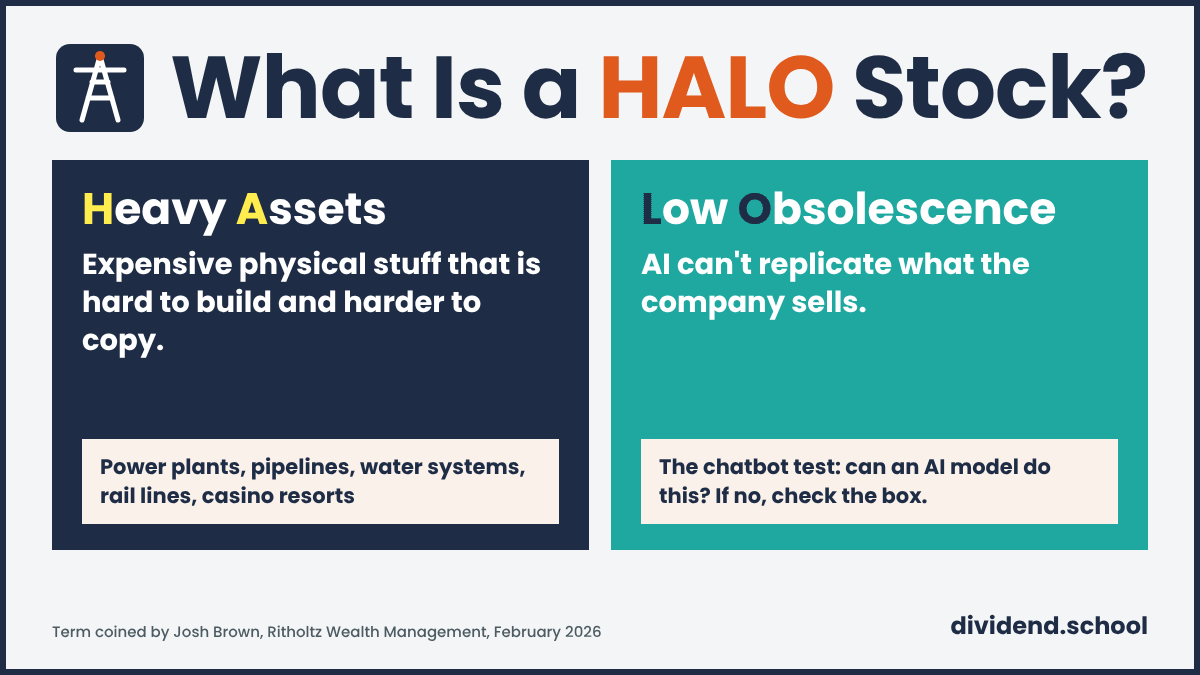
Josh Brown, the CEO of Ritholtz Wealth Management, gave the answer a name back in February: HALO. Heavy Assets, Low Obsolescence. The term stuck. Goldman Sachs published a research framework around it 16 days later, and by May there were ETFs named after it.
HALO describes something dividend investors have quietly owned for decades. Pipelines, water mains, power plants, and casinos on the Las Vegas Strip. Boring stuff that throws off cash.
In today’s post, we will discuss:
What HALO Stocks Are
Why HALO Matters for Dividend Investors
How to Find HALO Stocks
The Catch: Heavy Assets Eat Cash
Five HALO Dividend Stocks Worth a Look
How to Use HALO in Your Process
Okay, let’s dive in and learn what makes a HALO stock.
What HALO Stocks Are
HALO has two halves, and a company needs both.
Heavy assets. The business runs on expensive physical stuff that is hard to build and harder to copy. Think power plants, pipelines, rail lines, and hotels. A competitor would have to spend billions (plus get the permits) to match it.
Low obsolescence. What the company sells isn’t going away when the next chatbot ships. Brown’s own test is simple: can an AI model replicate what this company sells? If the answer is no, that’s a check in the box.
A few quick examples:
Electricity: HALO. A chatbot needs more of it, not less.
Drinking water: HALO. AI can’t make a glass of water.
A casino resort on the Strip: HALO. People fly to Vegas to be there in person.
Payroll software: not HALO. Light on assets, and squarely in AI’s crosshairs.
The opposite of HALO is the asset-light business.
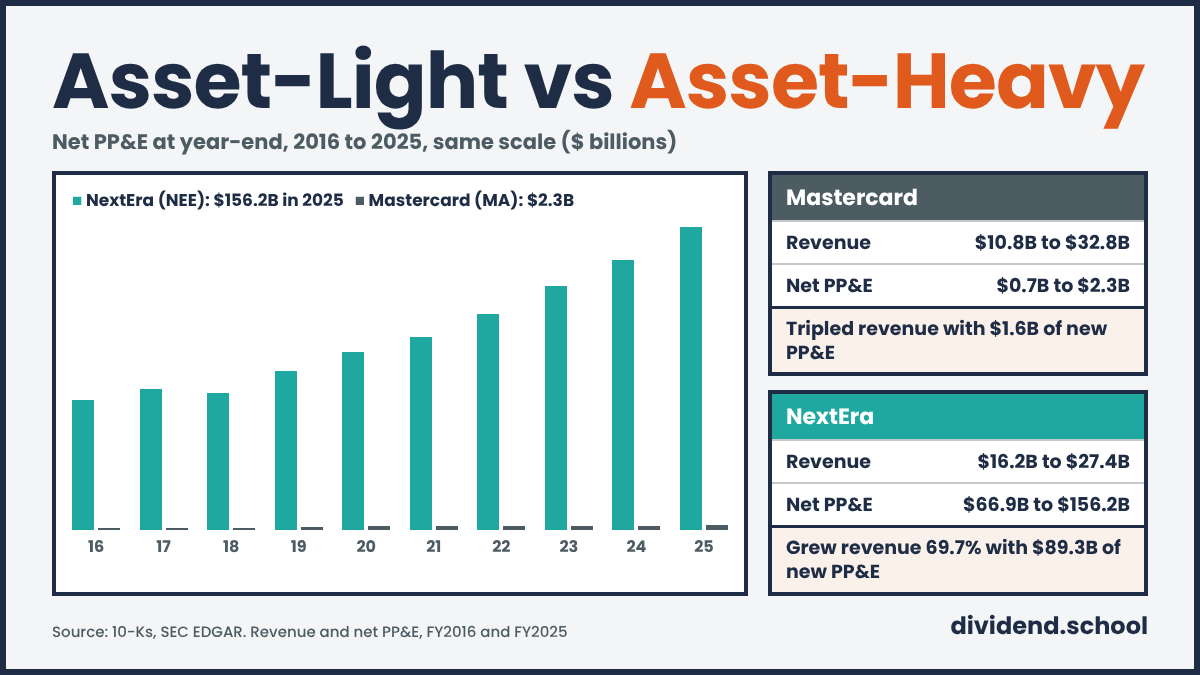
For the last 15 years, asset-light was the thing we all wanted. Software and payment networks needed almost no capital to grow, so more cash flowed to shareholders. I own plenty of them myself (Mastercard and Microsoft, for starters).
HALO flips that on its head. When AI makes it cheaper to copy a digital product, the things that are expensive to copy start to look valuable again.
Why HALO Matters for Dividend Investors
Why should a dividend investor care about a Wall Street buzzword?
Because the heavy-asset world is where a lot of our dividends already come from. Three reasons HALO and dividends fit together:
Long-lived assets produce steady cash. A water main stays in the ground for decades. A pipeline under contract collects fees whether oil prices go up or down.
Many of them are regulated or contracted. Utilities earn an allowed return set by regulators, and REITs sign leases that run for decades. Predictable cash is what a dividend needs.
The moat is physical. Nobody builds a second water system next to American Water’s in the same town.
Low obsolescence matters for the dividend too.
A company that might not exist in ten years is a terrible dividend stock, no matter what it yields today. So HALO really asks a question we already care about. Will this business still be paying us in 2036?
In our November 7 Pro issue, we ranked 10 AI-proof dividend stocks. Three were free. The other seven, including the one I ranked #1, sit behind the wall with the numbers that put them there.
If you already have your own list of AI-proof names and the filings to back it up, you don’t need it. If you have been meaning to build one, it’s done.
How to Find HALO Stocks
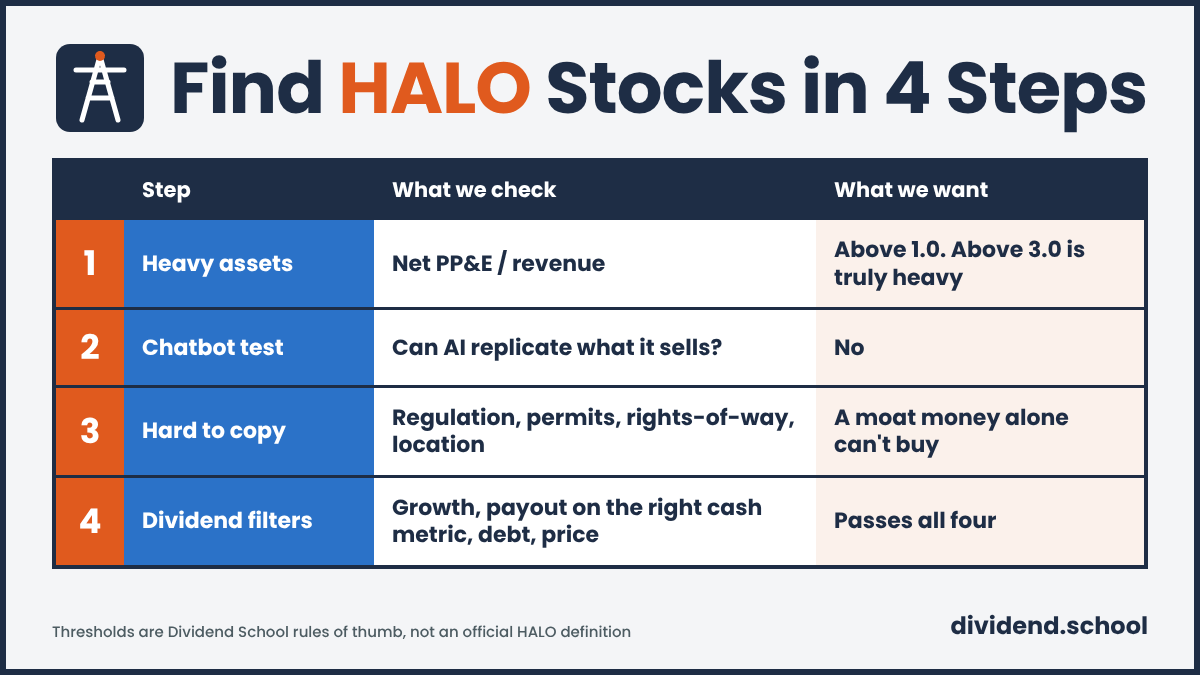
Is there an official HALO list? No. The term spans sectors and doesn’t fit the usual buckets like growth or value, so we build our own screen. Four steps.
Step 1: Measure How Heavy the Assets Are
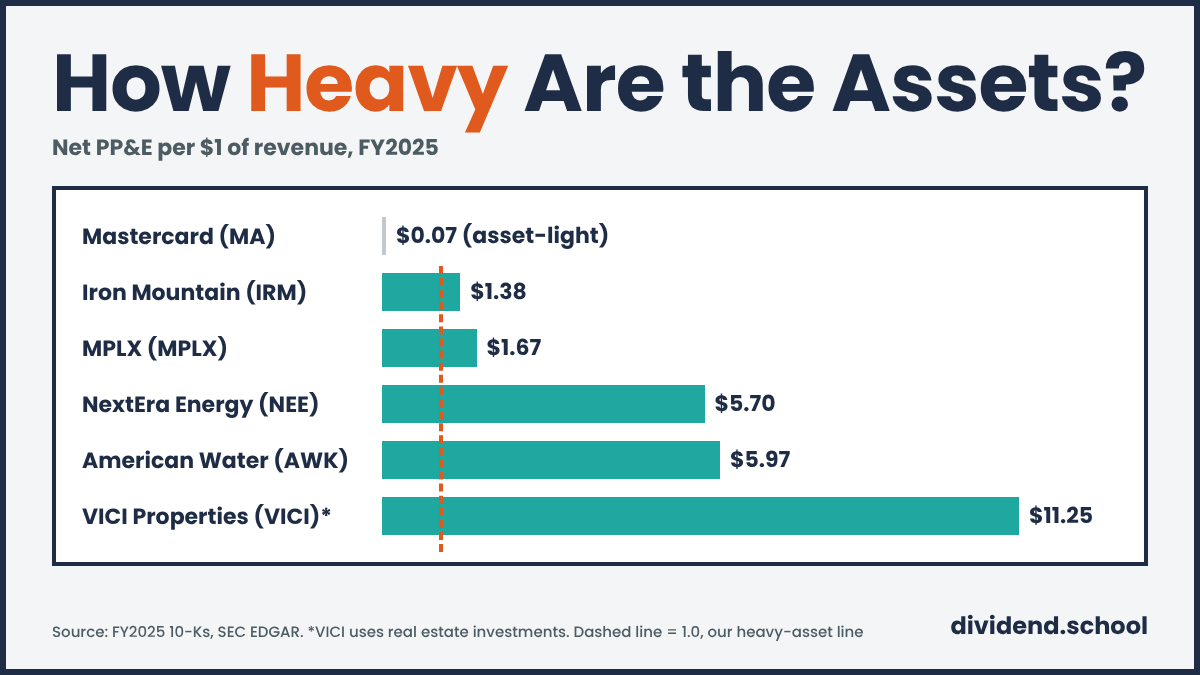
The cleanest way I know is to compare a company’s physical assets to its sales. On the balance sheet, that is property, plant, and equipment (PP&E), net of depreciation. For a REIT, use its real estate investments.
Then divide by revenue:
Heavy-asset ratio = net PP&E / revenue
Let’s run two companies through it, using their 2025 10-Ks.
Mastercard:
Net PP&E: $2.3 billion
Revenue: $32.8 billion
Ratio: 0.07 ($2.303B / $32.791B)
Mastercard owns 7 cents of hard assets for every dollar it brings in. That’s about as asset-light as it gets.
NextEra Energy:
Net PP&E: $156.2 billion
Revenue: $27.4 billion
Ratio: 5.70 ($156.197B / $27.412B)
NextEra owns $5.70 of power plants, transmission lines, and poles for every dollar of revenue. Big difference.
My rule of thumb: a ratio above 1.0 gets a company into the heavy-asset conversation. Above 3.0 and it’s truly heavy.
Step 2: Run the Chatbot Test
Ask Brown’s question. Can an AI model replicate what this company sells?
Be honest here. A trucking company is heavy on assets, but self-driving trucks are a real long-term threat. Airlines are heavy too, and famously bad for shareholders. Heavy alone isn’t enough.
We want products people will need in the physical world for as long as we hold the stock. Power, water, fuel moving through pipes, buildings people want to be in.
Step 3: Check What Makes the Assets Hard to Copy
This is the moat question. The best HALO companies have something a competitor can’t buy with money alone:
A regulated territory (utilities)
Rights-of-way and permits (pipelines, rails)
Irreplaceable locations (the Las Vegas Strip)
Decades of customer relationships and switching costs (records storage)
Step 4: Apply Our Dividend Filters
HALO gets a company onto our list. From here, every name still runs through the same checks we use on any dividend stock:
Dividend growth over the last five years
Payout ratio, measured on the right cash metric for the business
Debt load and the balance sheet
Valuation, so we don’t overpay
So what is the catch?
The Catch: Heavy Assets Eat Cash
Heavy assets are expensive to own.
Pipes rust. Power plants need upgrades. Every one of those costs shows up as capital expenditures (capex), and capex comes out of the same cash pile that pays our dividend.
Let’s look at what three of the companies below did in 2025, from their 10-Ks:
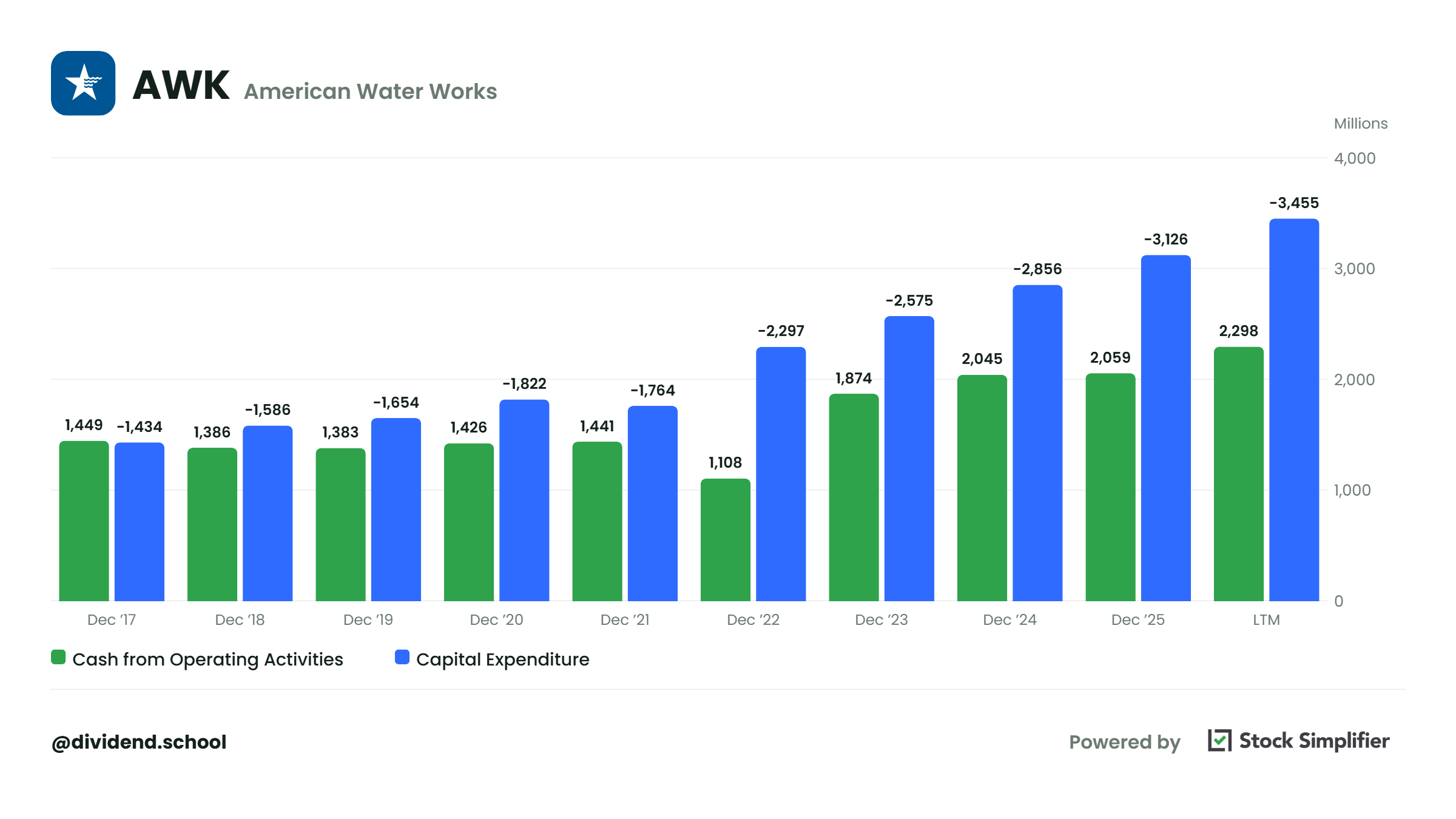
American Water Works:
Operating cash flow: $2.06 billion
Capex: $3.13 billion
Free cash flow: -$1.07 billion
Dividends paid: $633 million
Iron Mountain:
Operating cash flow: $1.34 billion
Capex: $2.27 billion
Free cash flow: -$932 million
Dividends paid: $919 million
MPLX:
Operating cash flow: $5.91 billion
Capex: $1.81 billion
Free cash flow: $4.10 billion
Distributions paid: $4.02 billion
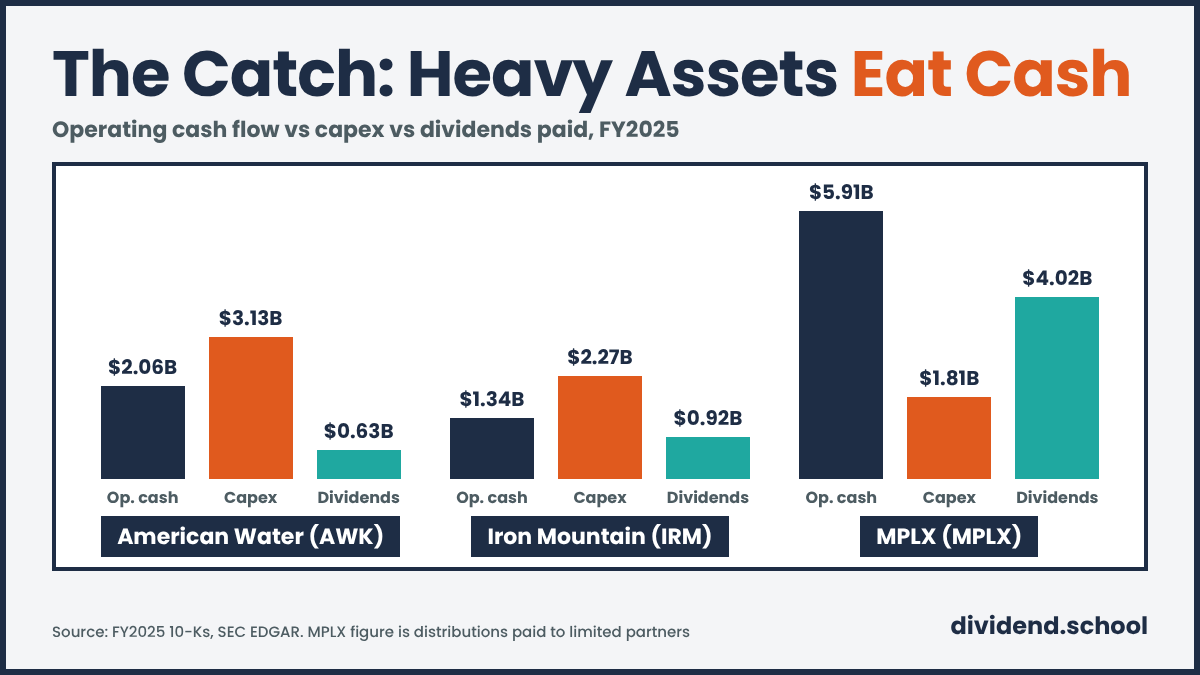
Two of the three spent more on capex than they brought in from operations; that’s a lot of cash going out the door. So how do they pay a dividend at all?
They borrow, and they issue stock. For a regulated utility like American Water, that’s the business model. Build the pipes, add them to the rate base, and earn an allowed return on them for decades. Same story at NextEra, which spent $23.9 billion on investing activities in 2025.
That works as long as the investments earn more than the money costs. When interest rates rise, the math gets harder for every company that funds growth with debt, and HALO companies fund a lot of growth with debt. A durable business and a safe dividend are two separate questions, and we have to answer both.
Which payout ratio do we use, then? It depends on the type of company:
Utilities: payout ratio on earnings per share, with an eye on the debt.
REITs: AFFO payout ratio. AFFO is the REIT equivalent of free cash flow.
Pipelines (MLPs): distribution coverage on distributable cash flow (DCF), which is the MLP’s version of free cash flow. Coverage of 1.2x or better means the distribution is paid with room to spare.
This is the math we run on every company in Dividend School Pro. Payout on the right cash metric, the debt, the capex bill, and then a Buy Below price so we know what we are willing to pay. Every name in our Universe gets one.
Five HALO Dividend Stocks Worth a Look
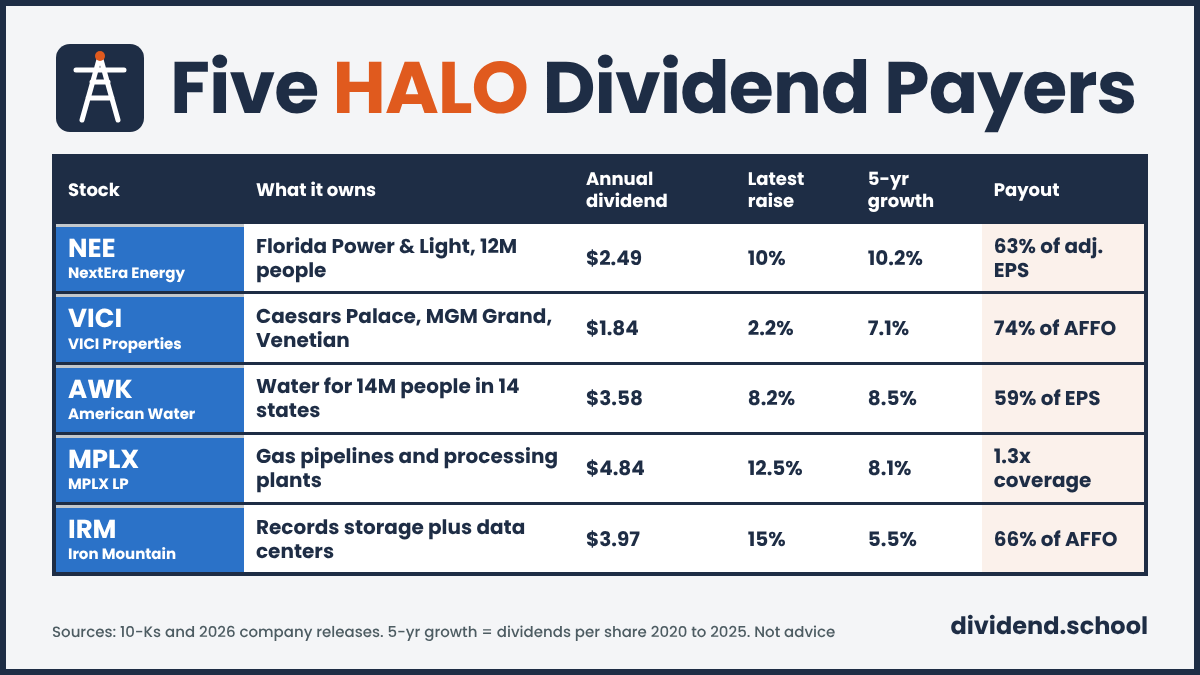
Here are five companies that pass the HALO test and pay a growing dividend. Two come from our Dividend Universe, and three are new names I have been digging into.
Quick disclosure up front: I own NextEra and VICI personally.
1. NextEra Energy (NEE)
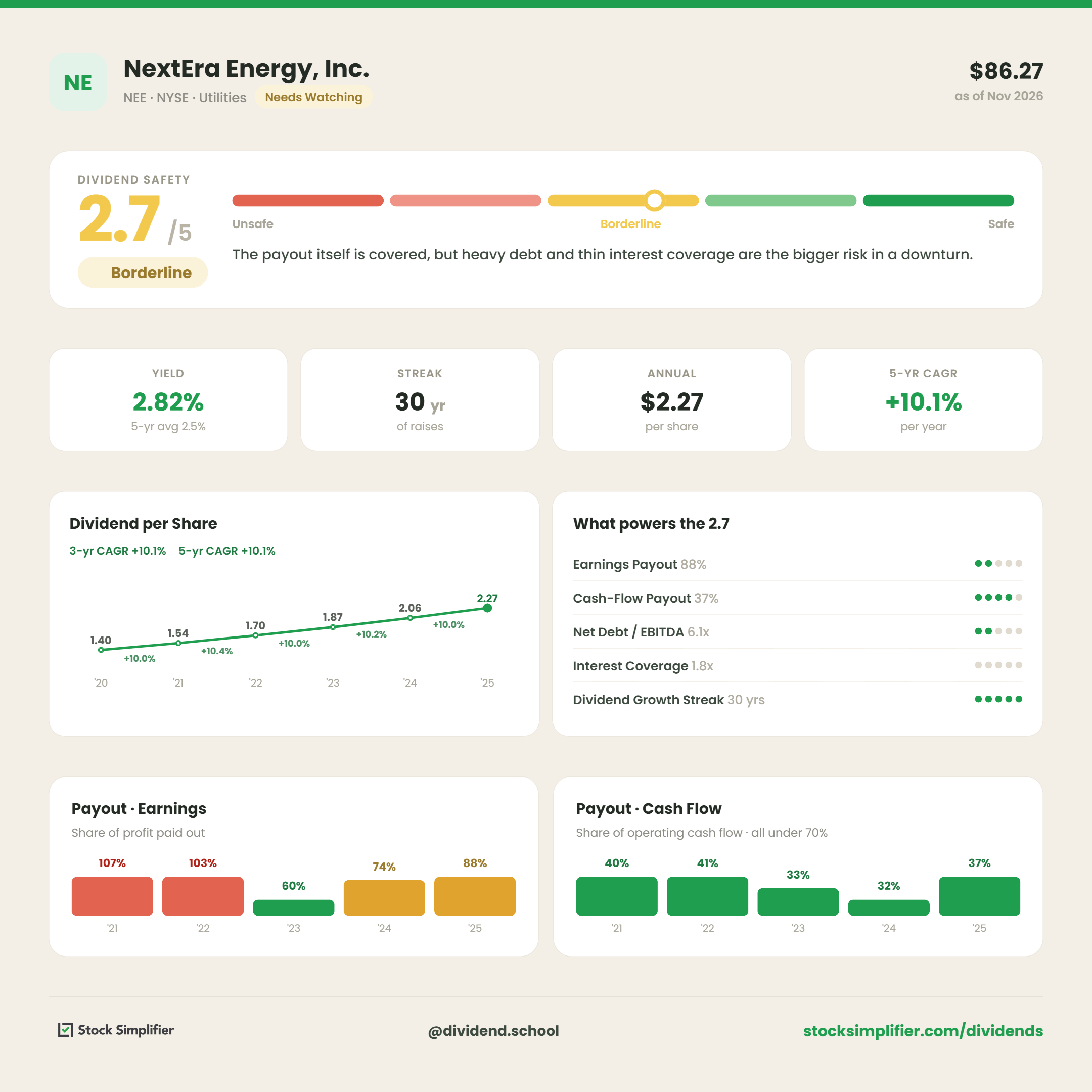
NextEra owns Florida Power & Light, the largest electric utility in the US, serving 12 million people. It also owns NextEra Energy Resources, the largest energy infrastructure developer in the country, with a big book of wind, solar, and battery storage projects.
The HALO case is easy. Every new data center adds to the demand for electricity. NextEra raised its target for large new power customers in Florida (think data centers) to 8 gigawatts by 2032.
The dividend:
Quarterly dividend: $0.6232 or $2.49 annualized
Yield: 2.9%
2026 raise: 10%
Five-year growth: 10.2% a year
Payout: 62.8% of the 2026 adjusted EPS guidance midpoint
One heads-up. Management guided dividend growth down to 6% a year from the end of 2026 through 2028, and the pending Dominion Energy deal adds a lot of moving parts.
Steady as they go, just a little slower from here. NextEra is in both my personal portfolio and the Dividend Universe, where it’s a 10% position.
2. VICI Properties (VICI)
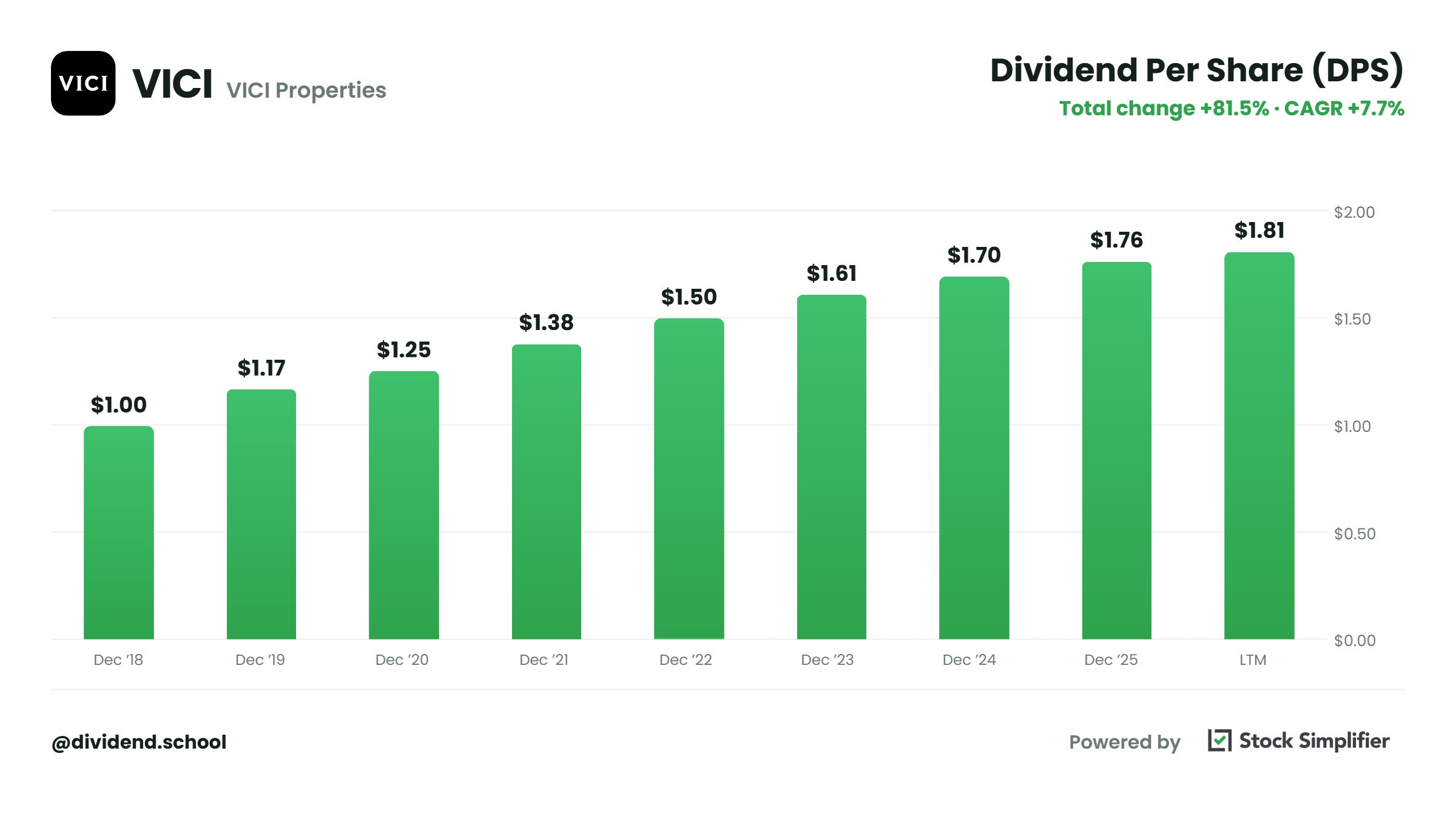
VICI is a REIT that owns casino resorts and leases them to the operators. Caesars Palace, MGM Grand, and the Venetian are all VICI buildings. In total it owns 100 properties with over 66,000 hotel rooms.
Can a chatbot replace a weekend in Vegas? I don’t think so.
The leases are triple-net, meaning the tenant pays the taxes, insurance, and upkeep. So VICI owns heavy assets without the heavy upkeep bill, a rare thing in the HALO world. Real estate investments of $45.1 billion against $4.0 billion of revenue give VICI the heaviest ratio of our five, at 11.25.
The dividend:
Quarterly dividend: $0.46 ($1.81 annualized)
Yield: 7.28%
Latest raise: 2.2%
Five-year growth: 7.1% a year
AFFO payout: 74.3% of the 2026 AFFO guidance midpoint
Two things to watch. A big share of the rent comes from two operators, Caesars and MGM, so their health matters a lot to ours. And the latest raise of 2.2% is the slowest of the group, which7. is the price we pay for the high starting yield.
I am fine with that trade, and I own it.
Want our Buy Below prices for NextEra and VICI? They sit in our Buy Below register, along with the other names in the Dividend Universe, and both stocks are held in the Dividend Universe Portfolio we run in public. Pro members see the full holdings, the trades, and every Buy Below.
3. American Water Works (AWK)
American Water is the largest regulated water and wastewater utility in the US. It serves 14 million people in 14 states, plus 19 military bases.
Water might be the purest HALO business there is. The pipes are buried, the territory is set by regulators, and demand doesn’t care what the stock market thinks about AI. Data centers use plenty of water too.
The dividend:
Quarterly dividend: $0.895 ($3.58 annualized)
Yield: 2.28%
2026 raise: 8.2%
Five-year growth: 8.5% a year
Payout: 58.7% of the 2026 EPS guidance midpoint, inside management’s 55% to 60% target
The yield is lower than most utilities, which is the price of the faster growth. Two things to watch: the merger with Essential Utilities, targeted to close by the end of the first quarter of 2027, and the capex bill we saw above.
4. MPLX (MPLX)
MPLX owns pipelines, gas processing plants, and storage terminals, and Marathon Petroleum controls it. It collects a fee for moving and processing natural gas and liquids, much like a toll road.
Big caveat first. MPLX is a master limited partnership, so owners get a K-1 tax form instead of a 1099, and holding it in an IRA can create its own tax headaches. Talk to your tax person before buying.
The distribution:
Quarterly distribution: $1.2111 ($4.84 annualized)
Yield: 7.52%
Latest raise: 12.5%, the third year in a row at that rate
Five-year growth: 8.1% a year
Distribution coverage: 1.3x in the third quarter of 2026
Leverage: 3.8x
That’s a lot of growth for a high yielder. Management said a recent asset sale could slow next year’s raise, though it still expects a “significant” increase in 2027. Something to keep an eye on.
5. Iron Mountain (IRM)
Iron Mountain started out storing paper records in a literal mountain. It still stores boxes for businesses around the world, and it has used that cash to become a fast-growing data center owner.
Why does that make it HALO twice over? Physical records nobody wants to move, plus the buildings AI runs in. Data center leasing hit 102 megawatts in the third quarter alone.
The dividend:
Quarterly dividend: $0.993 ($3.97 annualized), payable in January
Yield: 3.07%
Latest raise: 15%
Five-year growth: 5.5% a year, but 12.6% a year since 2023 after three flat years
AFFO payout: 66.5% of the 2026 AFFO guidance midpoint
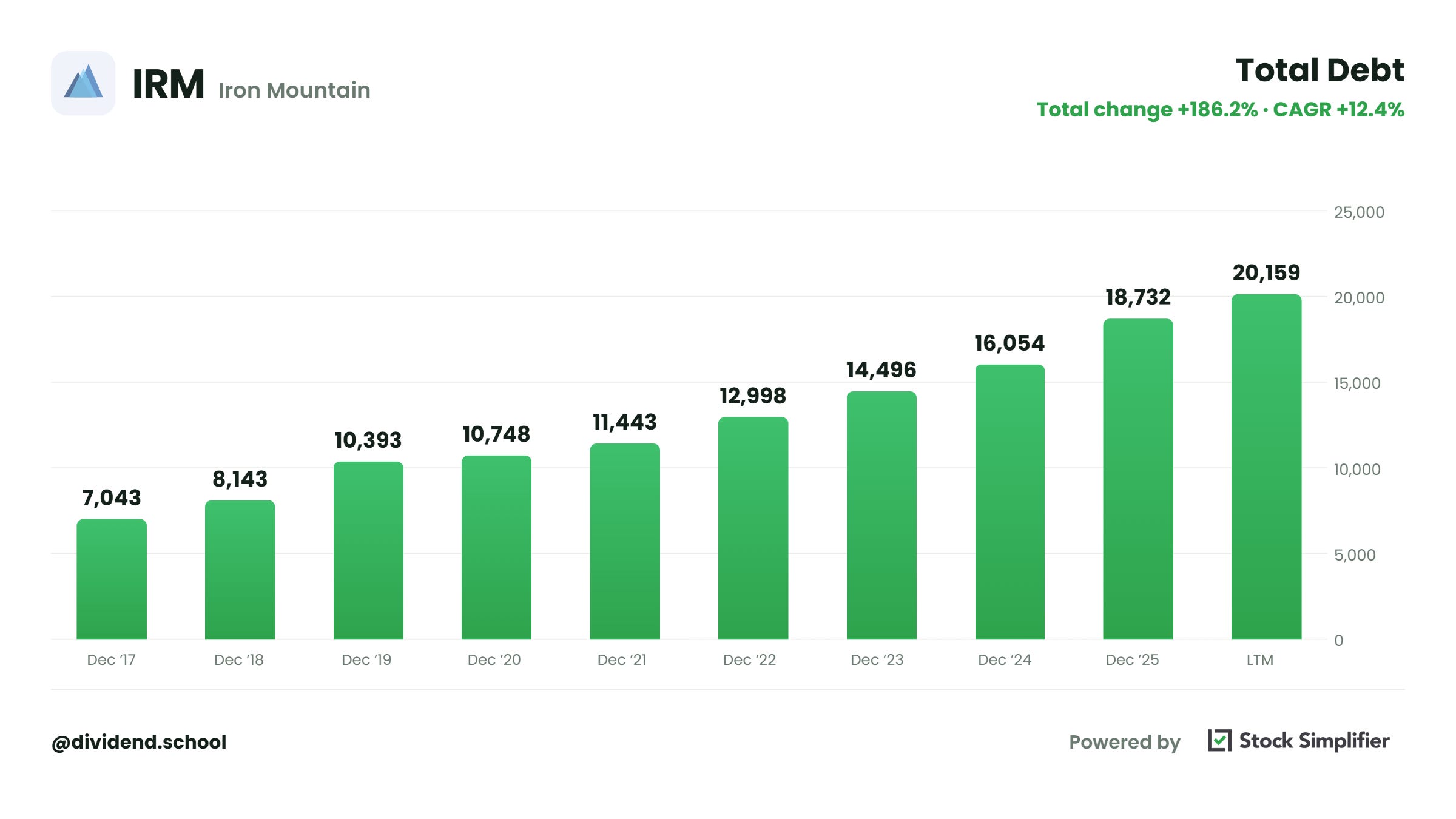
The bad news, IRM is the most aggressive of the five. Capex of $2.27 billion in 2025 against $1.34 billion of operating cash flow, and long-term debt of $16.4 billion. The growth is real. So is the leverage.
How to Use HALO in Your Process
So how do we put this to work?
I treat HALO as a filter that sits in front of my usual process. Everything after it stays the same. Here is how I would use it this week:
Run the chatbot test on what you already own. You might be surprised how many asset-light businesses you hold (I was).
Add the heavy-asset ratio to your checklist. Net PP&E divided by revenue takes two minutes from the 10-K.
Match the payout ratio to the business. Earnings for utilities, AFFO for REITs, distributable cash flow for MLPs. Never just the yield.
Watch the capex and the debt. Spending more than it earns is fine while rates cooperate.
Don’t overpay for a trend. HALO has been a hot trade all year, and hot trades get expensive. Patience is a virtue.
Am I selling my asset-light winners to chase HALO? Nope. A portfolio with some of each gives us cash from the physical world and growth from the digital one.
Black Friday is coming to Dividend School Pro. Starting Friday, November 27th, the Pro offer includes Stock Simplifier Pro for as long as you stay a member, plus The Forever Five, our new report on the five dividend stocks I would hold forever.
Watch your inbox Friday morning, or get the details first at Dividend Live, Tuesday, November 24, at 7 PM ET.
HALO is a new name for an old idea. Own the things the world can’t do without, and let them pay us while we wait.
If you have any questions or would like me to cover something in particular, please don’t hesitate to reach out.
Until next time, take care and be safe out there,
Dave
P.S. Every month, our Pro deep dive runs one company through this exact process, from the filings to the Buy Below. That comes on top of two paid issues a week, Thursday and Saturday. The Black Friday offer opens Friday, November 27th.
Disclosure: I own NextEra Energy (NEE) and VICI Properties (VICI). I don’t own American Water Works, MPLX, or Iron Mountain. This is for educational purposes, not personal investment advice.