

Thirty companies. That is the whole Dividend Universe.
Not three hundred, and not the sixty-nine names on the Aristocrats list. Thirty, because thirty is the number one person can genuinely follow every single month.
Why does the number matter so much?
Because “monitored” has to mean something. Every month, each of the thirty gets:
The quarter read, if it reported
Any dividend action, raise, freeze, or cut
A fresh coverage check on free cash flow
A recalculated Buy Below price
That last one is where the Best Buys come from. We re-run valuation on all thirty every month, and the five trading furthest under their Buy Below become the list. Which is why the Universe barely moves and the Best Buys change every time.
The names span sectors on purpose. September’s five run from a technology consultancy to a payroll processor to a casino landlord, with yields from 0.9% to 7%.
Why the spread?
Because we are building a portfolio here, not running a screen. Five names that all do the same thing in the same downturn is one name with extra steps.
And when something breaks, the name comes off, and I say why. Frankly, the removals teach more than the additions do, because a removal is me showing my work on something I got wrong.
So what does all that selecting actually produce?
Here is the whole Universe against the index, on five-year numbers.
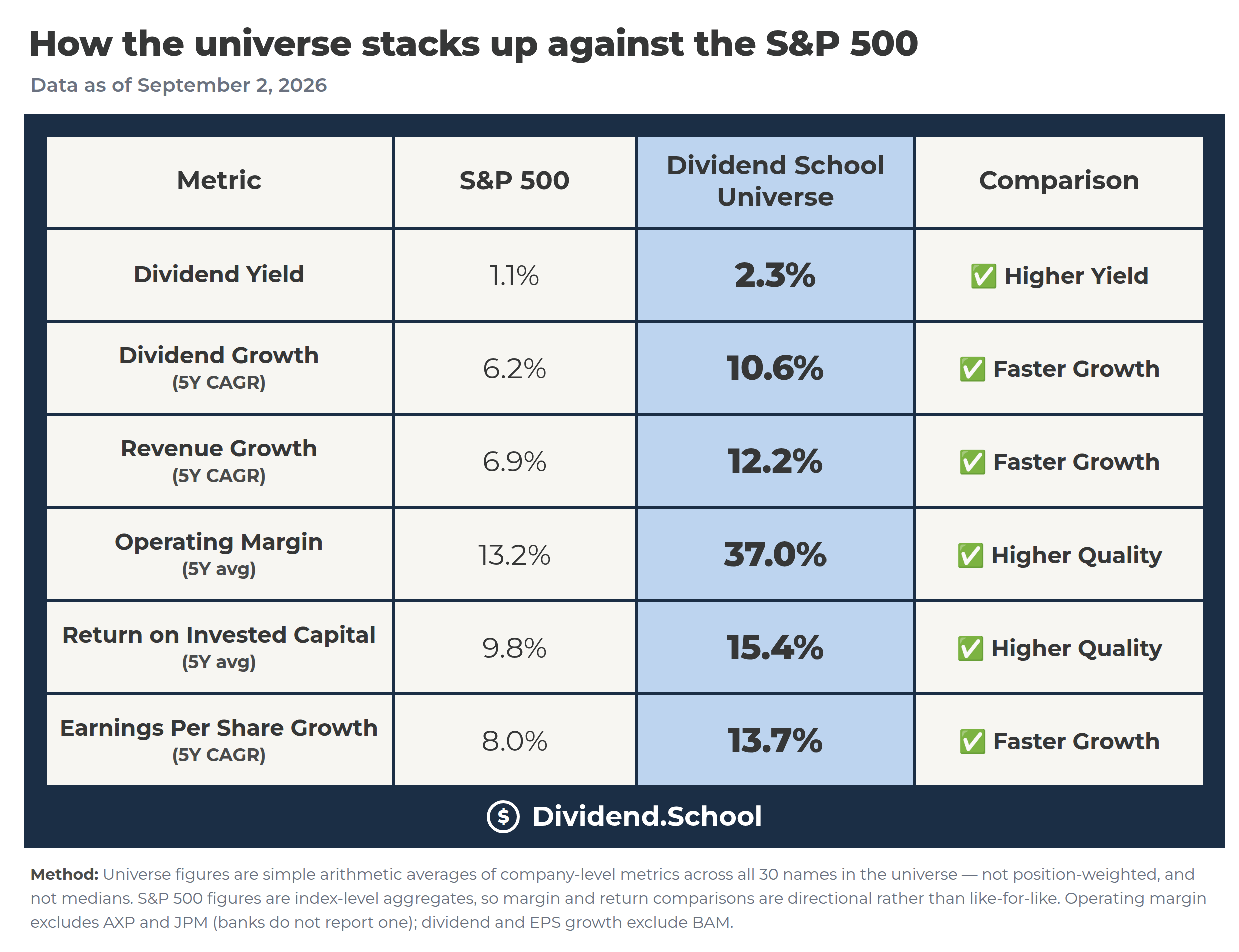
Dividend yield: 2.3% against the S&P 500’s 1.1%
Dividend growth: 10.6% a year against 6.2%
Revenue growth: 12.2% against 6.9%
Operating margin: 37.0% against 13.2%
Return on invested capital: 15.4% against 9.8%
Earnings per share growth: 13.7% against 8.0%
Two of those matter more than the other four for anybody who plans to live on this money. Double the starting yield, and a dividend growing 71% faster (10.6% / 6.2%).
What does that combination do given some time?
Say $100,000, spread evenly across the names, and say both keep doing what they have done for the last five years.
Year 10: the Universe pays $6,299 a year. The index pays $2,007.
Year 20: the Universe pays $17,252 a year. The index pays $3,663.
That is yield on cost, and the math is not complicated. A 2.3% yield growing at 10.6% reaches 17.25% on the original money after twenty years (2.3% x 1.106^20). The index, starting at 1.1% and growing at 6.2%, reaches 3.66%.
Here is the same thing said another way, and it is the version that stuck with me.
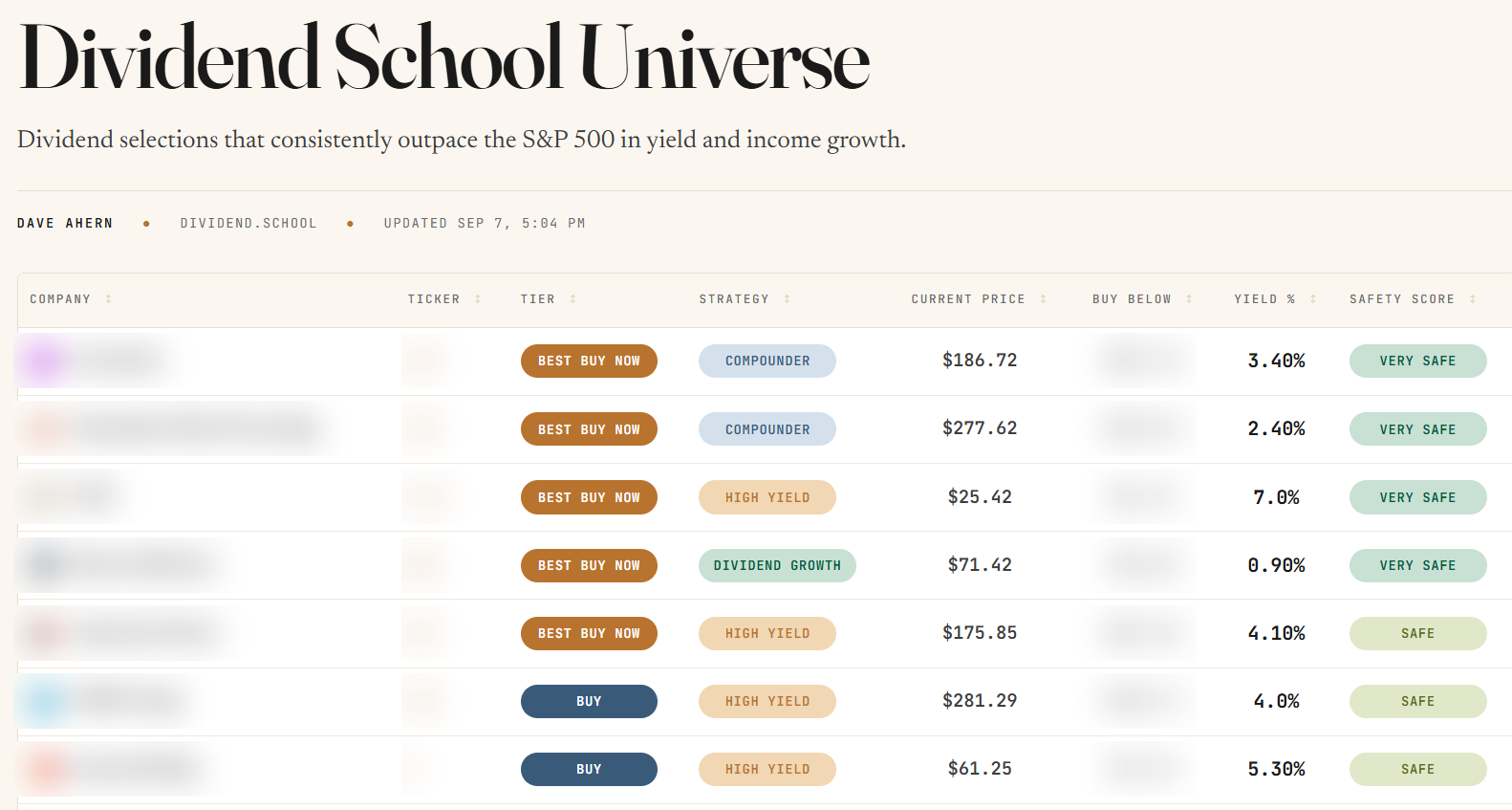
The Universe reaches a 6.3% yield on cost in ten years. The S&P 500 needs about twenty-nine years to get to the same place.
Big caveat here, and this matters. Those are trailing five-year rates, not a forecast. My crystal ball is quite cloudy. Companies freeze dividends, companies cut them, and thirty names I picked myself are never going to behave like an index of five hundred. The arithmetic shows what the gap between a 2.3% starting yield and a 1.1% one is worth if the growth holds up. It is not a promise that it will.
That gap is why the Universe is thirty names instead of five hundred.
Through Sunday, it is $299 for the year, down from $369, locked at $299 for as long as the membership runs. Seven days free before anything is charged.
Until next time, take care and be safe out there,
Dave