

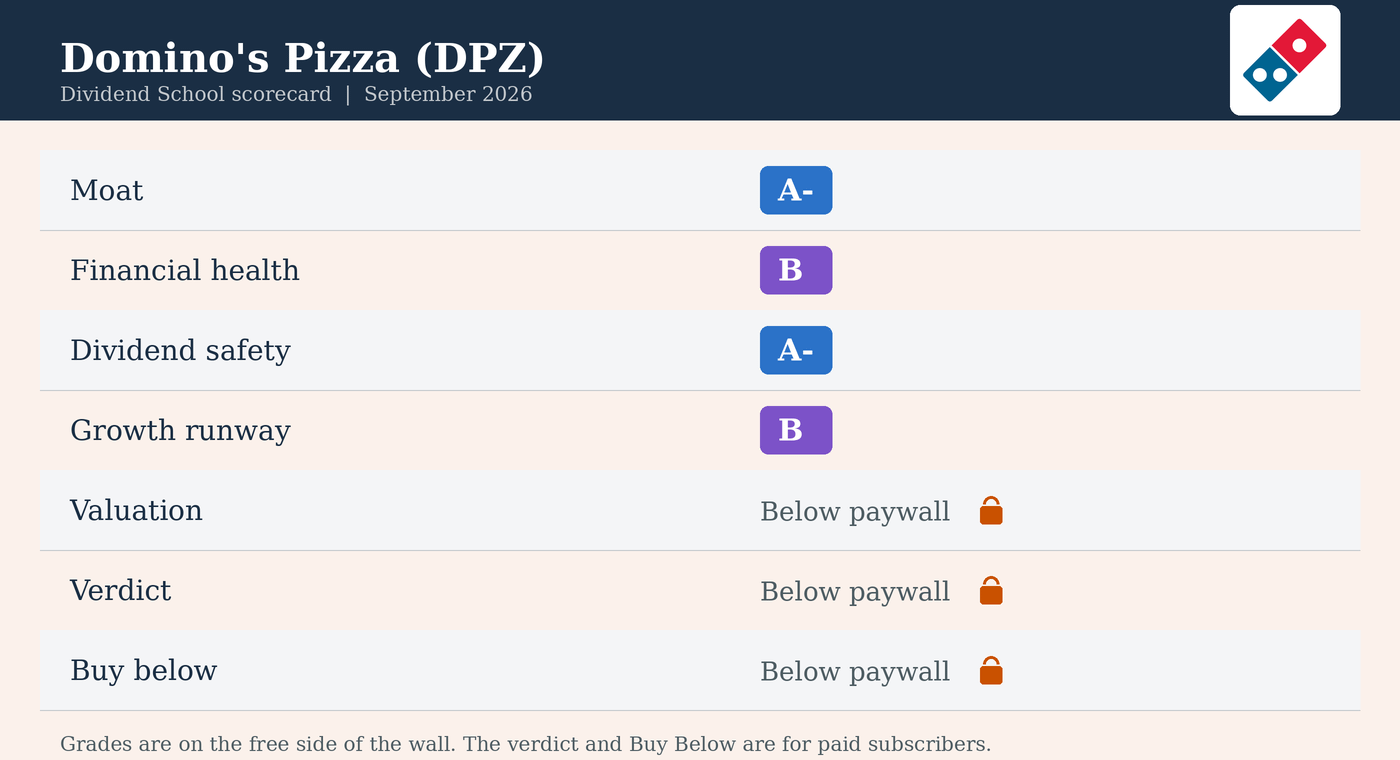
Domino’s is a simple business. Most people assume they make money from pizza, but that’s not quite the story. Domino’s generates royalties from 22,531 stores, most of which they don’t own. They financed those stores with $4.8 billion of debt, which the company is not on the hook for.
Today, we will discuss what this is and how much it is worth.
In today’s post, we will dig into:
Answering a Reader’s Question
The Bet
What Domino’s Does
How Domino’s Makes Money
The Moat and the Competition
The Financials
Is the Dividend Safe?
Where the Growth Comes From
Management and Capital Allocation
The Risks
What Domino’s is Worth
The Decision
Okay, let’s dive in and figure out whether 4.3 times debt to EBITDA is a problem for a pizza company heading into a shaky economy.
1. Answering a Reader’s Question
Back on August 10 we published a joint report on Domino’s with Max from MaxDividends. The stock was $347.44. My verdict was Buy, with the 2027 refinancing on the watch list, and I said I would keep adding on weakness.
Back on August 10th, Max from MaxDividends and I published a joing report covering Domino’s. At that time, Domino’s was trading at $347.44 and our verdict was Buy. One watch list item was the 2027 refinancing, and I said I would add on any weakness.
Well, guess what, weakness show up. Dominos closed Friday at around $311, 10.3% below our valuation estimate, and 32% below the 52-week high of $458. The stock fell 8.6% in four trading days this week, from $341. All with no earnings or change in guidance news.
Recently, I had a astute reader write in asking a smart question. This is my answer for him and others with the same questions.
Here is the question:
“Almost all of the metrics appear attractive, but I have some concern about the debt/EBITDA ratio as we go into what appears to be a very unstable economic environment over the next year. (Perhaps pizza is way less discretionary than other products in this sector.)”
Frankly, in August I added refinancing to the watch list and wanted to dig deeper. This is my attempt at digging deeper.
The debt is one of the big questions with this company. Today, we will give it a full treatment of whether the 4.3x net debt-to-EBITDA puts the dividend at risk. We will also answer whether, if the economy goes south, pizza is actually less discretionary than the rest of the quick-casual restaurant category.
The short version is the reader is asking the right question. Domino’s debt does not behave like debt at most other company. In part because of the business structure, but also because the company has a history of operating with higher debt levels and its part of the structure, not a bug.
Here are the current numbers (as of this writing):
Price: $311.79
Dividend: $1.99 a quarter, $7.96 a year
Yield: 2.55% ($7.96 / $311.79)
Trailing P/E: 17.7x ($311.79 / $17.64 of trailing twelve-month earnings)
Free cash flow yield: 6.5% ($671.5 million of 2025 free cash flow / $10.31 billion market cap)
A 2.55% yield is not a screaming bargain, and there are other options out there. For Domino’s, this is the highest yield the company has offered since going public in 2013. The prior high yield was 2.10% at the beginning. Since then, the yield has ranged between 1.2% and 1.8%.
The dividend has marched higher since 2013, at a 21.1% CAGR, while the yield has fluctuated. This reflects stock-price volatility, not dividend growth.
2. The Bet
As I mentioned earlier, Domino’s business model is simple. They operate as a franchisor. Domino’s collects a percentage of every sale from its 22,000-plus stores owned by other operators. Domino’s also sells those same stores their dough, cheese, and boxes through their distribution channels.
Domino's turns $4.9 billion in revenue into $672 million of free cash flow, for an almost 14% free cash flow margin. They spend $121 million in capex to maintain operations and their distribution while paying out a third of the cash in a dividend.
Domino's has raised that dividend for 13 straight years, and I think that will continue.
The bet is this asset-light business, which carries 4.3 times leverage, can continue to carry it through any downturn. It has before, in the recent past, with 5.2 times during 2023. Right now the market is pricing Domino’s at its cheapest multiple in a decade. I believe they are confusing a slow year with a broken model.
3. What Domino’s Does
Domino’s doesn’t sell you pizza, a common misconception of the business. Instead they use franchisee’s to sell you that pizza while also selling the franchisee the cheese and dough.
Below is the company organization as it stands today”
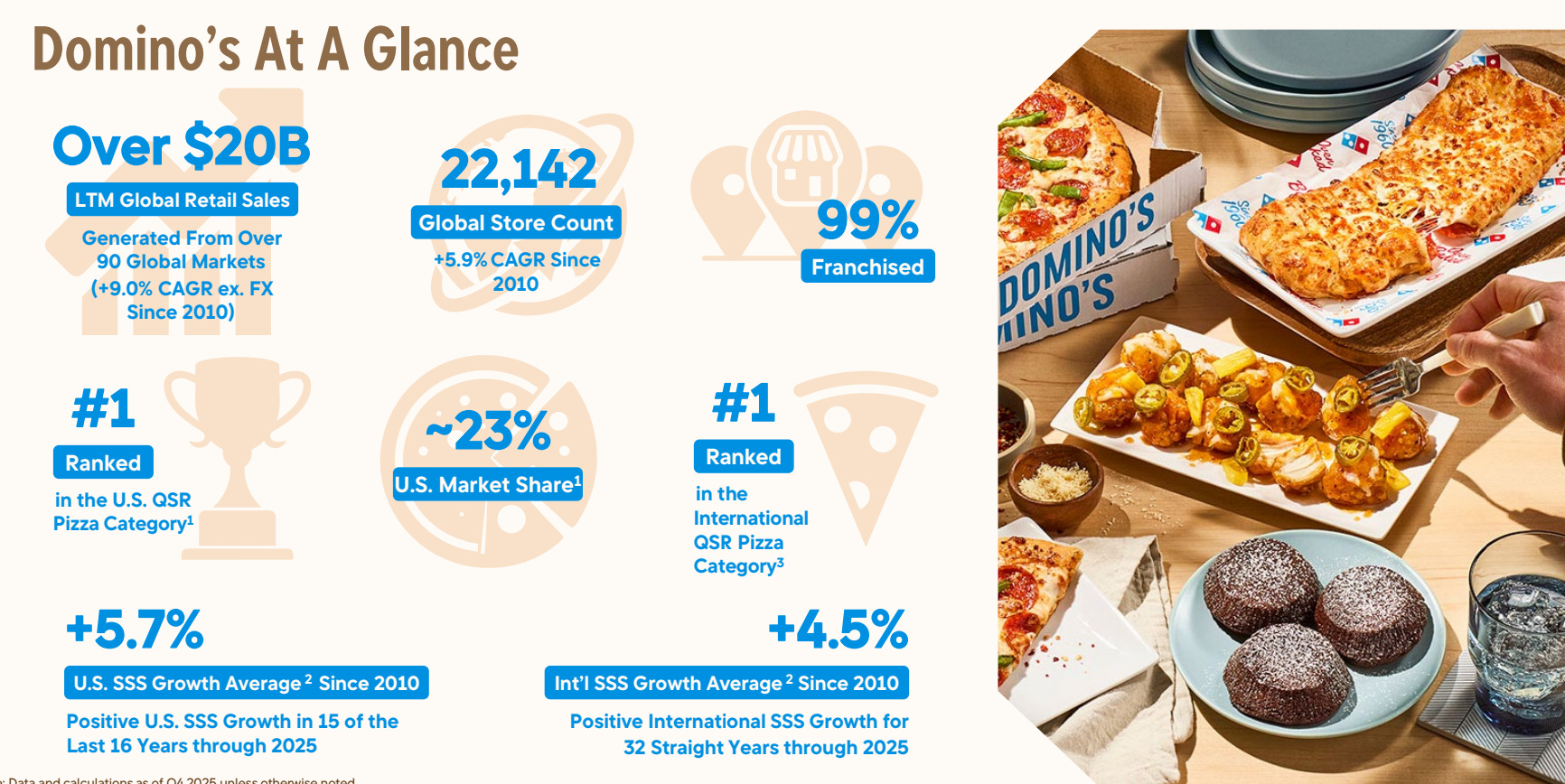
22,531 stores in more than 90 markets
7,231 in the US, of which 186 are company-owned, and 7,045 are franchised
15,300 international, all franchised
754 independent US franchisees, the average one running nine stores
$20.1 billion of retail sales rung up at those registers in 2025
Domino’s owns fewer than 1% of its own stores. It refranchised 77 more in the second quarter, in Virginia and Michigan, which is why the company-owned count fell from 262 to 186 in one quarter. They sold those stores, and they remain open today.
So if Domino’s doesn’t sell us pizza, what do they do all day?
They operate three business all stacked on top of one customer, their franchisees.
The royalty business: 5.5% of every US franchise sale, and 3.0% on average from international master franchisees, for almost no cost
The supply chain business: 27 centers in the US and Canada that make the dough and deliver the food to every store, at cost plus a margin, with half the profit shared back to stores that buy everything from Domino’s
The advertising fund: 6.0% of US franchise sales, collected and spent on the franchisees’ behalf, which passes through the income statement at a 100% margin and zero profit
The international side runs through master franchisees, big operators who own the rights to whole countries. Jubilant FoodWorks runs India and Turkey, 2,513 stores in India alone as of June. Domino’s Pizza Group runs the UK, with 1,410 stores. Domino’s Pizza Enterprises, listed in Australia, runs Australia, Japan, France, Belgium, and eight other markets. Alsea runs Mexico and Spain. DPC Dash runs China.
Domino’s collects a royalty from each of them and otherwise stays out of the kitchen.
How big is the biggest one? From the 2025 10-K, the largest of those master franchisees runs 3,524 stores, 24% of the international system, and produced 1.4% of Domino’s consolidated revenue. Keep that number in your pocket for the risk section.
Whole-business Securitization 101
Now the debt question answered.
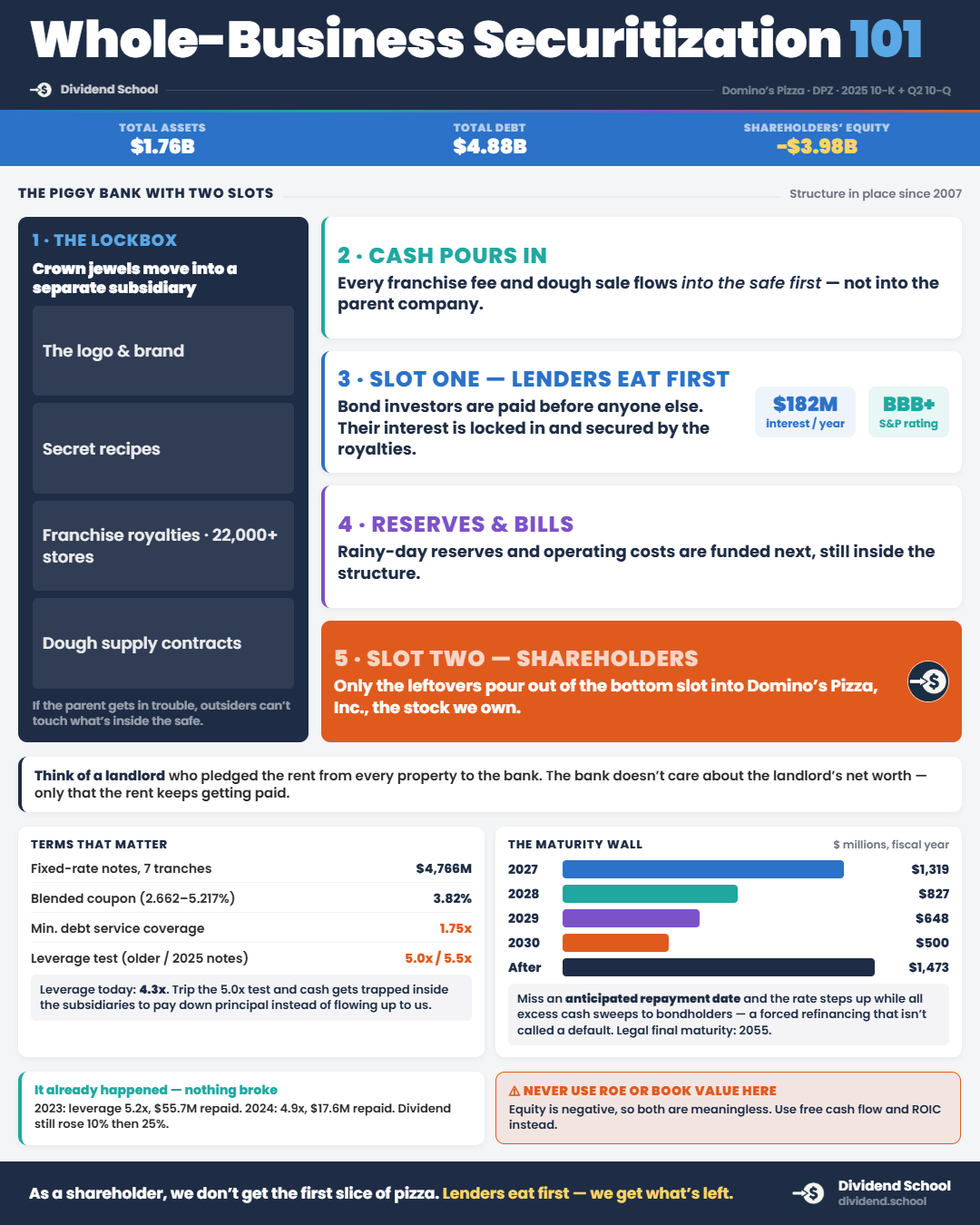
If we open the Domino’s financials and glance at the balance sheet. Always a prudent thing to do. You will notice they have negative equity. Total assets equaled $1.76 billion at June 14, and Total debt equaled $4.88 billion. Shareholders’ equity, our portion, is negative $3.98 billion.
That’s a scary number: negative four billion dollars. For a company worth $10 billion in market cap.
First, how is that possible, and second, why isn’t everyone freaking out?
Simple, because Domino’s doesn’t borrow money like Ford or Kraft Heinz does. It uses something called whole-business securitization and has done so since 2007.
Here is a plain-English explainer, like for a 10-year-old (my speed).
Imagine Domino’s builds a big piggy bank with two slots at the bottom, labeled “Lenders” and “Shareholders.”
Here’s how it works:
The Lockbox: Domino’s took it’s most valuable treasures—it’s logo, secret recipes, franchise fees, , and dough supply contracts. They then locked them all up in a separate, protected safe called “special subsidiary.” Even if the main company gets in trouble, nobody on the outside can touch what is inside the safe.
Borrowing Cash: Domino’s went to big lenders (bond investors) and said, “Please lend us billions today. In return, all the cash from pizza sales will go straight into this safe first.”
First in Line: Every month, money from franchise fees and dough sales pours into that safe. The lenders get their cut first; their interest payments are locked in and guaranteed by those royalties.
The Leftovers: Only after the lenders are fully paid (plus some rainy-day savings and bills) does the leftover cash get poured out of the bottom slot into Domino’s Pizza, Inc. The company’s stock we bought.
Takeaway: As a shareholder, we don’t get the first slice of pizza. Lenders eat first, and we get whatever is left.
Or think of it as a landlord who has pledged the rent from every property they own to the bank. The bank doesn’t care about the landlord’s net worth. The bank only cares that the rent keeps getting paid.
This is why the debt looks so large next to Domino’s assets. And why the company can keep carrying the debt load. The lender (bond investors) is underwriting royalties from 22,000+ stores. Those notes have carried a BBB+ (investment grade) rating from S&P. All on a company with negative equity.
Here are the terms that matter, from the 2025 10-K and the second quarter 10-Q:
$4,766 million of fixed-rate notes across seven tranches, coupons from 2.662% to 5.217%
A blended coupon of 3.82%, which works out to $182 million a year of interest on the notes
A minimum debt service coverage ratio of 1.75x. Below that, cash gets trapped inside the subsidiaries and used to pay down principal instead of flowing up to us
A leverage test: scheduled principal payments of 1% a year are suspended as long as leverage stays at or below 5.0x on the older notes and 5.5x on the 2025 notes
The company passed both tests at June 14 and at year-end, so every dollar of principal is classified as long-term
Each tranche has what the documents call an anticipated repayment date. That is the date Domino's is expected to refinance. If it does not, the interest rate steps up and all the excess cash sweeps to the bondholders until they are paid, which is the structure's way of forcing a refinancing without calling it a default. The legal final maturity on the newest notes is 2055.
So what is the actual maturity wall?
Fiscal 2027: $1,319 million (the 2017 and 2018 notes, at 4.118% and 4.328%)
Fiscal 2028: $827 million (the 2021 notes, at 2.662%)
Fiscal 2029: $648 million
Fiscal 2030: $500 million
After that: $1,473 million
How this bridges to the financials. For a “normal” company, debt to EBITDA tells us how many years of profit it would take to pay the lender back. In this scenario, the number gives us a more narrow definition. It tells us how close Domino’s is to the covenant that would turn off the cash-flow hose to shareholders.
At 4.3x today, the distance to the 5.0x test is close. We can also see how this plays out if the company fails the test, because it happened recently.
At the end of 2023, Domino’s reported leverage of 5.2x, and that year it repaid $55.7 million of debt, which is close to 1% of the notes plus the lease payments. In 2024, leverage fell back to 4.9x, and repayments fell to $17.6 million. Domino’s raised its dividend 10% in 2023 and 25% in 2024.
Bottom line, nothing broke.
WARNING: never use return on equity or book value to judge this company. The equity is negative, so both numbers are meaningless. NEVER. Use free cash flow and return on invested capital instead, as we do below.
4. How Domino’s Makes Money
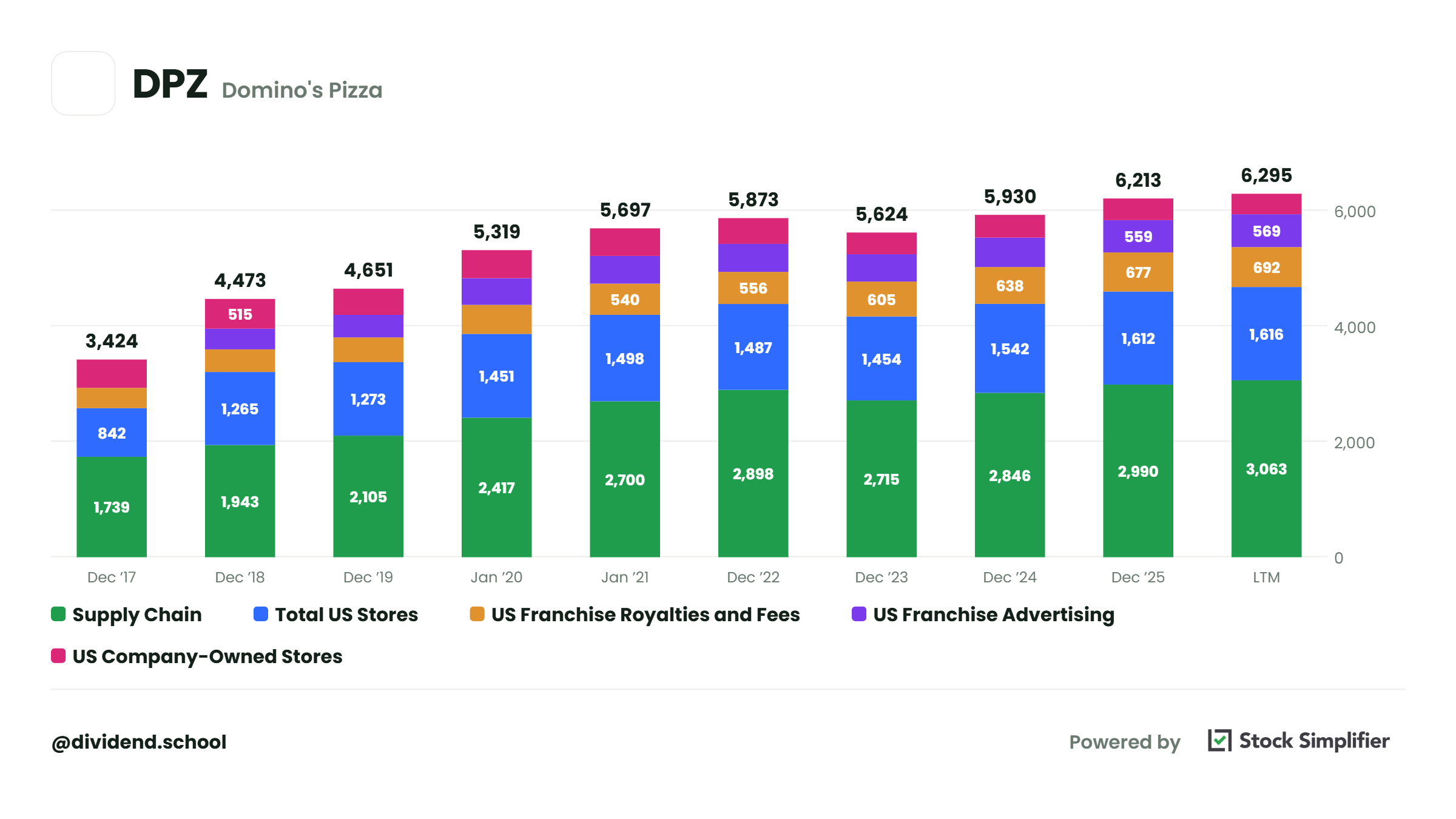
Domino’s reports revenue in five segments, with different businesses. Here is 2025, from the 10-K:
Supply chain: $2,989.5 million, 60.5% of revenue
US franchise royalties and fees: $677.1 million
US franchise advertising: $559.5 million (pass-through, zero profit)
US company-owned stores: $375.2 million
International franchise royalties and fees: $338.7 million
Total revenue: $4,940.0 million, up 5.0% from $4,706.4 million.
Why doesn't revenue tell the whole story here?
Because 60% of it is Domino’s selling cheese to its own franchisees at a 12% gross margin. Profit is the number to watch, by segment:
US stores (royalties plus company stores): $575.3 million of segment income
Supply chain: $320.1 million
International franchise: $288.5 million
Notice the international franchise profits. It turned $338.7 million of revenue into $288.5 million of income. That is an 85.2% margin and all pure royalty, no trucks, no dough.
The supply chain, almost nine times the revenue, made $320.1 million, contributing a 10.7% margin.
So what drives the top line?
Two things: how many stores there are, and how much each one sells.
Domino’s calls the second one same-store sales, and it is the number we need to follow. For any restaurant or retail business it is the key KPI to watch.
2025 US same-store sales: +3.0%
2025 international same-store sales: +1.9%
2025 net new stores: 776 (172 US, 604 international)
2025 global retail sales growth: +5.4% excluding currency
Every point of US same-store sales is worth $100 million of retail sales ($9.95 billion of US retail sales x 1%). At a 5.5% royalty, that is $5.5 million of royalty revenue, plus a few million of supply chain profit on the extra dough and cheese. Call it $10 million of operating income per comp point, on a base of $954 million.
That is the thing to understand about this business. A flat year at the stores, against the 3% the company wants, is a 3% problem for Domino’s profits. And that has been the problem for the stock price. The market pays for growth and with growth stopping, well….
Here are the headline results for the second quarter, the latest:
Revenue: $1,194.4 million, +4.3%
Income from operations: $232.0 million, +3.1%
Net income: $135.8 million, +3.6%
Diluted EPS: $4.07, +6.8% (buybacks did the last three points)
US same-store sales: +0.1%
International same-store sales: (0.1)%
Free cash flow, first half: $313.6 million ($352.6M operating cash flow less $39.0M capex)
Same-store sales were meh; earnings per share still grew 6.8%. That gap is the franchisor model working as designed.
5. The Moat and the Competition
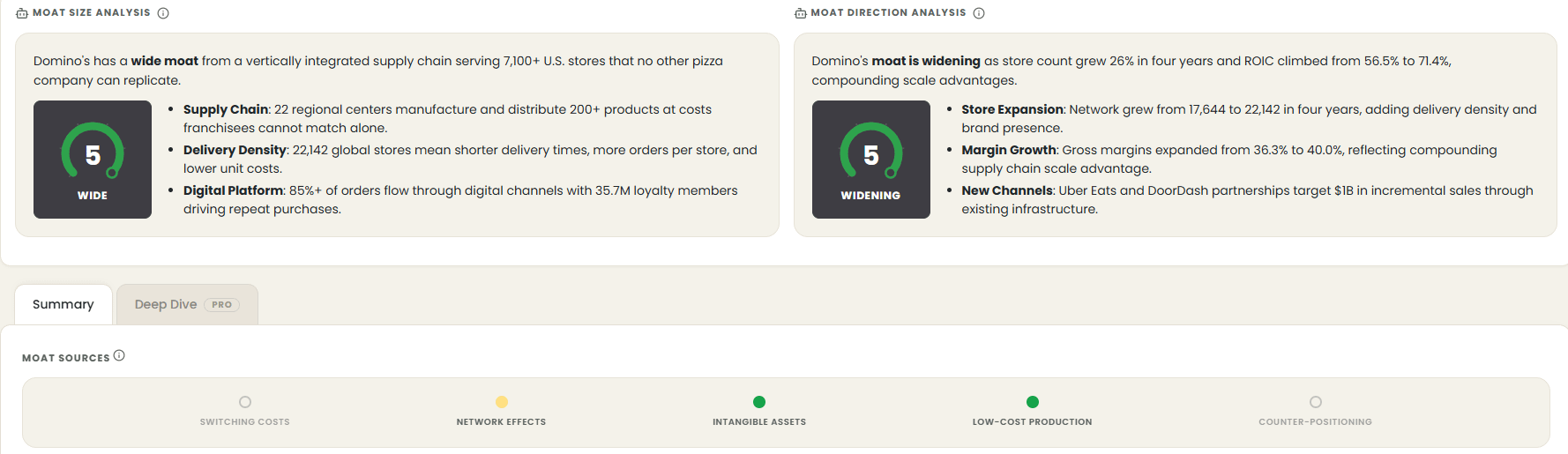
Domino’s moat has three parts, and I wrote them up in August, so here they are in short form with the numbers refreshed.
Scale in advertising: US franchisees paid $559.5 million into the national ad fund in 2025, up 9.7%. Every franchisee pays in, and one brand spends it
The supply chain: 27 centers make and deliver the dough to every US store, at a margin that grew from 9.0% in 2023 to 10.7% in 2025, while franchisees still got half the profit back
The order platform: more than 85% of US sales are ordered digitally, and the loyalty program has 37 million active members
Does any of that show up in returns?
It does.
Operating income after tax in 2025 was $745 million ($954.0M of operating income less taxes at 21.9%). Invested capital, using total assets less non-interest-bearing current liabilities, was $1.18 billion. That is a 63% return on invested capital ($745M / $1,181M). Any method you prefer lands above 50%, and a business earning that on its capital does not need to borrow to grow, which is why the debt could all go to buybacks instead.
So who is winning the pizza war?
Domino’s, but it hasn’t helped the stock performance lately.
Pizza Hut: Yum! Brands agreed in June to sell its business outside China for $1.5 billion to LongRange Capital and its China business for $1.2 billion to Yum China. Yum’s CFO guided 250 US closures for the first half of 2026
Papa John’s: North America comps fell 8.3% in the second quarter, the company ended its sale process on August 6 and suspended its dividend the same day
Little Caesars: private, growing, and the one competitor fighting Domino’s on carryout value
Domino’s share of the three public chains’ US sales went from 38% in 2016 to 54% in 2025, per Barron’s. The number-two and number-three brands are closing stores, being sold, or both.
That is a moat.
But it is also a flat category: $49.6 billion of US pizzeria sales in 2025, down 0.3% per PMQ, which means Domino’s growth has to come from taking somebody else’s slice.
Domino’s has struggled against delivery apps.
DoorDash and Uber Eats turned every restaurant in town into a delivery competitor, and Domino’s own delivery comps were negative in both quarters this year. Management joined the apps in 2023 and 2025 instead of fighting them. Whether that was the right call is the biggest open question, and we cover it in the risks.
6. The Financials
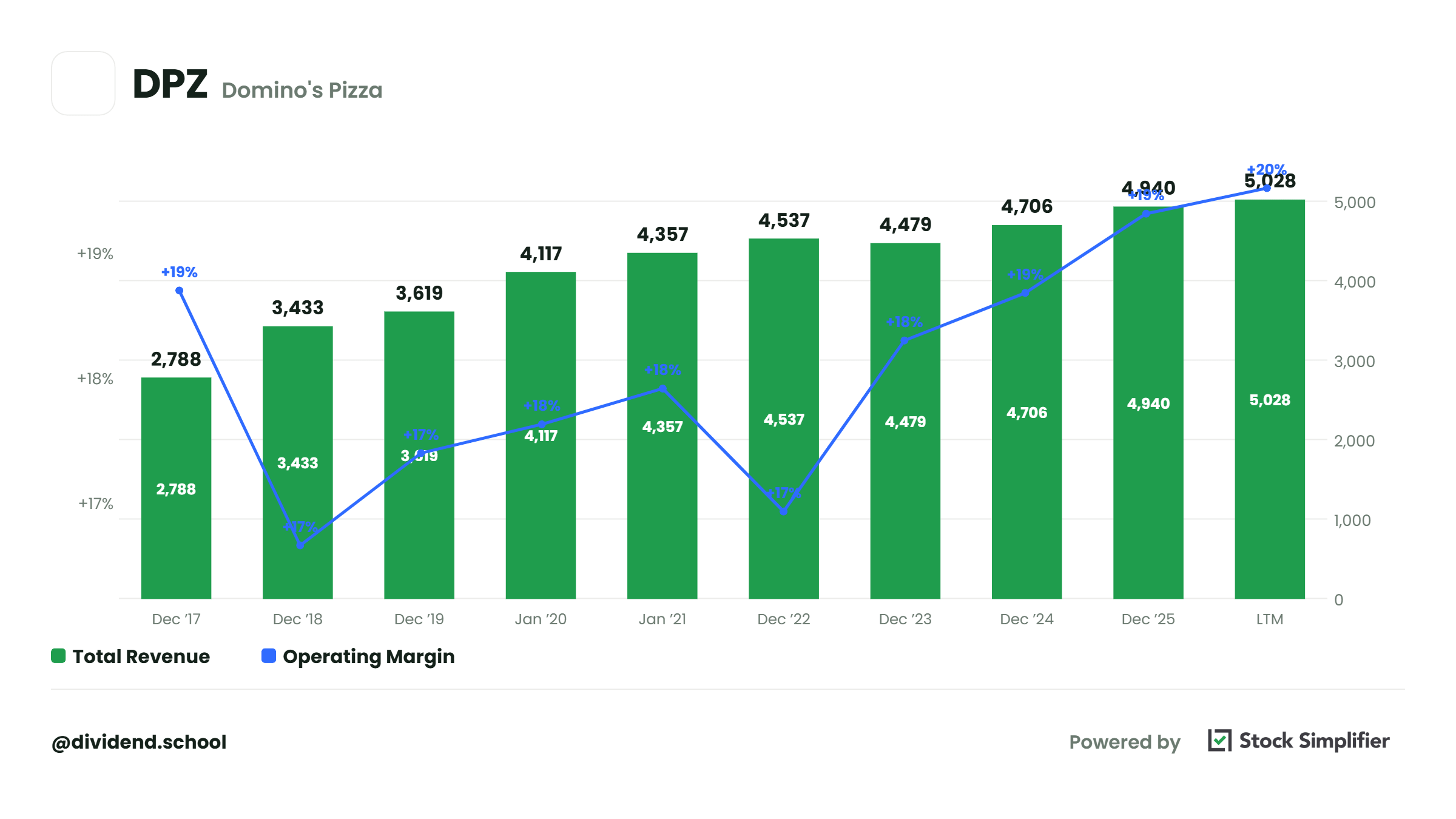
Every number here answers one question: is this a high-quality business, or a levered one that looks high-quality because the leverage flatters the per-share numbers?
Revenue grew 5.1% in 2024, 5.0% in 2025, and 3.9% in the first half of 2026. Steady and slowing. Operating margin has expanded every year since 2022, to 19.3% in 2025. That is what an asset-light model looks like.
Cash generation is where Domino’s earns its grade:
2025 operating cash flow: $792.1 million
2025 capital expenditures: $120.6 million
2025 free cash flow: $671.5 million, up 31%
Free cash flow conversion: 112% of net income ($671.5M / $601.7M)
Capex was 2.4% of revenue. The franchisees build the stores. Domino’s builds dough plants and software.
Now the balance sheet:
Total debt: $4,883.6 million at June 14
Cash: $164.8 million, plus $187.9 million of restricted cash held inside the securitization
Net debt: $4,718.8 million
Leverage, the company’s own measure: 4.3x, down from 4.7x a year earlier and 4.9x in the first quarter of 2025
Interest expense, 2025: $196.0 million
Interest coverage: 4.9x ($954.0M of operating income / $196.0M)
EBITDA to interest: 5.6x ($1,104M of trailing adjusted EBITDA / $198M)
How to read that?
Coverage of 4.9x is fine for a normal company and comfortable for this one, because the interest is fixed. Every dollar of the $4,766 million of notes carries a fixed coupon; the only floating-rate facility is a $320 million revolver that was undrawn at year-end apart from letters of credit. If rates go up tomorrow, Domino’s interest bill does not move until a tranche comes due.
Which brings us to the one line on the balance sheet I would actually lose sleep over. The 2027 notes.
$1,319 million comes due in July 2027 at coupons of 4.118% and 4.328%. The last time Domino’s borrowed, in August 2025, it paid 4.930% for five-year money and 5.217% for seven-year money. If the 2027 refinancing prices at the seven-year rate, the extra interest is $13.7 million a year ($1,319M x 1.04 percentage points). After tax, that is $0.31 a share, on earnings of $17.64. A real cost, not a solvency event.
The 2028 refinancing hurts more. $827 million at 2.662%, the cheapest money Domino’s will ever have borrowed, rolls into whatever 2028 looks like. At 5.2%, that is $21 million a year.
So the reader’s 4.3x is real, and it will cost more to carry. Does it threaten the interest payments?
No. We are 0.7 turns of leverage away from the test that would restart principal payments, and a long way further from the coverage covenant. Neither one is a dividend cut, and both are on my watch list.
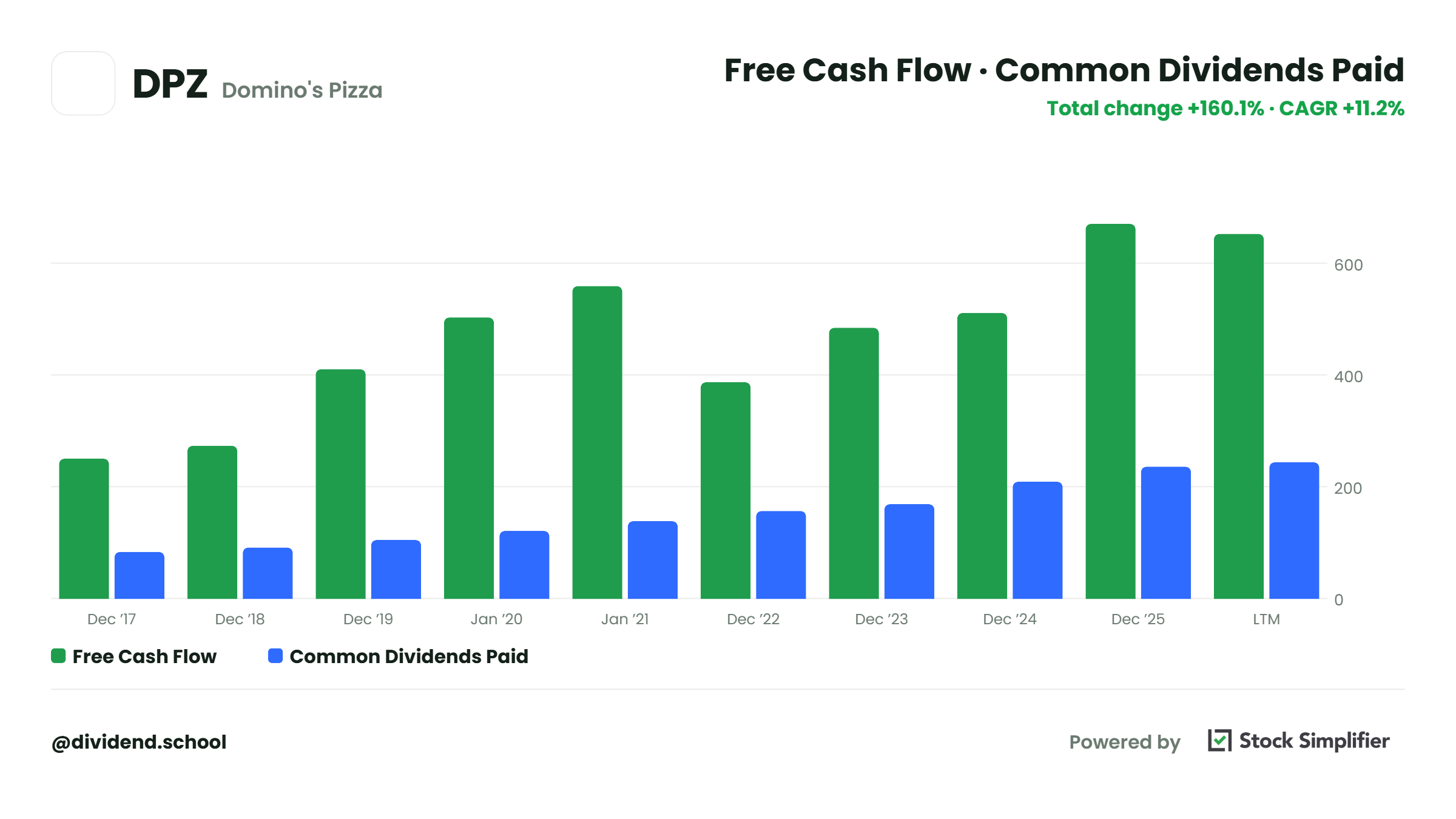
Already a paid subscriber? Keep scrolling. The dividend safety read, the fair value, and the Buy Below price are below.
The rest of this deep dive is for paid Dividend School Pro subscribers.
That is the mechanism, for free. How the debt is structured, what the covenants say, and how far we are from them.
The part I cannot give away is the answer to the reader’s question. Below the line:
The dividend stress test: how far Domino’s EBITDA could fall before the buybacks stop, before the principal payments restart, and before the cash to the dividend gets trapped, with the 2008 and 2023 numbers as the test cases
The fair value: a reverse DCF, a price-to-free-cash-flow range, and the assumptions behind everything.
The Buy Below price, the position size, and the two things that would change my mind between now and the October 13 earnings report
After that it’s $369 a year or $35 a month, with a 30-day money-back guarantee either way.