

Hi everyone!
The Universe is growing again. Five companies join today, and we go from 35 names to 40.
Earlier this month I ran a screen on the parts of the Universe that felt thin. We had one energy name, two utilities, and not much in consumer staples. Five companies came out the other side, and all five are now on our list of businesses I’d buy every month.
In today’s post, we will discuss:
How the five got picked
Addition #1: Snap-on (SNA)
Addition #2: ConocoPhillips (COP)
Additions #3 through #5
The five new rows
Okay, let’s dive in and meet the new names.
How the five got picked
Every name in the Universe has to be a high-quality business that pays a growing dividend. For this screen, that meant three bars:
Return on invested capital above 12%. For energy and utilities, return on equity instead.
Dividend growth above 8% a year, over five years.
A yield above 2.5%.
Why ROE for energy and utilities?
Because a regulator sets what a utility can earn on its equity, ROE (net income / shareholders’ equity) is the number that matters there. For energy, oil price swings the balance sheet with every write-down, so we checked ROE alongside ROIC.
Four of the five clear all three bars. One misses the yield bar by 13 hundredths of a point, and I’ll explain below why I added it anyway.
A note before we start. Adding five names to the Universe isn’t the same as buying five stocks. These are the companies we’ll track every quarter, grade every earnings season, and buy when the price is right. Which brings us to the Buy Below for each one.
Addition #1: Snap-on (SNA)
Hi everyone!
The Universe is growing again. Five companies join today, and we go from 35 names to 40.
Earlier this month I ran a screen on the parts of the Universe that felt thin. We had one energy name, two utilities, and not much in consumer staples. Five companies came out the other side, and all five are now on our list of businesses I’d buy every month.
In today’s post, we will discuss:
How the five got picked
Addition #1: Snap-on (SNA)
Addition #2: ConocoPhillips (COP)
Additions #3 through #5
The five new rows
Okay, let’s dive in and meet the new names.
How the five got picked
Every name in the Universe has to be a high-quality business that pays a growing dividend. For this screen, that meant three bars:
Return on invested capital above 12%. For energy and utilities, return on equity instead.
Dividend growth above 8% a year, over five years.
A yield above 2.5%.
Why ROE for energy and utilities?
Because a regulator sets what a utility is allowed to earn on its equity, so ROE (net income / shareholders’ equity) is the number that matters there. For energy, the price of oil swings the balance sheet around with every write-down, so we checked ROE alongside ROIC.
Four of the five clear all three bars. One misses the yield bar by 13 hundredths of a point, and I’ll explain below why I added it anyway.
A note before we start. Adding five names to the Universe isn’t the same as buying five stocks. These are the companies we’ll track every quarter, grade every earnings season, and buy when the price is right. Which brings us to the Buy Below for each one.
Addition #1: Snap-on (SNA)
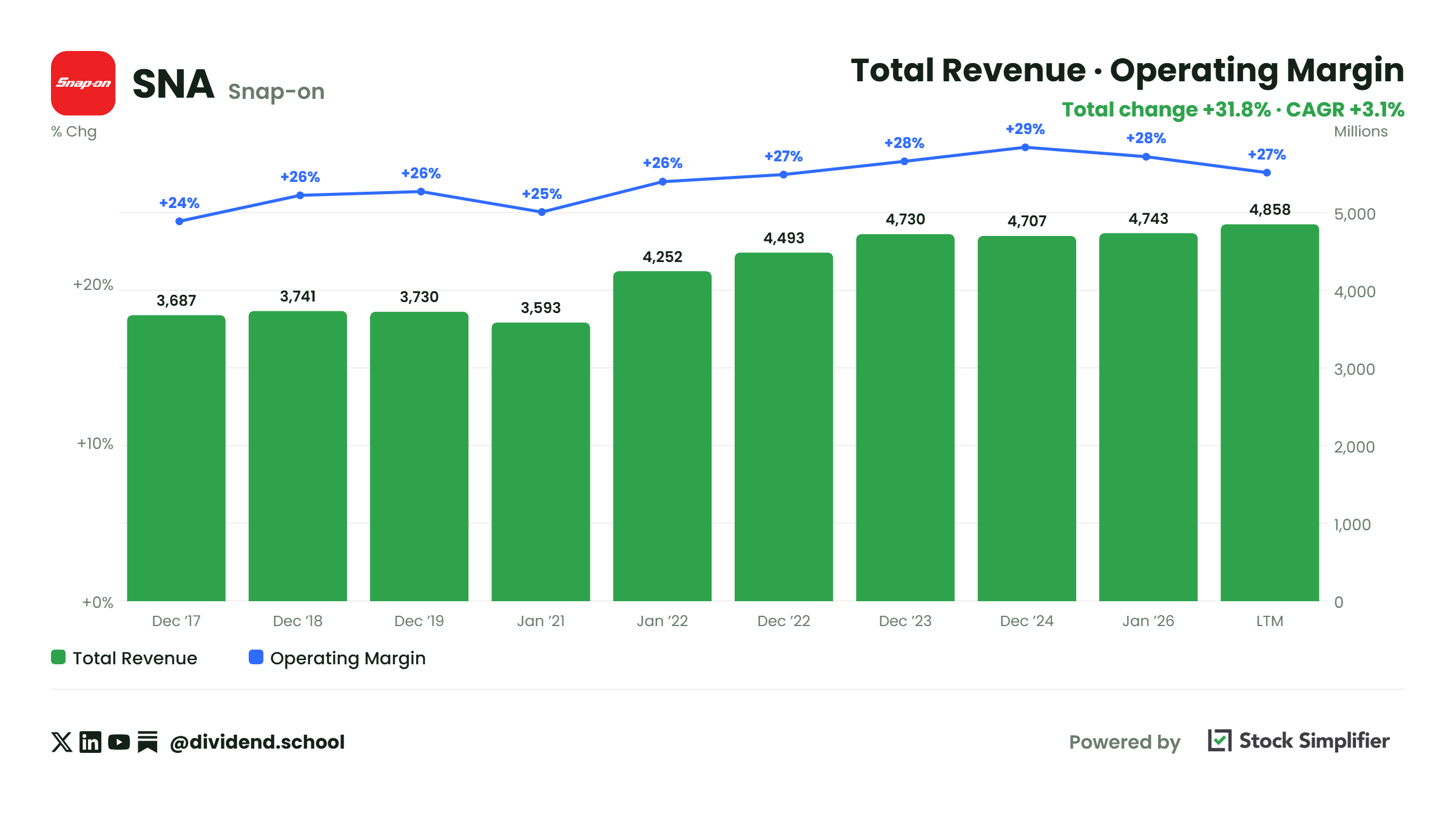
Snap-on sells tools to professional mechanics. If you’ve ever seen a white van parked outside an auto repair shop with a wall of red toolboxes inside, that’s Snap-on. A franchisee drives the same route every week, and the mechanic buys a wrench, a diagnostic scanner, or a new toolbox right off the truck, often on credit from Snap-on itself.
Strategy: Dividend Growth. Safety score: 4.6/5.
2025 revenue: $5,156.1 million
2025 diluted EPS: $19.19
Free cash flow per share, last twelve months: $20.49
Return on invested capital, five-year average: 15.8%
Annual dividend: $11.00 ($2.75 a quarter)
Yield: 3.01% at $364.99
The dividend
Snap-on just raised its dividend 12.7%, from $2.44 a quarter to $2.75.
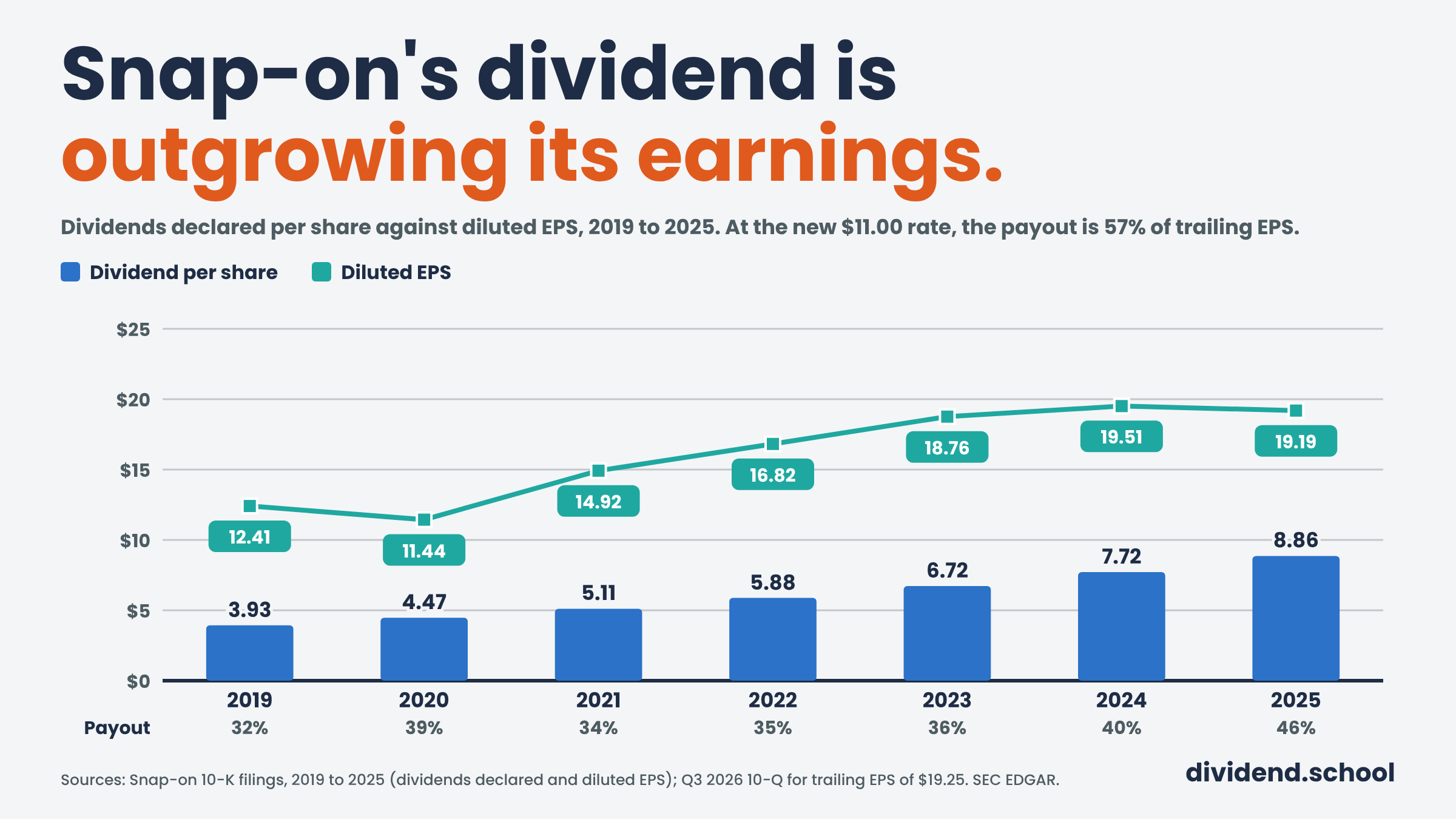
That’s not a one-off. In November 2021, the quarterly payment was $1.42. Five raises later it’s $2.75, growth of 14.1% a year. Love the consistency.
How much of the cash does it take?
Payout on free cash flow: 53.7% ($11.00 / $20.49)
Payout on earnings: 57% of the last twelve months’ $19.25 of EPS
Plenty of cover.
What to keep an eye on
Two things:
Revenue has stalled
The dividend is growing faster than the business
Revenue has stalled. Snap-on did $5,108.3 million in revenue in 2023, $5,108.4 million in 2024, and $5,156.1 million in 2025. Over three years, it's basically the same number. Through the first nine months of 2026, it’s up 2.9%, but third-quarter EPS fell to $4.64 from $5.02 a year ago.
The dividend is growing faster than the business. Back in 2021, Snap-on paid out 34% of earnings ($5.11 / $14.92). At the new rate, it’s 57%.
Is that a problem?
Not today. But a 14% raise each year on top of flat earnings can’t go on forever, and I’d expect the raises to slow toward the cash-flow growth rate. That’s still a good raise, just not 14%.
The Buy Below
Our Buy Below for Snap-on is $384.
Why value it on 4.6% growth when the dividend grows 14%?
Because the dividend can’t outgrow the cash forever. The Buy Below comes from a discounted cash flow model on the $20.49 of free cash flow per share, growing 4.6% a year for five years and then fading, with an 8.5% required return and a 15% margin of safety. The 4.6% is close to the 4.9% annual growth in free cash flow per share since 2021, and much less than the 14% dividend growth. I’d rather value the business on what it earns than on what it pays.
At $364.99, Snap-on trades 5.0% below the Buy Below, at 17.8 times free cash flow.
Verdict for our process
Snap-on is a 15.8% ROIC business with a customer base that has to keep buying. The weak spot is growth, and we’re paying for very little of it. At $384, we’re assuming free cash flow grows 4.6% a year.
For me, Snap-on is a buy under $384.
Addition #2: ConocoPhillips (COP)
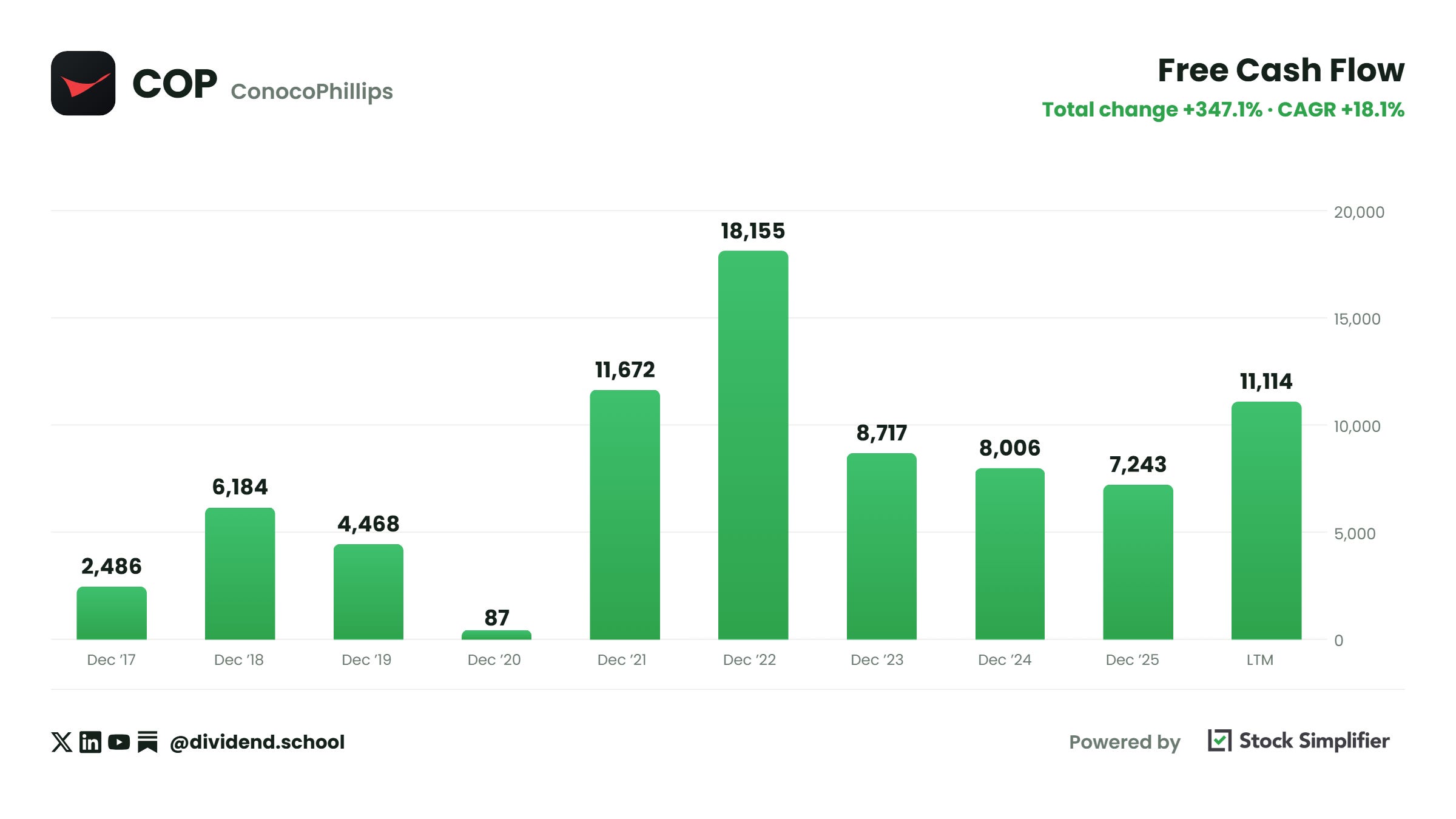
ConocoPhillips calls itself the world’s largest independent oil and gas producer. Independent means it only finds and pumps oil and gas. No refineries, no gas stations. When oil is high, it prints money. When oil is low, it doesn’t.
Strategy: Dividend Growth. Safety score: 3.6/5.
2025 revenue: $58,944 million
2025 diluted EPS: $6.35
Free cash flow per share, last twelve months: $9.29
Return on equity, five-year average: 22.4%
Annual dividend: $3.72 ($0.93 a quarter)
Yield: 2.65% at $140.52
The dividend
ConocoPhillips just raised its ordinary dividend 10.7%, from $0.84 a quarter to $0.93.
In late 2021, the quarterly payment was $0.46. Five raises later, it’s $0.93, a 15.1% increase per year. In 2022 and 2023, it also paid a variable dividend on top, when oil prices spiked. Those extra payments are gone; in 2024 it folded part of the variable payment into the regular dividend, which is the one we count.
How much of the cash does it take?
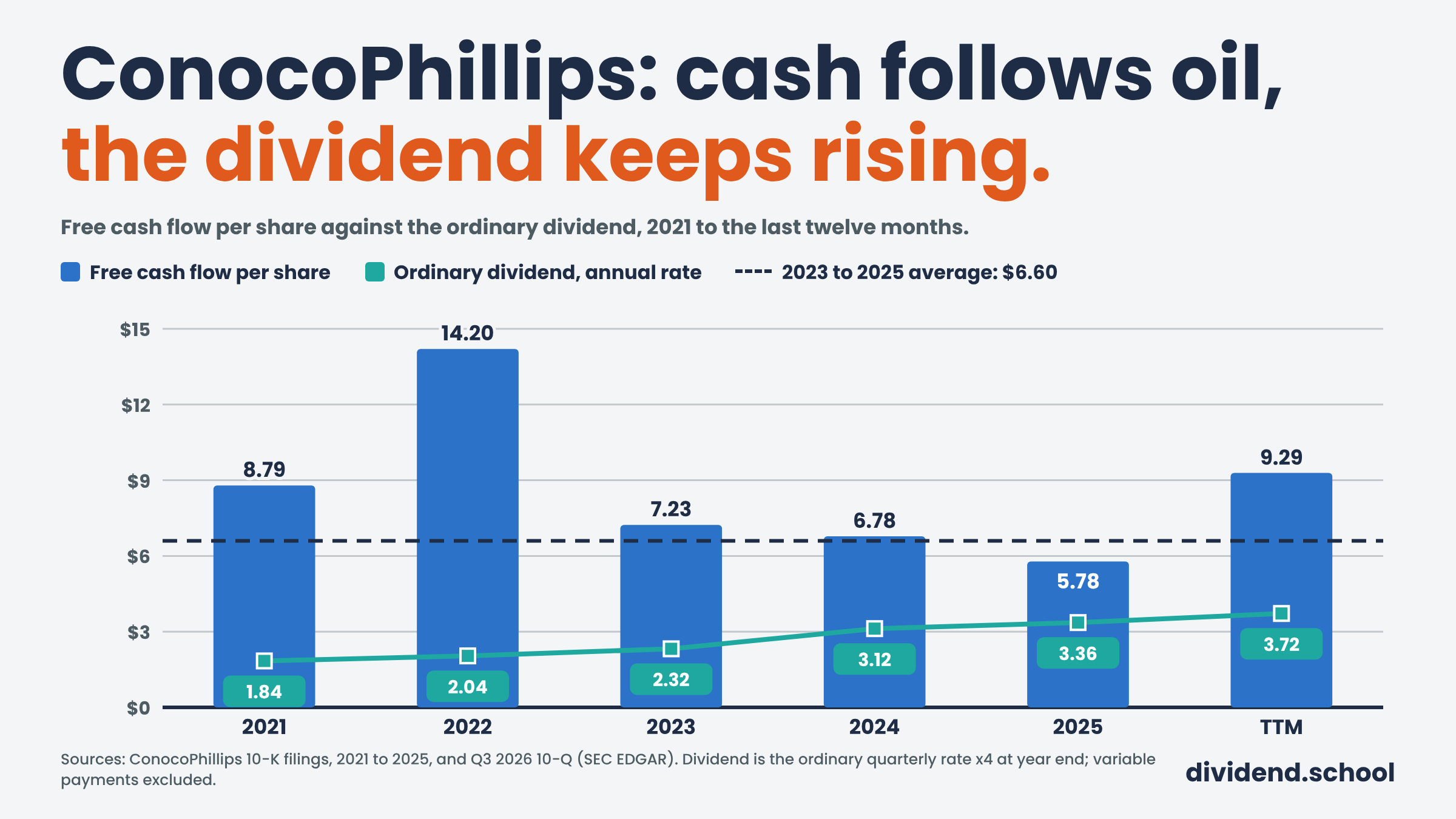
Payout on free cash flow, last twelve months: 40.0% ($3.72 / $9.29)
Payout on 2025 free cash flow: 64% ($3.72 / $5.78)
The first number looks great. The second shows what happens when oil cools off.
Free cash flow follows oil prices
Look at free cash flow per share over the last four years:
2022: $14.20
2023: $7.23
2024: $6.78
2025: $5.78
Last twelve months: $9.29
Down 59% from 2022 to 2025, then back up 61% over the last twelve months. Same company, same wells. The price of oil did that.
So what number do we value?
Neither extreme. We use the three-year average from 2023 to 2025, $6.60 a share, as a “normal” year. It’s the same approach we use for Carlisle, another business whose cash flow jumps around from year to year. My crystal ball on oil prices is quite cloudy.
What to keep an eye on
Free cash flow per share in 2025 was 34% below 2021 ($5.78 against $8.79). Part of that is oil prices. Part of it is the Marathon Oil acquisition, which ConocoPhillips paid for in stock. Diluted shares went from 1,181 million in 2024 to 1,253 million in 2025, so more shares split the same cash, even with $5,018 million of buybacks in 2025.
Does that put the dividend at risk?
Not at these levels. At the normalized $6.60, the new dividend takes 56% of free cash flow. But if oil falls and stays down, raises come first, and we shouldn’t expect another 15% year.
The Buy Below
Our Buy Below for ConocoPhillips is $149.
That’s a discounted cash flow model based on normalized free cash flow of $6.60 per share, growing 7% a year for five years and then fading, with an 8% required return and a 20% margin of safety. The bigger margin of safety is for the oil price. We can’t control it, and neither can ConocoPhillips.
At $140.52, the stock sits 5.7% below the Buy Below.
Verdict for our process
Owning ConocoPhillips means taking a view that the world keeps needing oil and gas for a long time. I’m comfortable with that. A 22.4% ROE and a dividend growing 15% a year, from a company that also bought back $5 billion of its own stock last year, is a lot to like.
For me, a buy under $149, sized smaller than our steadier names. This is the one of the five that will make us the most nervous in a bad year. Plus, this makes me work on something a little outside my comfort zone: commodities.
That’s two of the five, graded in full and free.
Below the line, the other three:
Number 3 yields 8.46%, raised its payout 12.5% for the third year in a row, and trades 34% below our Buy Below. The market doesn’t believe it. Here’s the one number that decides who’s right.
Number 4 froze its dividend in 2025, then raised it 6% this year. Its free cash flow is the highest it’s been since at least 2019, and I’ll show you why I don’t fully trust that.
Number 5 misses our yield bar, and I added it anyway. Five straight raises between 8% and 9%, and a merger that closes next year.
Plus the five new rows for the Universe table, with all five Buy Belows.
The rest of this issue is for paid Dividend School Pro subscribers.
One thing before you join. Don’t do it today.
On Friday, November 27, Pro drops to $299 a year from $369, and that price stays locked for as long as you’re a member. Stock Simplifier Pro and The Forever Five are included.
Want it sooner? Tuesday, November 24, at 7 PM ET, I’m going live on Substack to break down Mastercard. Anyone on the Live can grab the offer that night.
This issue will be waiting when you join, all three names and the five new rows.
Members, keep scrolling.