

As usual, superinvestors bought a lot of dividend stocks last quarter. You could argue many of them didn’t buy them for the dividends alone.
I scoured (with the help of Claude) 83 managers on Dataroma, the best source, for the latest 13f filings from Q2 2026. Seventy-nine filed in the quarter. We discovered some interesting investments, and some not-so-surprising ones as well.
In today’s post, we will learn:
What is a 13F and How to Use One
Two Value Investors Buying the Same 70-Year Dividend King
Greenhaven Betting 15% on Two Unloved Dividend Growers
Every Big High-Yield Purchase was a Broken Dividend
Buffett Didn’t Buy for Yield
Berkshire sold Visa and Mastercard, Ackman Bought Both
How to Use This in Your Process
What is a 13F and How to Use One
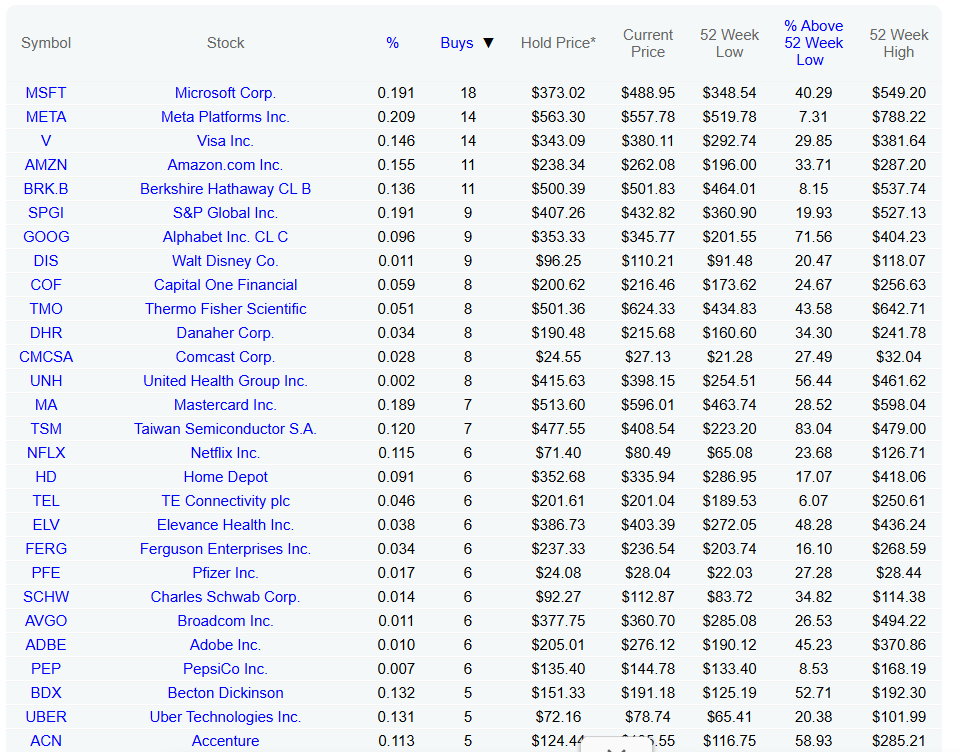
A 13F is the quarterly form any institutional manager with over $100 million in US equities has to file with the SEC. It lists their long US stock positions as of the last day of the quarter, and it is due 45 days later.
That gap matters. When you read that a superinvestor bought Mastercard in Q2 of 2026, what you are looking at is a purchase sometime earlier in the year. They may have bought it in May or June, and sold it by now. And you are reading the report in August and possibly making a decision on that earlier buy.
The 13F also omits other parts of the portfolio that might be large positions. Investments such as bonds, money markets, short positions, etc. are not included in a 13F.
The 13F answers one question. What did Bill Ackman own on June 30th of 2026? It doesn’t tell when he bought it, at what price, or whether he still owns it until the next 13F release.
Most investors read 13F reports through an aggregator such as Dataroma. And these are quite good. Something to keep in mind when reading them. They track changes in shares and portfolio weight. That’s it.
These are useful tools, but always remember what they are telling you. Don’t make investment decisions based solely on their information.
Two Value Investors Buying the Same 70-Year Dividend King
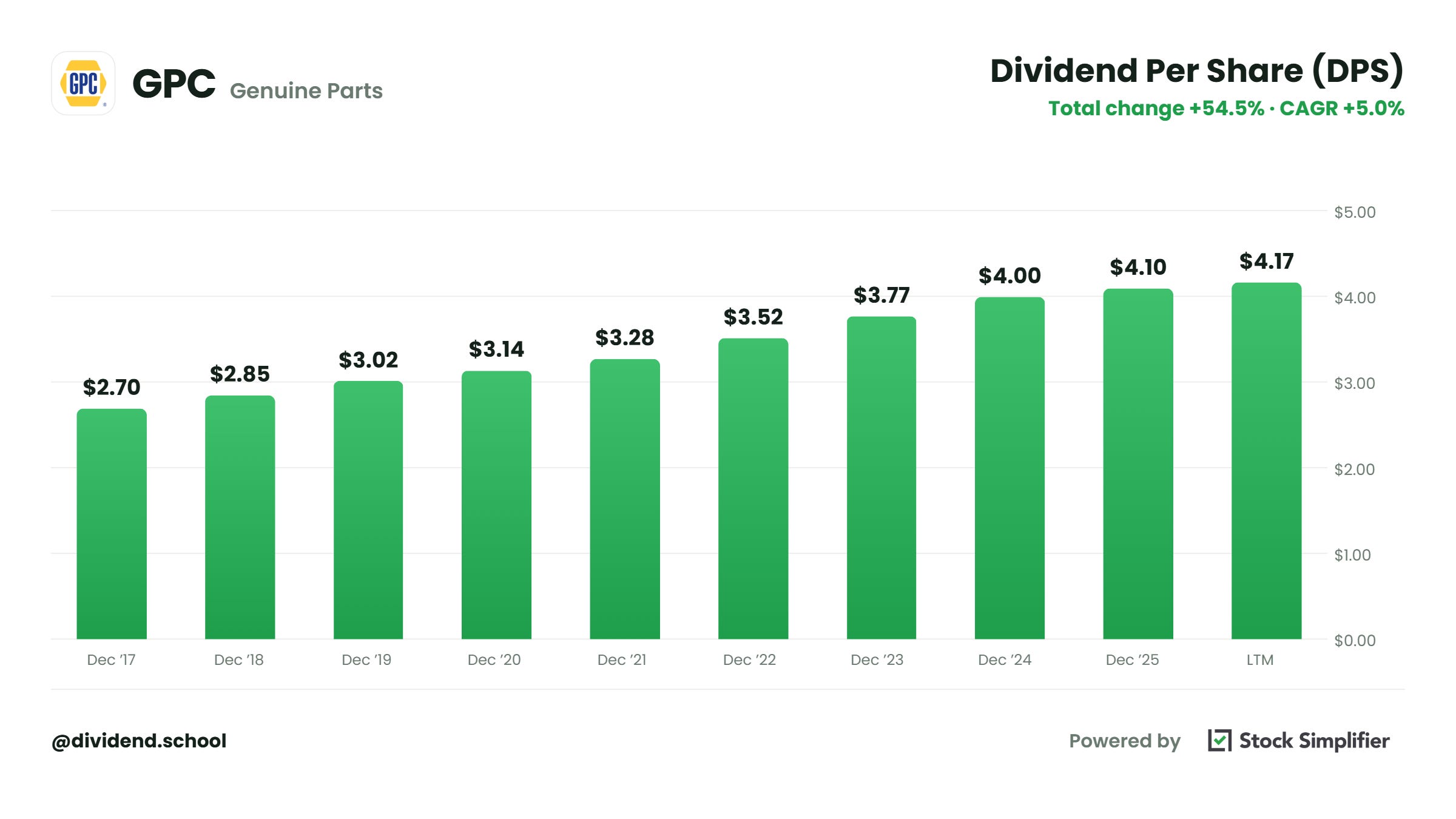
Genuine Parts (GPC), the automotive distributor of replacement parts, has paid a growing dividend for 70 consecutive years. It’s one of the Dividend Kings with a longer history than most. 2026 has not been kind to the company.
Two superinvestors of different styles bought the company in the same period.
Seth Klarman of Baupost added 1.49 million shares, bringing its total to 2.81 million shares with a total position of $332.2 million (6.1% of portfolio)
Harry Burn of Sound Shore opened a new position with purchases totaling 579,343 shares worth $68.4 million. He created a 2.1% position in GPC.
Sound Shore also opened a $69.7 million position in National Fuel Gas (NFG), representing another 2.1% of the portfolio.
GPC currently yields 3.1%, and while that looks good, the GAAP payout ratios not so much. The payout ratio reads as a smooth 1,886%, which is an accounting distortion related to restructuring and separation charges. While these are real costs, they are one-time and distort the real earnings.
The free cash flow payout ratio is 77%. Much better and more reliable.
The two payout coverage ratios tell you what kind of research every investor needs to do. GPC screens as “cheap for a reason.” Our research must determine if that reason is permanent.
Part of dividend investing is finding the best balance of growth and yield.
And the other part is to make sure every company’s dividend is safe.
Check any company's dividend safety using this FREE TOOL:
Greenhaven Betting 15% on Two Unloved Dividend Growers
Greenhaven Associates manages around $8,7 billion. Last quarter they opened two new positions and added 15% of them to the portfolio. Big bets for sure.
Who were they?
Becton Dickinson (BDX): 5.6 million shares for $858.8 million for a 9.9% position
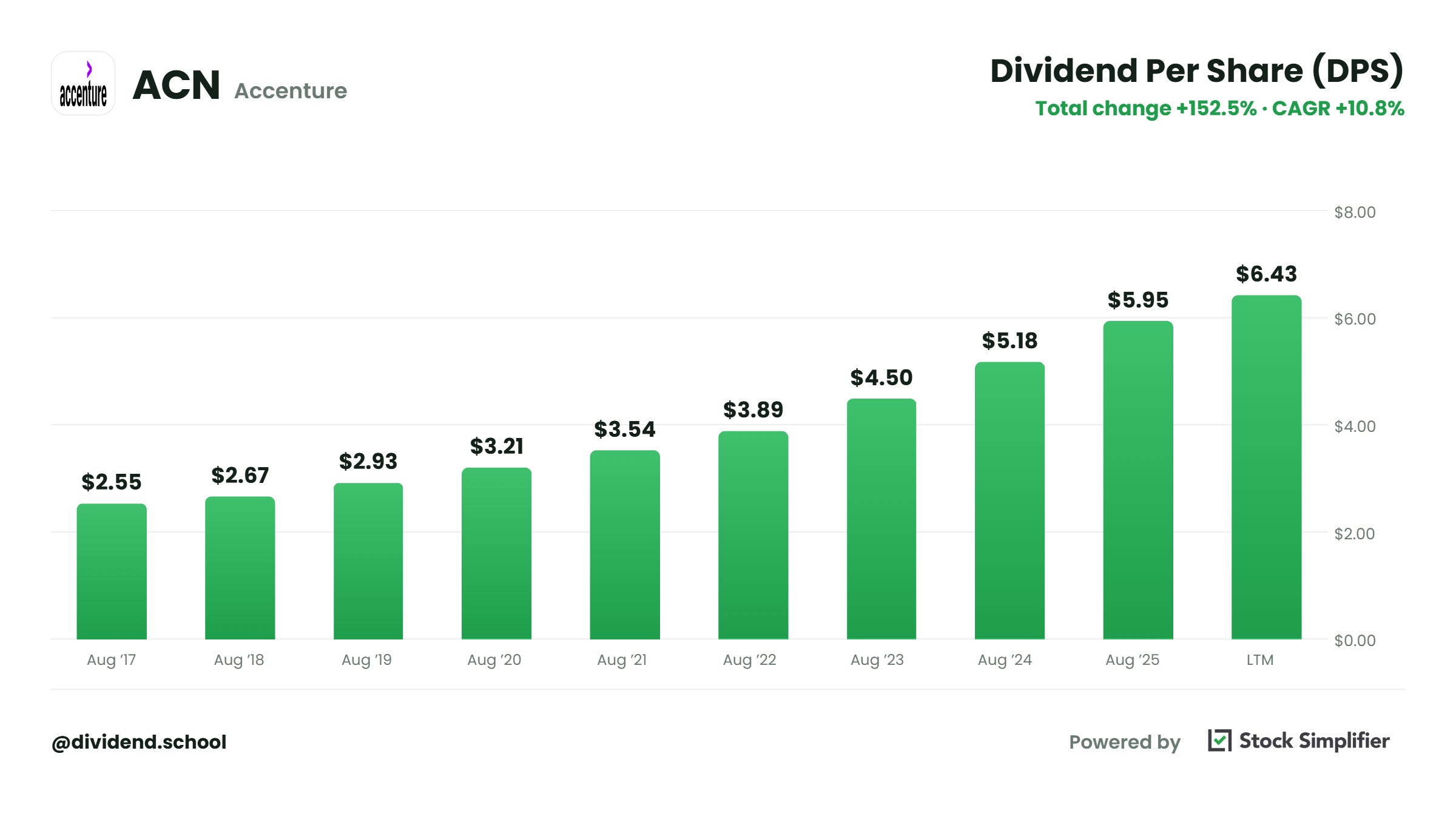
Accenture (ACN): 3.3 million shares for $421.2 million for a 4.9% position
BDX is a medical technology company that makes medical devices, instrument systems, and lab equipment, and it is also a Dividend Aristocrat. This 54-year-old dividend grower last raised 1.0%; it’s its weakest in decades. The company pays a 2.29% yield, with a payout ratio (earnings) of 126%, yikes, but a reasonable free cash flow payout of 42%.
Accenture has a current yield of 3.77%, it’s highest in years. The reason for the yield is simple: a falling stock price as the market voices its worries about AI concerns.
Here is something we can take away from both purchases.
A rising yield on a quality company is the market telling us it believes something is broken with the company or they are misreading the signals. The size of the dividend raise can tell us which one is the worry and which one isn’t.
BDX only raising 1% is not a great signal. And that is why have a good due diligence process is key. Time will tell whether Greenhaven is right or wrong on BDX and ACN.
Every Big High-Yield Purchase was a Broken Dividend
We can learn a lot from superinvestors’ investments.
Today’s lesson: every high-yield investment came on the back of a broken dividend. In other words, there was a red flag or scary signal associated with each company’s dividend or high yield.
A great example of this. Prem Watsa, who owns Kraft Heinz (KHC), added to his position this quarter, raising his stake to 12.8% of the portfolio. This is now his single biggest position. But if you look at the stock, it’s kinda ugly. KHC yields 6.4%, but the company cut its dividend 36% in 2019 and has held it flat ever since. No growth. The company also took a $7.6 billion impairment in Q2 2026.
Another example. Bruce Berkowitz of Fairholme opened three new positions in dividend payers.
Pfizer (PFE)
Campbell’s (CPB)
UPS
All three are on the struggle bus, with high yields above 6% and either freezing dividend streaks or elevated free cash flow payout ratios.
Another example, Christopher Davis, added LyondellBasell (LYB) after it cut its dividend roughly 50% in February.
Every one of these managers is buying a company whose dividend has already broken, and the price now reflects it. The good news: the cut is behind them; the cash coverage has reset to a more manageable level. And the managers believe the companies are worth more than the market believes.
That is a completely different investment than buying yield.
The big takeaway: understand the business and what the company can do in the future. If you understand UPS and have insight into what you think it will earn in 2029, and ignore the headlines, you can find great potential investments.
But the key is to look at the last dividend action before you look at the yield. It’s one number that separates a rebuilt payout from one that is about to break.
Buffett Didn’t Buy for Yield
Warren Buffett didn’t buy for yield, he never has, and never will. He and Greg Abel had a busy quarter.
During the quarter, they bought:
Alphabet (GOOGL)
Delta
Lennar
Macy’s
New York Times
Some of those were newer positions, while Google was an increase.
They also reduced some of their positions, including:
Bank of America
Kroger
Nucor
Capital One
Ally
DaVita
Constellation Brands: exited entirely
The manager most investors associate with dividend income (Buffett) spent the quarter buying a lot of a new dividend payer and exiting positions with a strong history of dividend payments.
Buffett has never bought for yield; three of his great investments, American Express, Coke, and Apple, all pay dividends. For Buffett, the attraction was the cash flows the company throws off, which he can redeploy. Whether the cash comes from dividends or is generated internally has never mattered to Buffett. It’s the cash flows, period.
Consider this: Coke paid Buffett $816 million in dividends in 2025. Compared to the $1.3 he paid for that investment in 1988, at a reasonable price. He has more than compounded that investment through other opportunities, such as American Express, Apple, and BNSF.
Berkshire sold Visa and Mastercard, Ackman Bought Both
During the first quarter of 2026, Berkshire exited both Visa and Mastercard.
One quarter later, Bill Ackman added both
Visa equals a 5.76% position
Mastercard equals a 5.61% position
S&P Global equals a 5.43% position
Three new positions, all for around $1.1 billion each, all in businesses that act as tolls on the financial flows.
The interesting thing is that two of the most recognizable investors took opposing views on the same companies 90 days apart.
Here is why this is interesting for dividend investors.
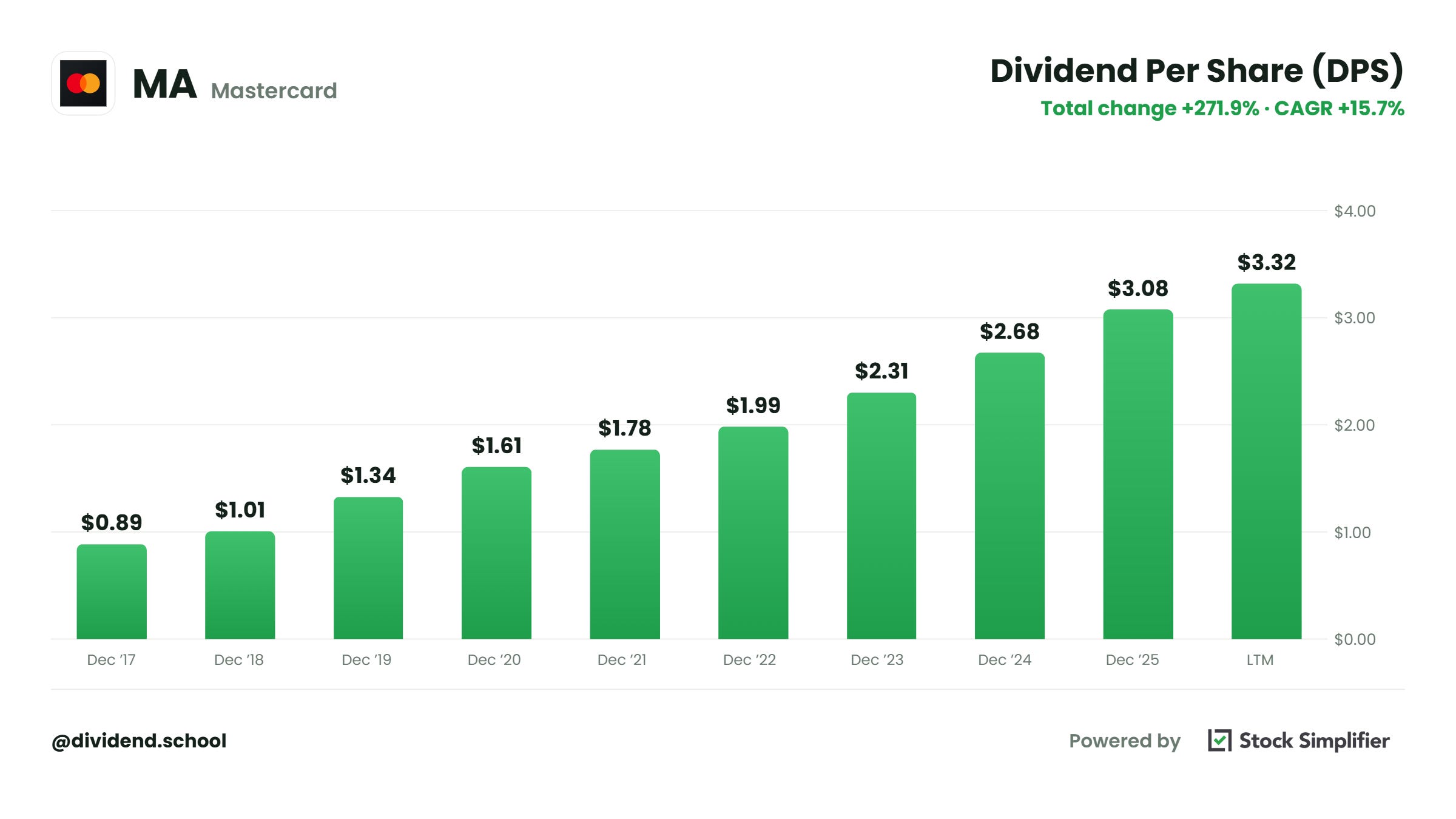
Visa and Mastercard are dividend growers, but they don’t show up in most screens because their yields are low. But their stats are off the charts because of their business model:
Visa = 0.75% yield
23% payout ratio
21% FCF payout ratio
17-year streak
Last raise: 13.6%
Mastercard = 0.62% yield
19% payout ratio
16% FCF payout ratio
14-year streak
Last raise: 14.6%
At a 0.62% yield, that looks like nothing, but add a 14% annual raise for 15+ years, and now we are talking about something. The yield on cost starts to approach 4.4% after 15 years, on a company paying out less than one-fifth of its earnings.
That is what a dividend grower looks like next to a dividend payer. And if you are using minimum yields in your screens, you look right past it.
The other name Ackman bought, S&P Global, is another toll road in the financial space. On the surface, everything looks great: a 53-year raise streak and a 24% payout ratio; what’s not to love? However, the latest raise was 2.1%, the weakest in years.
So, SPGI gets put on a watch list.
A long streak with a slowing raise is something to watch. Remember the streak is a historical fact, while the raise is the current forecast.
How to Use This in Your Process
Three habits come out of this quarter.
Read the last dividend action first, then the yield. Every high-yield name a superinvestor bought last quarter had a freeze, a skipped raise, or a cut behind it. Yield rises when the price falls, and the price usually falls for a reason management already announced.
Size the raise, not just the streak. A 54-year Aristocrat raising 1.0% (BDX) and a 51-year Aristocrat raising 10.4% (ADP, bought by both First Eagle and Giverny this quarter) are in different businesses even if a screener sorts them the same way. Carlisle just became a Dividend King and announced a 14% raise on August 6, 2026. Home Depot raised 1.3%, its smallest in over a decade, and the Gates Foundation Trust opened a million shares anyway.
Use free cash flow payout, not earnings payout. Genuine Parts reads at 1,886% on GAAP earnings because of separation charges and about 77% on free cash flow. Air Products looks like a clean 44-year Aristocrat at a 2.41% yield until you notice trailing free cash flow is negative and the last raise was 1.1%. The 44-year streak is accurate and the cash behind it has thinned out.
One more thing worth watching from the quarter. Sysco (SYY) showed up in three unrelated portfolios: Bill Nygren’s Harris/Oakmark added 11.01M shares to 16,292,380 ($1.36B), Daniel Loeb opened 580,000 shares, and Yacktman added. A 56-year Aristocrat at a 2.65% yield that just slowed its raise to 1.9%. Same tension as SPGI, smaller company.
Final Thoughts
Using a 13F is a great way to source investment ideas. And it’s always nice when someone you respect buys or owns something you do as well. It’s a nice form of confirmation bias.
But remember the gap between when they buy and when they report, and what we see.
Also notice the pattern we talked about today. The superinvestors were buying companies that had a broken dividend, either recently or in the recent past. They are betting that the business rebounds and moves forward from those bumps in the road. And if they are right, they get a great company for a reasonable price, which is the bread and butter of value investing.
Copying is a great way to learn, and following super investors into these types of investments can work out well. Always do your own due diligence and make sure you understand what you own and why.
Until next time, take care and be safe out there,
Dave
P.S. Want to know if your dividends are safe?
Check any dividend payer in one free sheet.
Every streak, payout ratio, and debt load for Coca-Cola, Johnson & Johnson, Realty Income, and 997 more. Straight from SEC filings, updated monthly.
who is right ?