

Run a yield screen on everything listed in the US, and one corner of the market keeps showing up at the top of the list. Yields of 9%, 10%, 12%, and one at 18%.
Business development companies, or BDCs.
Most investors have never owned one. Plenty have never heard of them, and the ones who have usually file the whole group under “yield trap” and move on. That is a mistake, but so is buying the biggest yield on the list. Both mistakes come from the same place: not understanding how these things actually work.
So today we fix that.
In today’s post, we will learn:
What a BDC Is
How a BDC Makes Its Money
Why the Yields Run 10% and Higher
The Tax Bill, and Which Account Fits
How We Score a BDC
The Scored BDC List
Okay, let’s dive in and learn how these 10% payers actually work.
What a BDC Is
In 1980, Congress decided America’s smaller companies needed better access to capital, so it amended the Investment Company Act of 1940 and created a new vehicle to do the job. That vehicle is the business development company.
Think of a BDC as a bank without branches. It raises money from shareholders like us, borrows some more, and lends the whole pile to mid-sized private companies. The kind of business too big for the local bank and too small for the bond market: your regional trucking firm, your software company doing $100 million in revenue, your family-owned manufacturer.
The law puts real fences around the model:
At least 70% of assets must sit in “qualifying” investments, mostly private US companies or small public ones (under $250 million in market cap).
The BDC must offer its portfolio companies significant managerial assistance. Advice and counsel, not just a check.
Leverage is capped by law. More on that below, because the cap is where the yield comes from.
The whole group adds up to roughly $450 billion in assets today. That is private credit, the asset class the financial press cannot stop writing about, except this version trades on an exchange where we can buy it with a ticker.
So why have most investors never heard of them?
Here is my favorite piece of trivia in this entire asset class. In 2014, the S&P and Russell indexes kicked every BDC out. The reason was an accounting rule, not performance: any fund that owns a BDC must fold the BDC’s operating expenses into its own reported expense ratio, which makes the fund look expensive even though nothing extra leaves anyone’s pocket. Index funds did not want the optics; the index providers dropped the group, and a decade later the fix is still stuck in Congress.
The result is an entire asset class your index fund owns none of. No forced buying, less analyst coverage, and yields that stay high partly because the biggest pools of money in the world are not allowed to reach for them. Kinda beautiful if you ask me.
How a BDC Makes Its Money
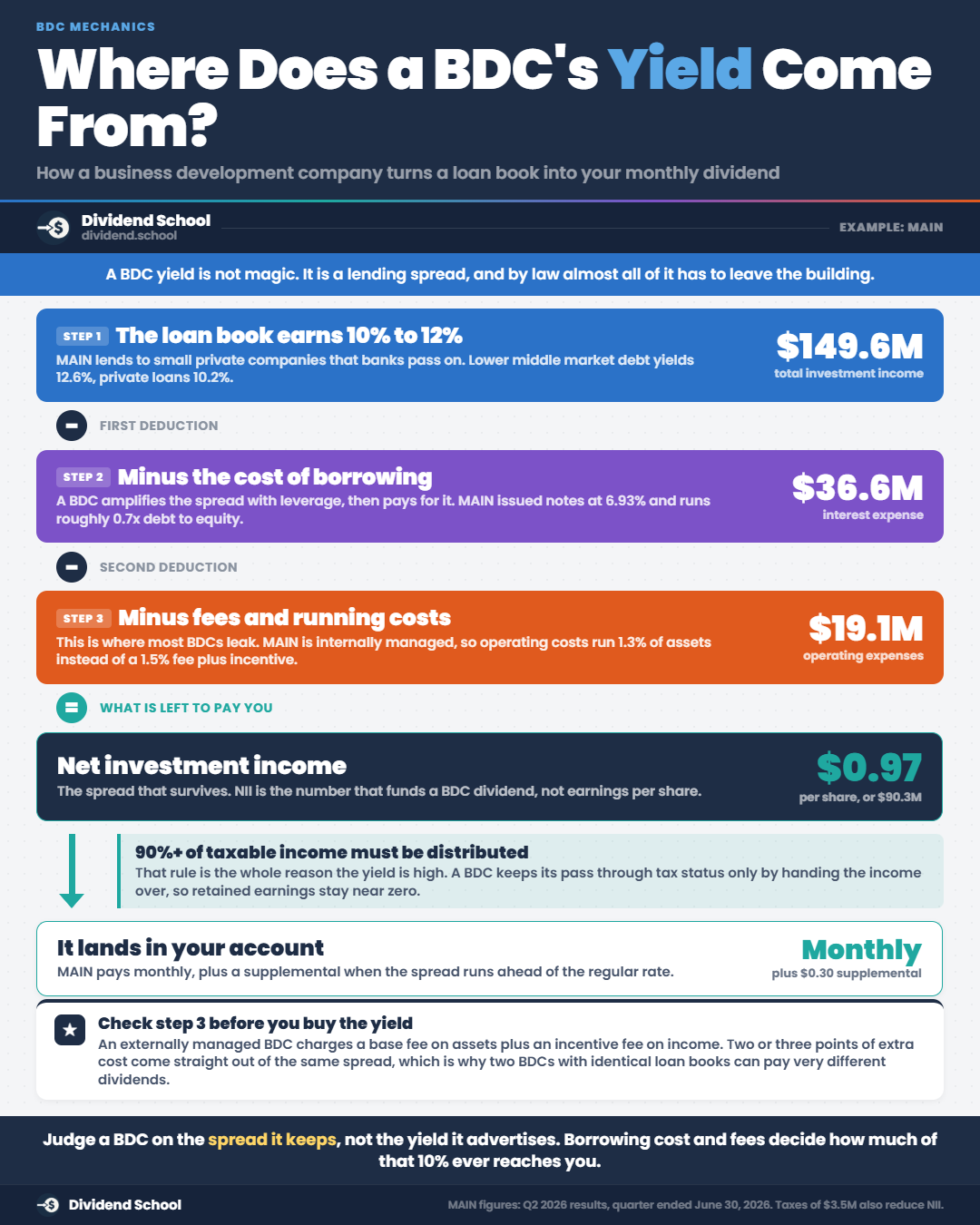
The engine is simple. Borrow at one rate, lend at a much higher one, keep the spread. Sound familiar? It is the same trade every bank on earth runs, minus the checking accounts.
The loans are the part worth understanding. A typical BDC loan is first-lien, senior secured, floating-rate, made to a private middle-market company. First lien means first in line if things go wrong, the same seat the bank holds on a mortgage. Floating rate means the interest the BDC collects moves with short-term rates rather than sitting fixed for ten years.
Two numbers tell us almost everything about a BDC, and both have a familiar cousin:
Net investment income (NII). All the interest and fees collected, minus what the BDC pays for its own borrowing and management. NII is the BDC equivalent of earnings per share, and it is the number the dividend has to live inside.
Net asset value (NAV). Portfolio value minus debt, per share. NAV is book value, plain and simple. When loans go bad, NAV is where the damage shows up.
Let’s use Ares Capital, the biggest BDC of them all, as our guinea pig. In the second quarter it earned $0.50 per share of NII and paid a $0.48 dividend, so dividend coverage was 104% ($0.50 NII / $0.48 dividend). NAV finished June at $19.35 per share. Three numbers, and we already know more about that dividend than most holders do.
One more term, because it decides everything. When a borrower stops paying, the loan goes on non-accrual, the BDC’s version of a bank’s bad-loan list. Non-accruals as a percentage of the portfolio is the single best early warning this asset class offers. A BDC can fake a lot of things. It cannot fake a borrower who quit paying.
Why the Yields Run 10% and Higher
A 10% yield from a regular company usually means the market expects a cut. So why does the same number mean something different here?
Two laws drive yield, and neither is a red flag.
Law one, the tax deal. A BDC that elects to be a regulated investment company pays no corporate tax as long as it hands at least 90% of its taxable income to shareholders every year. Same deal REITs get. Skip the distribution, and the IRS adds a 4% excise tax for anything short of 98% paid out in the calendar year. The government built these vehicles to pass money through, so they do, and the payout ratio that would terrify us at a normal company is simply the law working.
Law two, the leverage cap. The original 1980 rules capped BDCs at one dollar of debt per dollar of equity. In 2018, Congress loosened it to two dollars of debt per dollar of equity for BDCs whose boards or shareholders approve it, and most of the big ones did. Compare that to a bank running ten-to-one, and BDCs are still the sober ones at the party, but the extra turn of leverage juiced every yield in the group.
Stack it up: loans that pay far more than public bonds, up to 2x leverage, and a legal requirement to pay out nearly everything. That is how a well-run BDC yields 10% without a single alarm bell ringing.
Here is what the eight biggest names on my screen pay right now, on their regular dividends at late-August prices:
Ares Capital (ARCC): 9.6% ($1.92 in annual dividends / $20.09 share price)
Blue Owl Capital Corp (OBDC): 10.8%
Blackstone Secured Lending (BXSL): 12.3%
FS KKR Capital (FSK): 14.2%
Main Street Capital (MAIN): 5.4% (plus supplementals that take it near 7.4%)
Hercules Capital (HTGC): 9.1% (10.6% with supplementals)
Golub Capital BDC (GBDC): 10.0%
Prospect Capital (PSEC): 18.4%
Now the caveat, and I am putting it right here where it cannot be missed.
The structure explains why 10% is normal. It does not make every yield on that list safe. FSK pays 14.2% because the market has watched its NAV fall by 16.6% over the past year and priced in more pain. PSEC pays 18.4% because it has cut the dividend repeatedly and the market has stopped believing. Within one asset class, the same yield number can mean “the law working” or “the market bracing,” and the whole job is telling those two apart.
Which is exactly what the scorecard at the end of this piece does.
The Tax Bill, and Which Account Fits
This section will save some of us more money than the stock picks will. BDC dividends are taxed worse than almost any income we can buy, and where we hold them matters more than which one we pick.
Remember that a BDC’s income is mostly loan interest. When that interest passes through to us, the tax code keeps its character: it arrives as non-qualified ordinary dividends, taxed at our regular income rate. Not the nice 15-20% qualified dividend rate our Coca-Cola checks get. The rate on our paycheck.
How bad is the damage?
The arithmetic hurts. For a top-bracket investor in 2026, ordinary income is taxed at 37% plus the 3.8% net investment income tax, 40.8% all in. A 10% BDC yield keeps 5.9% after tax (10% x (1 - 0.408)). The same 10% paid as qualified dividends would keep 7.6% (10% x (1 - 0.238)). Same stock, same check, and the account choice moves our take by 1.7 points of yield per year. Compound that for a decade and it is real money.
It gets one notch worse. REIT investors currently deduct 20% of their REIT dividends under Section 199A. BDC dividends get no such deduction. The IRS rules limit that pass-through to REIT dividends specifically, so a BDC’s ordinary payout is full-freight ordinary income. The one tax perk the high-yield neighborhood enjoys, and BDCs are not invited.
So where do we hold them? The answer writes itself:
Roth IRA: the best seat in the house. The brutal ordinary rate becomes irrelevant, and a 10% compounder in a Roth is a beautiful thing.
Traditional IRA or 401(k): nearly as good. Everything coming out gets taxed as ordinary income anyway, so an asset already taxed at ordinary rates loses nothing by being here.
Taxable account: last resort. The IRS takes its cut at our full income-tax rate, every single year.
Two pieces of good news before we move on. BDCs send us a standard 1099-DIV, not the K-1 partnership form that makes MLP owners cry in March. And they throw off no UBTI, the tax landmine that makes some MLPs dangerous inside retirement accounts, so an IRA can hold as much BDC as we like with zero paperwork consequences. The IRS treats routine dividends inside an IRA as exempt, full stop.
One wrinkle to file away: parts of a BDC distribution can also arrive as capital gains or as return of capital, and the 1099 sorts it out each January. If the phrase “return of capital” makes your eye twitch, good instinct. We are going much deeper on dividend tax character in the free piece landing Tuesday the 15th, Qualified vs Ordinary Dividends: The $4,000 Mistake.
How We Score a BDC
Everything above is the education. Here is the process, the same five-question shape we use on the Universe, rebuilt for this asset class.
Five checks, one point each:
Coverage: NII of at least 100% of the regular dividend. The dividend has to live inside earnings. At 97% we are eating the seed corn; at 125% there is room for raises and mistakes.
NAV per share is flat or rising over the past year. A fat yield paired with a shrinking NAV is us being handed our own money back with a tax bill attached. My least favorite magic trick.
Non-accruals under 2% of the portfolio at fair value. The bad-loan list, remember. Under 2% is normal weather. Above 3%, the credit engine itself is misfiring.
Leverage at or under 1.25x debt-to-equity. The law allows 2x. The graveyard is full of lenders who used everything the law allowed.
A fee structure that respects us. Internal management is the gold standard because the people running the loans work for shareholders, not for a fee stream. External is fine at a 1% base fee. At 1.5% and up, we are the yield somebody else is harvesting.
Score five out of five, and we have a hold-forever candidate. Three is a watchlist. Under three, I don’t care what it yields.
I ran all five checks on all eight names above, straight from their June 30 filings. The results surprised me. Two perfect scores, and neither one is the biggest or the most famous name on the list. One of the most popular BDCs in America scored a 2. And the two biggest yields on the board sit on the two worst report cards, which is exactly how this asset class keeps score.
That is the education, free, and it is most of what anyone needs to know about the asset class.
The part I cannot give away is the grading. Eight BDCs, five checks each, forty data points pulled from the June 30 filings, and a letter grade with a verdict on every name. Two A’s, a D for one of the most famous names in private credit, and the popular favorite whose dividend is outrunning its earnings.
Members, keep scrolling. Everyone else: seven days free.
Membership is $369 a year or $35 a month, with a 7-day free trial and a 30-day money-back guarantee either way.