

Two investors collect $50,000 of dividends this year. One pays $0 in federal income tax on them. The other pays $3,820.
Same income. Same year. The difference is what kind of dividend it was and which account it was sitting in.
Most of us pick the stock, click buy, and never think about which account we clicked buy in. This piece is the fix.
In today’s post, we will discuss:
What makes a dividend qualified
The $3,820 mistake
Where each kind of dividend belongs
Real names, sorted by account
Common mistakes
How to use this in your process
One thing before we start. I am not a CPA, and this is not tax advice. The numbers below are the 2026 federal rules, and your state, your bracket and your CPA all get a vote.
If you have any specific questions related to your tax situation? Consult your accoutant and get advice to setup the accounts which best work for you. These suggestions below are a basic starting point, but if you have a more complicated portfolio or finances, a accountant will be worth their weight in gold.
Okay, let’s dive in and figure out where our dividends should live.
What makes a dividend qualified
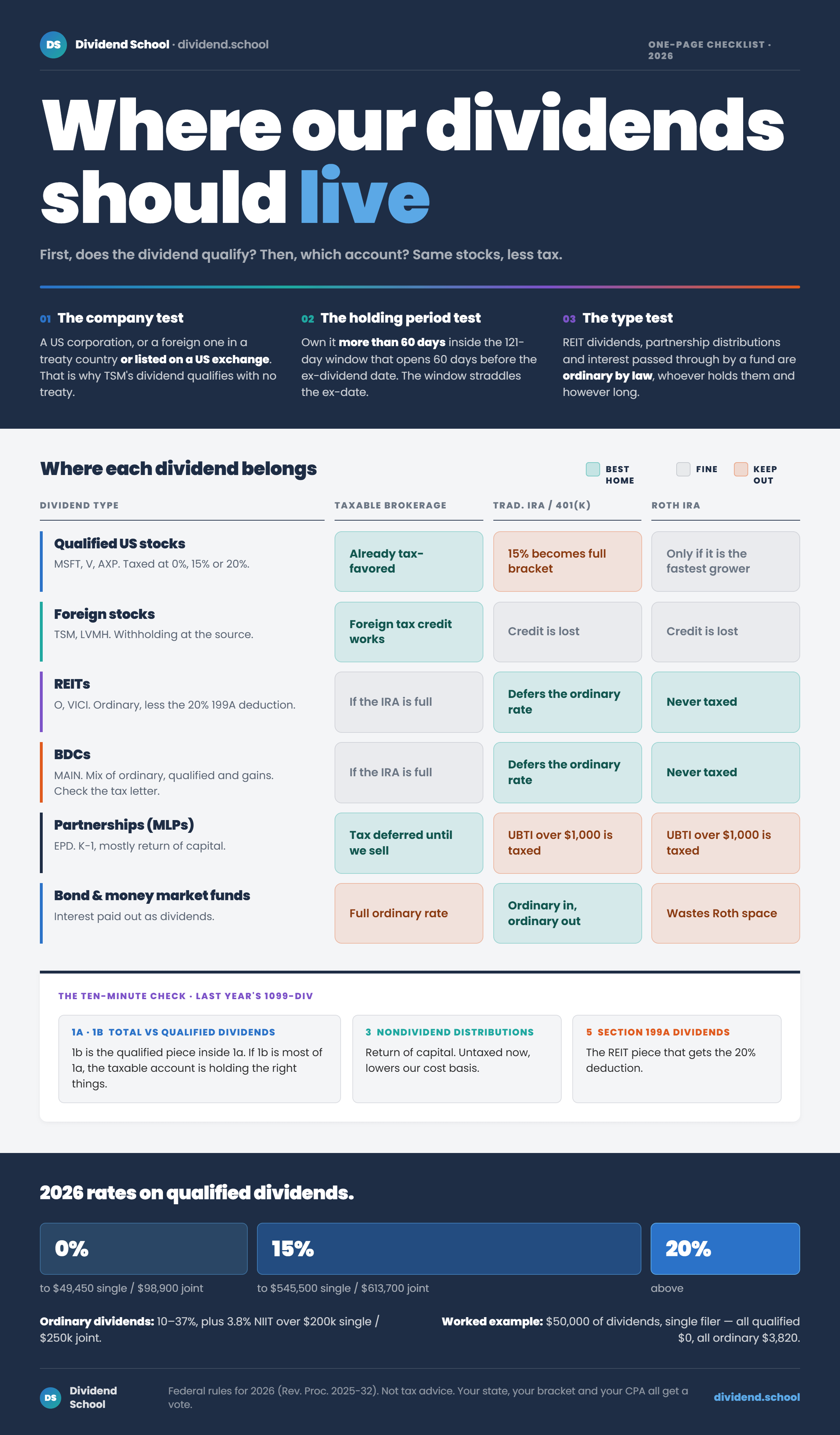
Every dividend lands on the 1099-DIV in one of two piles. Ordinary dividends get taxed like a paycheck, at whatever bracket we are in, 10% up to 37%. Qualified dividends get the long-term capital gains rates instead: 0%, 15% or 20%.
So the whole game is getting into the second pile. Three tests, and the dividend has to pass all three.
The company test. The payer has to be a US corporation, or a foreign one that either sits in a country with a full US tax treaty or trades on a US exchange. That last clause matters more than it looks, and we come back to it with TSM.
The holding period test. We have to own the shares for more than 60 days inside the 121-day window that opens 60 days before the ex-dividend date. WARNING, the window straddles the ex-date, it does not start at it. Buy a stock the day before it goes ex-dividend and sell it three weeks later and that dividend is ordinary, no matter who paid it.
The type test. Some payers are shut out by law regardless of the first two. REIT dividends. Distributions from partnerships. Interest that a fund passes through as a dividend, which is what bond funds and money market funds do. Those are ordinary by design.
Why are REITs and partnerships shut out?
Because they never paid corporate tax in the first place. Microsoft pays tax on its profit, then pays us a dividend out of what is left, and the lower rate is the IRS admitting the money was taxed once already. Realty Income skips the corporate tax entirely, so the IRS collects its share from us instead.
The $3,820 mistake
How big is the gap?
Bigger than most investors think, so let’s put numbers on it.
Say we are single, it is 2026, and our only income is $50,000 of dividends. The standard deduction is $16,100, so taxable income is $33,900 ($50,000 - $16,100).
Now run the same $33,900 through both piles:
All qualified: the 0% rate runs up to $49,450 of taxable income. Our $33,900 sits under it. Tax: $0.
All ordinary: 10% on the first $12,400 ($1,240) plus 12% on the remaining $21,500 ($2,580). Tax: $3,820.
Same $50,000. One version is free, the other costs $3,820 a year, every year.
Higher up the ladder the gap narrows but never closes. In the 24% bracket we pay 15% on qualified dividends and 24% on ordinary ones, so every $10,000 of dividends costs $1,500 one way and $2,400 the other.
One wrinkle for REITs, and it is a good one. The 2025 tax law made the Section 199A deduction permanent, and it knocks 20% off REIT ordinary dividends before tax. In our $50,000 example the deduction is capped at 20% of taxable income (20% of $33,900 = $6,780), so REIT income comes out at $3,006 rather than $3,820. I will take it, and it is still not zero.
Where each kind of dividend belongs
We cannot change what kind of dividend a company pays. We can change which account we hold it in, and the IRS treats the three account types completely differently:
Taxable brokerage: every dividend is taxed the year it arrives, at whichever rate applies.
Traditional IRA or 401(k): nothing is taxed until we withdraw, and then everything is ordinary income, qualified or not.
Roth IRA: nothing is taxed, ever, once we clear the five-year rule and age 59 and a half.
Notice what the Traditional IRA does to a qualified dividend. Income that would have been taxed at 15% comes out the other end taxed at our full bracket. No free lunch here. Shelter has a cost, and the cost is highest on the income that needed it least.
So three rules, in order:
A dividend that is already tax-favored stays in the taxable account. Qualified payers. Foreign payers, for a reason we get to in a second. Sheltering them wastes shelter.
A dividend taxed as ordinary income gets sheltered. REITs and bond funds go in the Traditional IRA. Whatever we expect to grow the most goes in the Roth, because Roth space is the scarcest thing we own, $7,500 a year of it.
A partnership breaks the shelter. More on that below with EPD.
What if we only have one account?
Then this article is a shrug, and that is fine. Buy the best businesses and move on. The rules above are for the day the second account shows up, which for most of us is a 401(k) rollover or the first Roth contribution.
Real names, sorted by account
Let’s run it on real companies, one structure at a time, with the tax bill per $1,000 of dividends for a reader in the 24% bracket. These are examples, not picks.
Microsoft, Visa, American Express. Plain US corporations, so qualified. Yields of 0.9%, 0.8% and 1.2%, so the income is small to begin with. Per $1,000 of dividends: $150 of tax (15%). These live in the taxable account. Putting Visa in an IRA shelters $8 of dividends per $1,000 invested and spends room we need for something else.
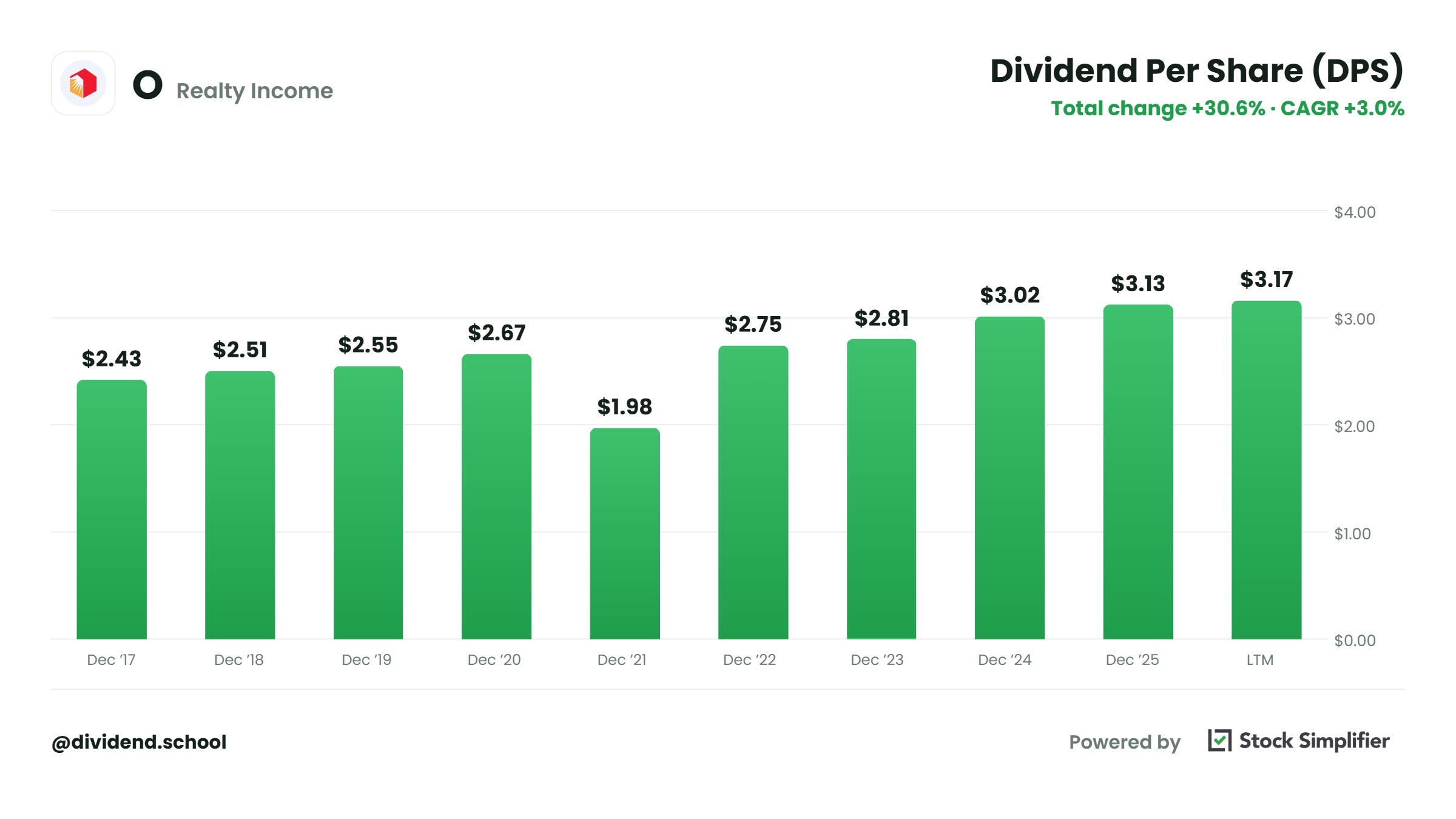
Realty Income and VICI. REITs, so ordinary, but look at what O actually paid in 2025. Of the $3.217 per share:
$1.0819 (33.63%) was return of capital, not taxed at all this year. It lowers our cost basis instead, and we settle up when we sell.
$2.1351 (66.37%) was ordinary income, and 199A takes 20% off that.
Per $1,000 of Realty Income dividends: $336 untaxed, $664 ordinary, less $133 for 199A, leaves $531 taxed at 24% = $127.
VICI ran heavier on the ordinary side in 2025, $1.7019 of $2.1975 per share, with only $0.0456 of return of capital.
Either way these are the first names into the IRA. In a Roth the $127 becomes $0, and at a 5.3% or 6.2% yield that adds up.
Main Street Capital. Here is where the internet gets it wrong. The standard line is that a BDC passes loan interest straight through as ordinary income, so it belongs in an IRA, full stop. Main Street’s own 2024 tax letter says otherwise. Of the $7.61 per share it paid, $2.42 was ordinary, $2.08 was qualified and $2.93 was long-term capital gain. Two thirds of it got the preferential rate.
So where does MAIN go?
Per $1,000, on that split: $76 on the ordinary piece, $41 on the qualified piece, $58 on the gains. $175 total. Higher than a qualified payer, lower than a REIT. So MAIN can sit in taxable if the IRA is full, and it goes in the IRA when there is room. Most other BDCs are pure lenders, and for those the standard line holds. We sort the whole group in the BDC piece later this month.
Enterprise Products. Different animal. EPD is a partnership, so there is no dividend at all. We get a distribution and a Schedule K-1 in March. Most of that distribution is return of capital, which lowers our basis each year and gets taxed when we sell, part of it as ordinary income. In a taxable account that is one of the most tax-efficient income streams we can own.
Put EPD in an IRA and the shelter can turn on us. Partnership income inside a retirement account counts as unrelated business taxable income. The IRA gets a $1,000 allowance, and above that the custodian files a tax return for the IRA and charges us for the privilege. Most years a modest position stays under the line. The year we sell is the year it jumps, because the gain from all that lowered basis lands on the final K-1 at once. Small position, rarely a problem. Large one, keep it in taxable and save the headache.
TSM and LVMH. Foreign, and two things happen at once. Taiwan takes 21% off TSM’s dividend before it reaches us, and France takes its slice off LVMH’s. In a taxable account we claim that back as a foreign tax credit, up to $300 single or $600 joint without an extra form. In an IRA there is nothing to claim it against. The withholding is just gone.
And the dividend itself? Taiwan has no tax treaty with the US, which should make TSM’s dividend ordinary. It is qualified anyway, because the ADR trades on the New York Stock Exchange and the code says a foreign stock readily tradable on a US market passes the company test. I love that rule. Both of these belong in taxable.
Common mistakes
Three I see over and over:
Selling inside the 61 days. A dividend capture trade around the ex-date turns a qualified dividend into an ordinary one. The holding period is the rule most often broken by accident.
Filling the Roth with the wrong thing. A 0.8% yielder in a Roth is shelter spent on income that was already taxed at 15% or less. The Roth is for the highest-yielding ordinary payer we own, or the fastest grower. Visa is neither.
Trusting the yield on the screen. A 6% REIT yield and a 6% partnership yield and a 6% BDC yield are three different after-tax numbers in the same account, and the screen only shows the one before tax.
One thing to keep in mind with all of this process. If you are investing less than the allowed amount for a Roth IRA annually, then put as much of your investments as you can in the Roth. Once you start to fill that up, then you can start to use different accounts for different investments, depending on your goals.
How to use this in your process
Here is how I am doing it now, and it takes ten minutes once a year (a little longer the first time, the 1099 is not a fun read).
Open last year’s 1099-DIV. Box 1a is total ordinary dividends. Box 1b is the qualified piece inside it. Box 3 is return of capital. Box 5 is the 199A piece. If Box 1b is most of Box 1a, the taxable account is holding the right things. If it is not, we have a REIT or a bond fund in the wrong place.
Then, before the next buy, ask one question. What kind of dividend is this?
Corporation, qualified, taxable account. REIT, ordinary, IRA first. Partnership, K-1, taxable and keep it modest. Foreign, taxable, so the credit works. Same stocks, less tax. That is the whole trick.
The checklist version of all this is above, one page, print it and stick it next to the monitor.
What I would read next
In a few days we will release a post covering the BDC universe and scored the ones paying 10% and up, which is the group this article waves at in one paragraph. If you own a BDC or are about to, that is where the tax question turns into a safety question.
That one is for members.
If you have any questions or would like me to cover something in particular, please don’t hesitate to reach out.
Until next time, take care and be safe out there,
Dave
P.S. Want to know if your dividends are safe?
Check any dividend payer in one free sheet.
Every streak, payout ratio, and debt load for Coca-Cola, Johnson & Johnson, Realty Income, and 997 more. Straight from SEC filings, updated monthly.
→ http://stocksimplifier.com/dave
As I switch to an income focus I just went through this. I was surprised how important the brokerage account became.