

On June 18, Accenture fell 20% in a single day, the worst drop in its history. The forecast was soft, but the fear underneath it was AI. If software can do the work of a junior consultant, what happens to a company that bills by the consultant?
I own Accenture, so the pain was close to home.
It got me asking the opposite question. Which dividend payers sell something AI can’t make, deliver, or replace? Paint still has to go on a wall. Trash still has to get hauled. A train still has to run on a track somebody owns.
So we built a list. Ten dividend payers, counted down from #10 to #1, each screened for AI risk and the cash and balance sheet behind the dividend.
In today’s issue, we will cover:
How we picked the ten
#10: Sherwin-Williams (SHW)
#9: Colgate-Palmolive (CL)
#8: Coca-Cola (KO)
#7 to #1: the top seven
The ten at a glance
Okay, let’s dive in and see how the ten made the cut.
How we picked the ten
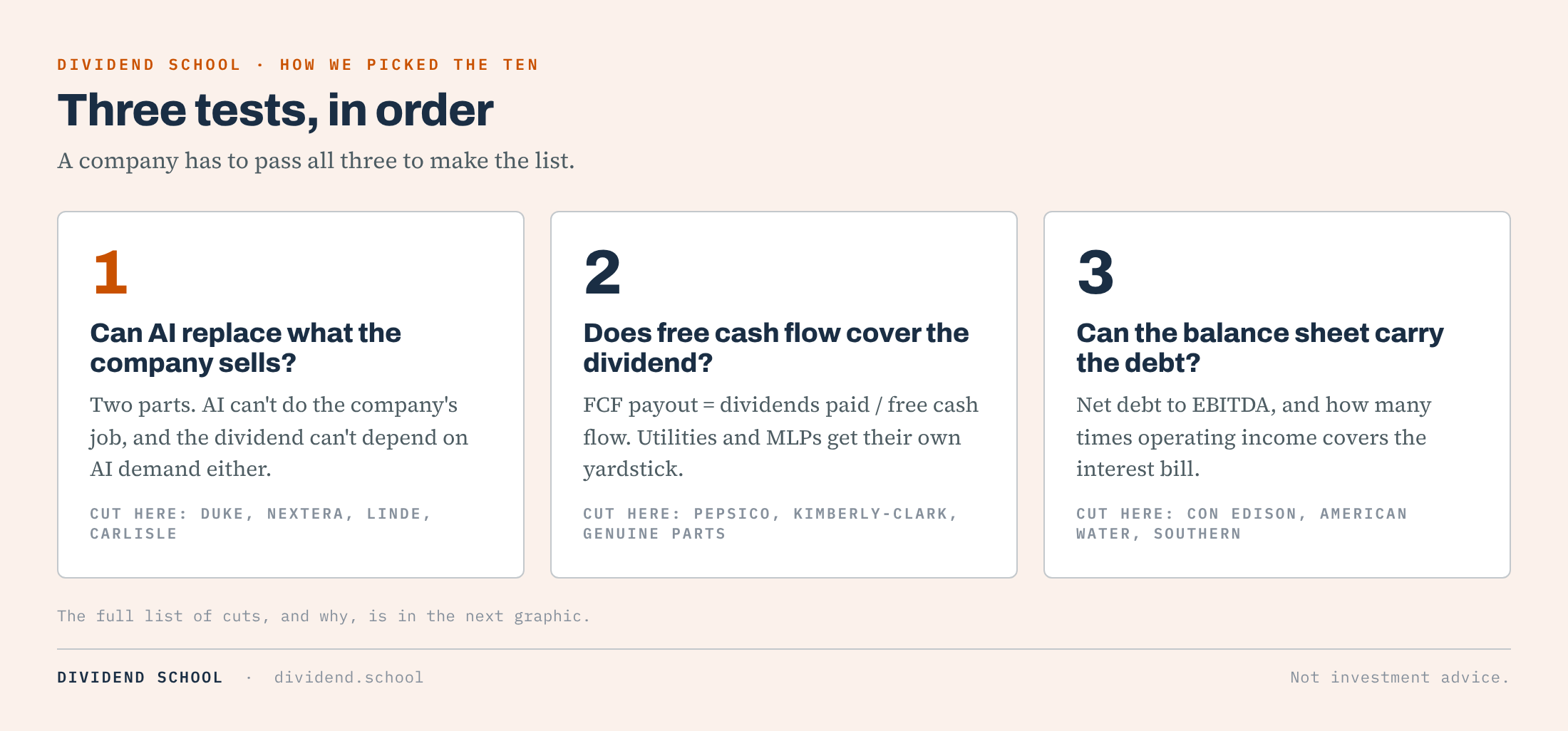
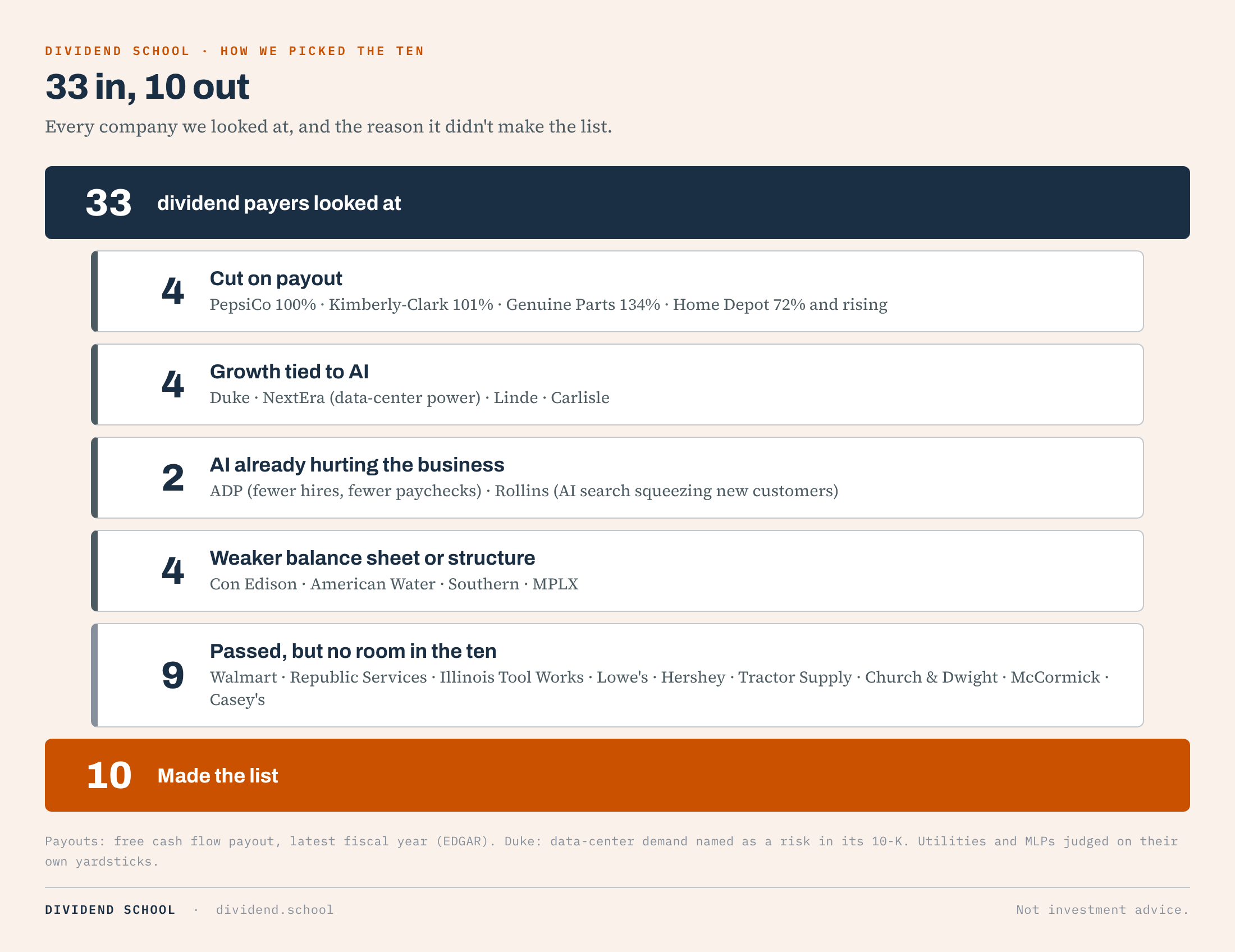
We started with 24 dividend payers and ran each one through three tests:
Can AI replace what the company sells?
Does free cash flow cover the dividend?
Can the balance sheet carry the debt?
Can AI replace what the company sells?
What do we mean by AI-proof?
Two things. First, AI can’t do the company’s job. Nobody is going to download a railroad. Second, the dividend can’t depend on AI either. A utility that needs data centers to hit its growth targets is an AI bet with a different label.
That second rule cost us two good companies. Duke Energy’s latest 10-K lists lower-than-expected data-center demand as a risk to its business, and NextEra’s growth plan leans on data-center power deals. Both are fine utilities. Neither belongs on this list. (I own NextEra, for the record.)
Does free cash flow cover the dividend?
Free cash flow is the cash left after a company pays for its equipment and buildings: operating cash flow minus capital spending. Our dividend comes out of that pile.
The free cash flow payout ratio tells us how much of the pile goes to shareholders:
FCF payout ratio = dividends paid / free cash flow
PepsiCo is our cautionary tale. Snacks and soda pass the AI test easily, and in 2025 PepsiCo generated $7,672 million of free cash flow ($12,087 million of operating cash flow minus $4,415 million of capital spending). It paid $7,638 million in dividends.
That’s a 100% payout ($7,638M / $7,672M). It was 101% in 2024 and 110% in 2022.
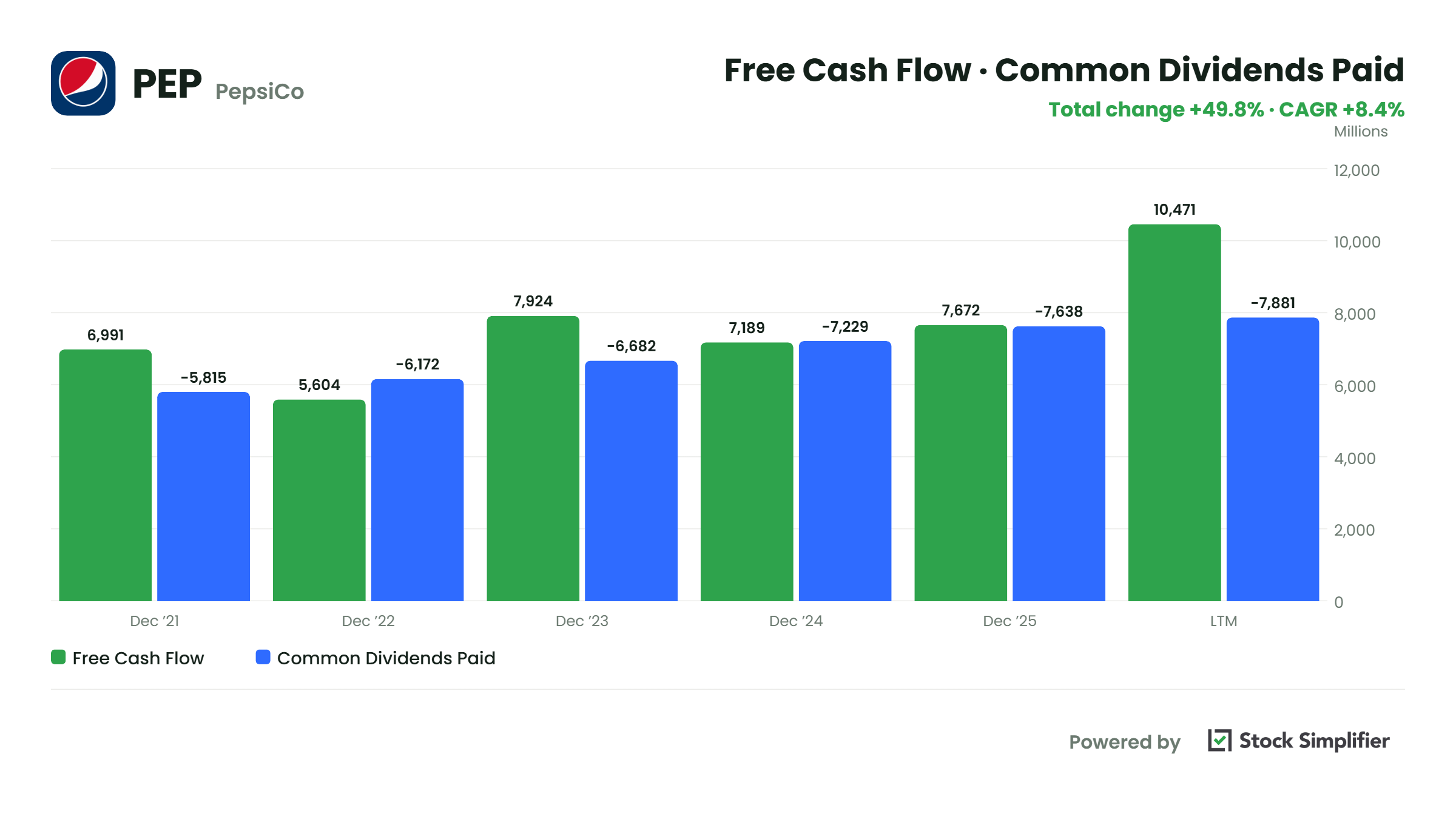
AI-proof isn’t the same as dividend-proof. Pepsi missed the cut, and so did Kimberly-Clark (101% in 2025) and Genuine Parts (134%).
Across our ten, payouts run from 30% to 77%, with two exceptions.
The exception: utilities and MLPs
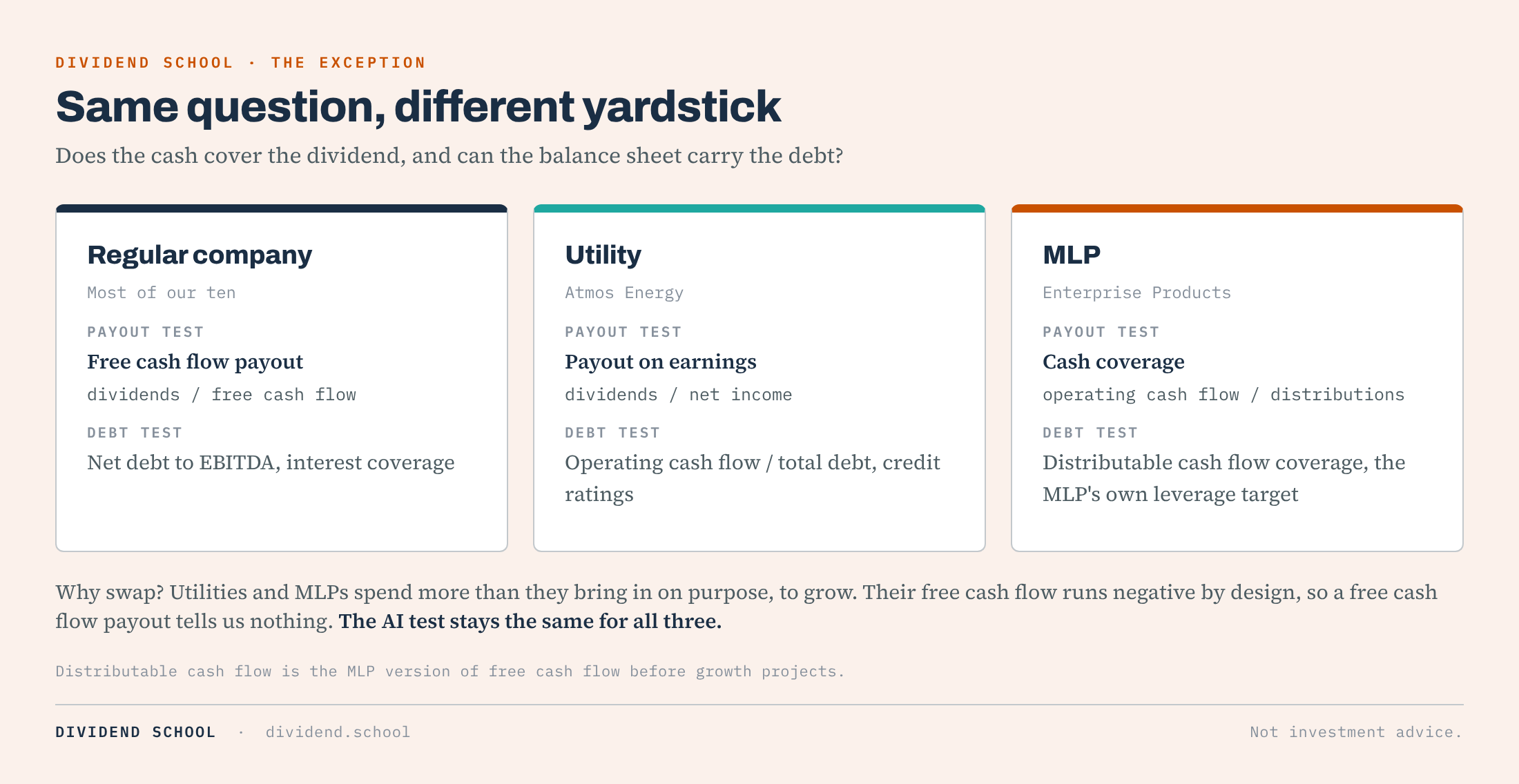
Big caveat here, and it matters for two of our ten. Utilities and MLPs fail this test on purpose.
A regulated utility spends more on pipes and wires than it brings in, year after year, because the regulator lets it earn a return on what it builds. More spending means more earnings. Free cash flow runs negative by design, so a free cash flow payout ratio tells us nothing.
A master limited partnership (MLP) does the same with pipelines and plants, funding part of its growth with debt.
So we swap the yardstick:
Utility: dividends / net income (the payout ratio on earnings), plus operating cash flow / total debt, a close cousin of the measure the credit rating agencies watch.
MLP: operating cash flow/distributions, plus the company’s own distributable cash flow coverage. Distributable cash flow is the MLP version of free cash flow before growth projects.
The AI test doesn’t change for either one.
Can the balance sheet carry the debt?
Two numbers here:
Net debt to EBITDA: total debt minus cash, divided by EBITDA (operating profit before depreciation and amortization). It’s the mortgage-to-income ratio of the corporate world: how many years of operating profit it would take to clear the debt.
Interest coverage: operating income divided by interest expense. How many times over profits cover the interest bill.
Lower is better on the first one, higher on the second. One name in our top seven runs above 3x on leverage and under 5x on coverage. It made the list anyway, because its free cash flow is growing faster than its debt.
#10: Sherwin-Williams (SHW)
Quick stats
Price: $332.61
Yield: 0.96%
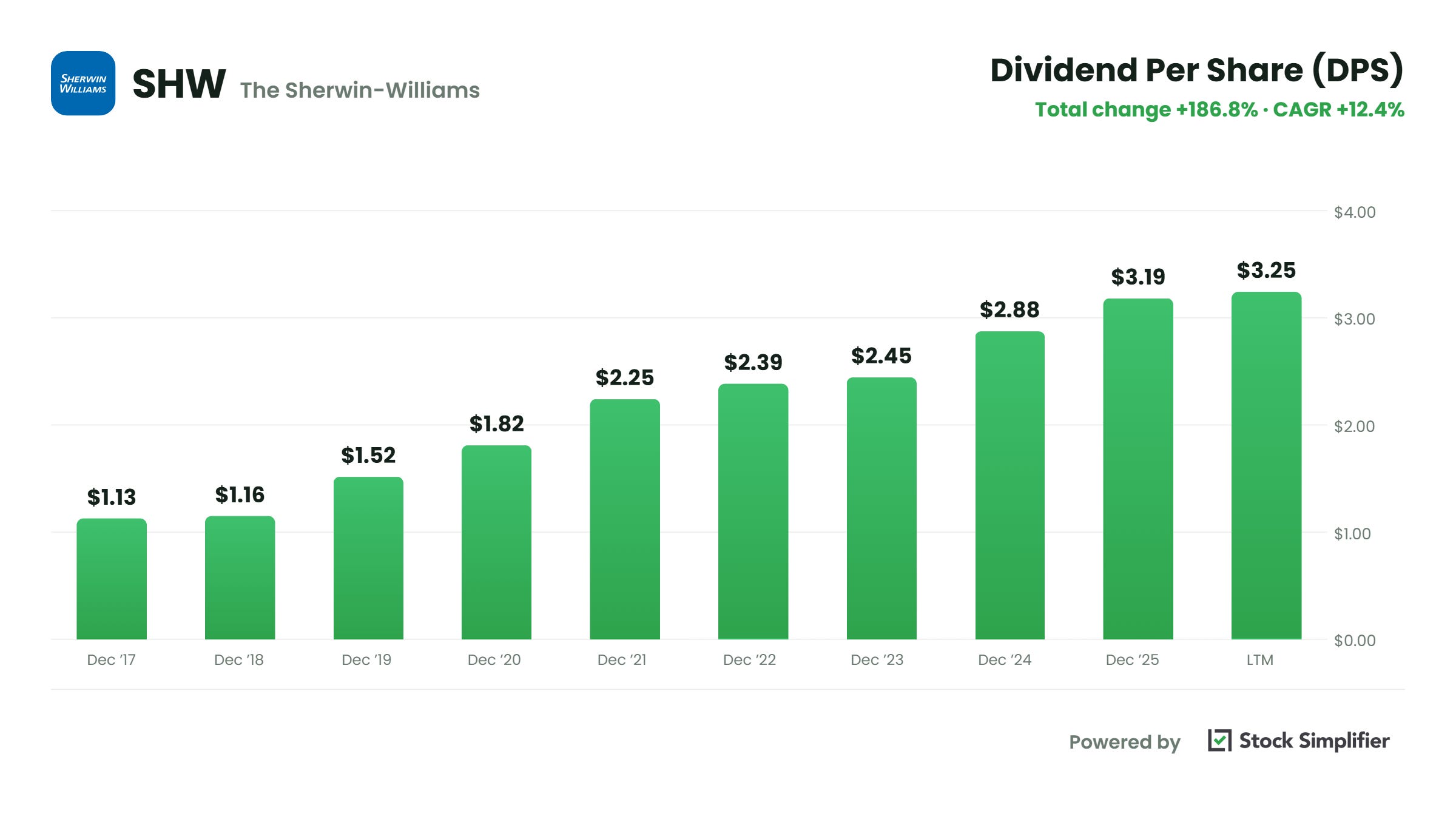
Dividend: $0.80 per quarter, $3.20 a year
Streak: 48 straight years of raises, counting 2026’s
Buy Below: $306
Sector: Paint and coatings
So what does Sherwin-Williams do?
It makes paint and sells much of it through its own stores to professional painters. A contractor running behind on a job doesn’t shop around. He drives to the Sherwin-Williams store down the road, where his account and his colors are on file.
Why can’t AI touch it?
Somebody still has to put the paint on the wall, and no app will do it for us.
AI does show up here, as a customer. Sherwin-Williams’ protective and marine coatings business sells to data-center builders, and on the third-quarter call, CEO Heidi Petz called AI “a nice tailwind” for that business. For us, that’s a bonus. The dividend runs on paint stores and repaint jobs.
The dividend math
Free cash flow, 2025: $2,654 million
Dividends paid: $790 million
FCF payout: 30%
Net debt to EBITDA: 2.4 times
Interest coverage: 8.2 times
A 30% payout is the lowest of our ten, which gives us plenty of room.
So why do we rank it only #10?
Two reasons. The yield is 0.96%, the lowest on the list. And the 2026 raise was a penny, $0.79 a quarter to $0.80, after a 10.5% raise the year before. A penny raise from a company paying out 30% of its free cash flow is a choice management made.
What could go wrong
Housing. Petz said homebuilder sentiment is the lowest it’s been since 2012, and Sherwin’s leading indicators point to muted demand into 2027.
Margins. Gross margin fell to 47.8% in the third quarter from 49.2% a year earlier, on raw material costs and the mix from Suvinil, the Brazilian paint brand it bought in October 2025.
The raise. One small raise is a blip. Two in a row is a trend we’d want explained.
#9: Colgate-Palmolive (CL)
Quick stats
Price: $95.29
Yield: 2.22%
Dividend: $0.53 per quarter, $2.12 a year
Streak: 63 straight years of raises, and dividends paid for 131 years
Buy Below: $82
Sector: Toothpaste, soap, and pet food
What does Colgate sell?
Toothpaste, mostly. Colgate is the global leader in toothpaste and manual toothbrushes, and it also owns Palmolive, Softsoap, Irish Spring, and Hill’s pet food.
Why can’t AI touch it?
We brush twice a day, and no chatbot is doing it for us. The moat is the brand and the shelf space it holds worldwide, built over more than a century.
There is one AI angle, and Colgate put it in its own 10-Q. AI and social commerce have made it easier for new competitors to sell straight to consumers. A startup toothpaste brand with a clever ad campaign is a nuisance to the market leader, if you ask me. We brush with what our dentist hands us.
The dividend math
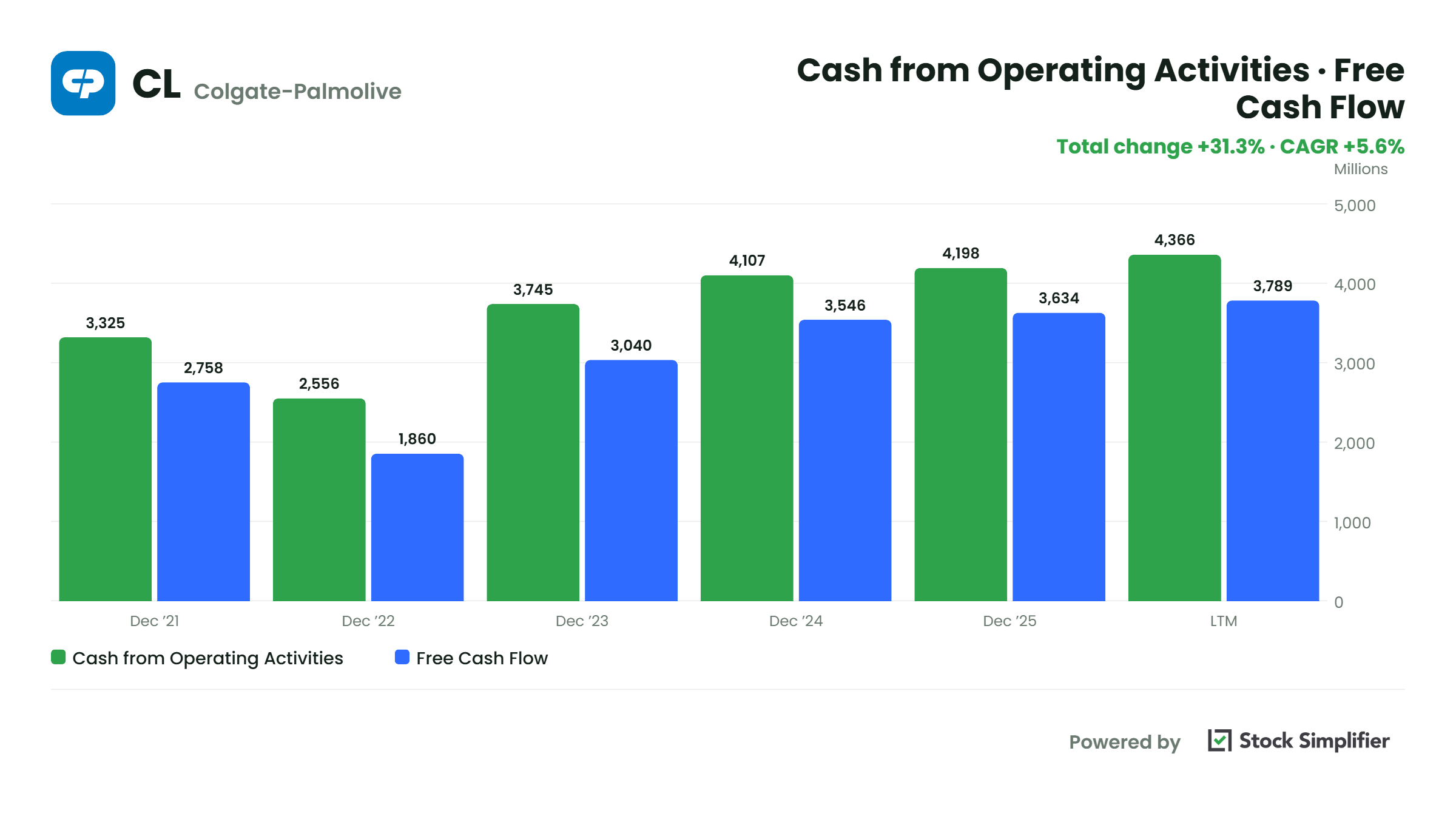
Free cash flow, 2025: $3,634 million
Dividends paid: $1,823 million
FCF payout: 50%
Net debt to EBITDA: 1.7 times
Interest coverage: 12.4 times
What do we make of the profit drop in 2025?
Operating income fell to $3,306 million from $4,268 million, mostly because of a $919 million write-down on Filorga, its French skin-care brand. Colgate says the category grew slower than expected, particularly in China. It’s a non-cash charge, and free cash flow still rose, from $3,546 million to $3,634 million.
The write-down also drags on our leverage number. Without it, net debt to EBITDA would be below 1.7 times.
What could go wrong
North America. Organic sales fell 1.6% in the third quarter, volume fell 3.7%, and operating profit in the region fell 11%.
Restructuring. In April, Colgate raised the expected cost of its productivity program from $350 million to $550 million, mostly severance, running through 2028.
Acquisitions. Filorga is mostly written off now. We'll keep an eye on anything new.
#8: Coca-Cola (KO)
Quick stats
Price: $94.08
Yield: 2.25%
Dividend: $0.53 per quarter, $2.12 a year
Streak: 64 straight years of raises
Buy Below: $80
Sector: Beverages
Why can’t AI touch it?
Coke mostly sells concentrate to bottlers worldwide, and they make the drinks, truck them, and stock the shelves. The brand on the can and that bottling network are the moat.
AI can write Coke’s ads, and it has- witness the Polar Bear Christmas ads. It can’t fill a vending machine.
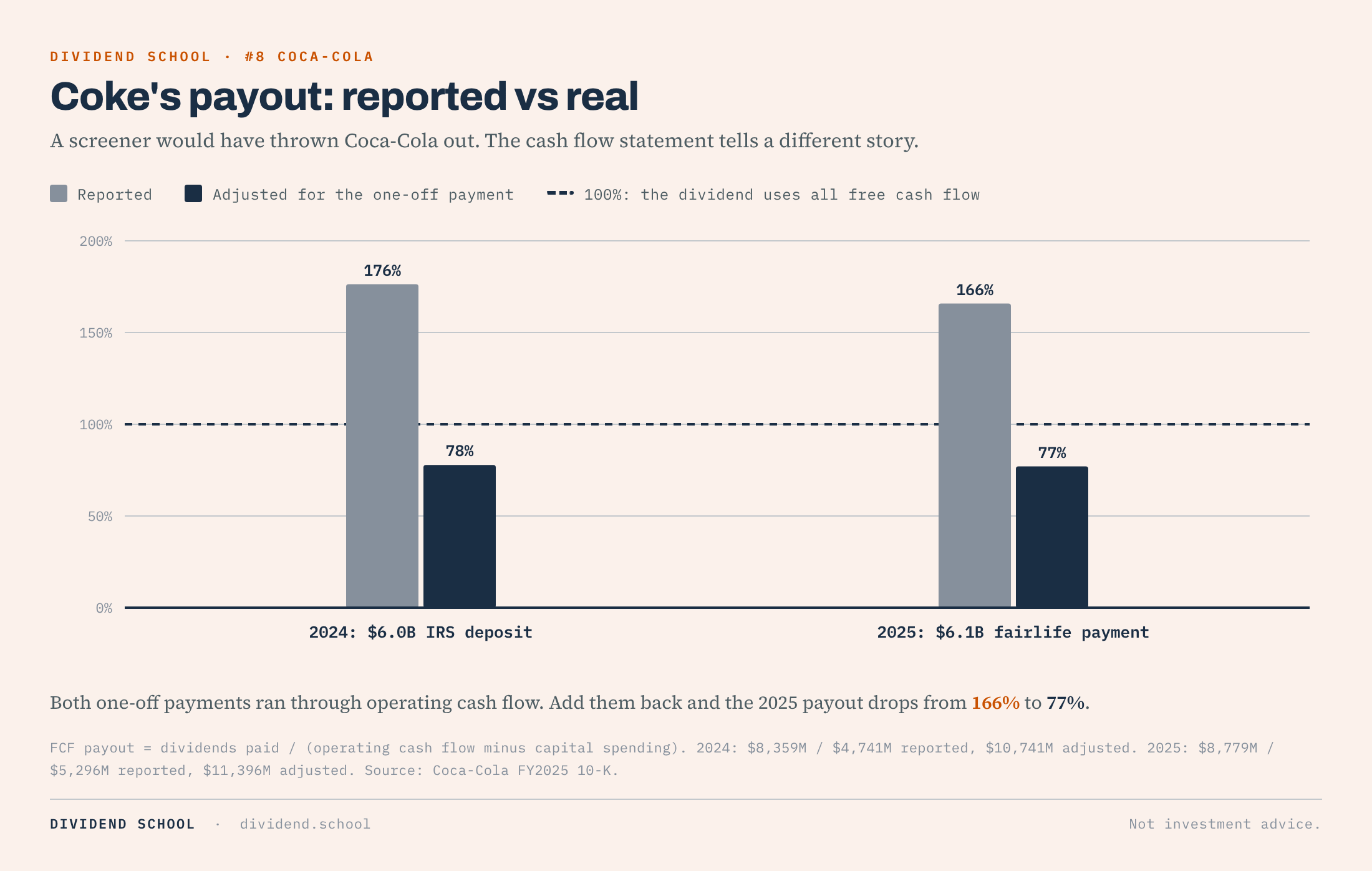
On reported numbers, though, Coca-Cola fails our free cash flow test:
Operating cash flow, 2025: $7,408 million
Capital spending: $2,112 million
Free cash flow: $5,296 million
Dividends paid: $8,779 million
FCF payout: 166%
A 166% payout should make us nervous. So what happened?
One payment. In 2025, Coke paid $6.1 billion as the final milestone on its 2020 purchase of fairlife, the milk brand, and that payment runs through operating cash flow. In 2024, it was a $6.0 billion deposit with the IRS. These are both one-offs.
Let’s add the fairlife payment back:
Free cash flow, adjusted: $11,396 million ($5,296M + $6,100M)
FCF payout, adjusted: 77% ($8,779M / $11,396M)
77% is the highest payout among our ten, and it’s covered. Coke also raised its 2026 free cash flow guidance to at least $13.0 billion in October.
That’s why we read the cash flow statement before we trust a payout ratio. A screener would have thrown Coke out.
The balance sheet:
Net debt to EBITDA: 2.4 times
Interest coverage: 8.3 times
What could go wrong
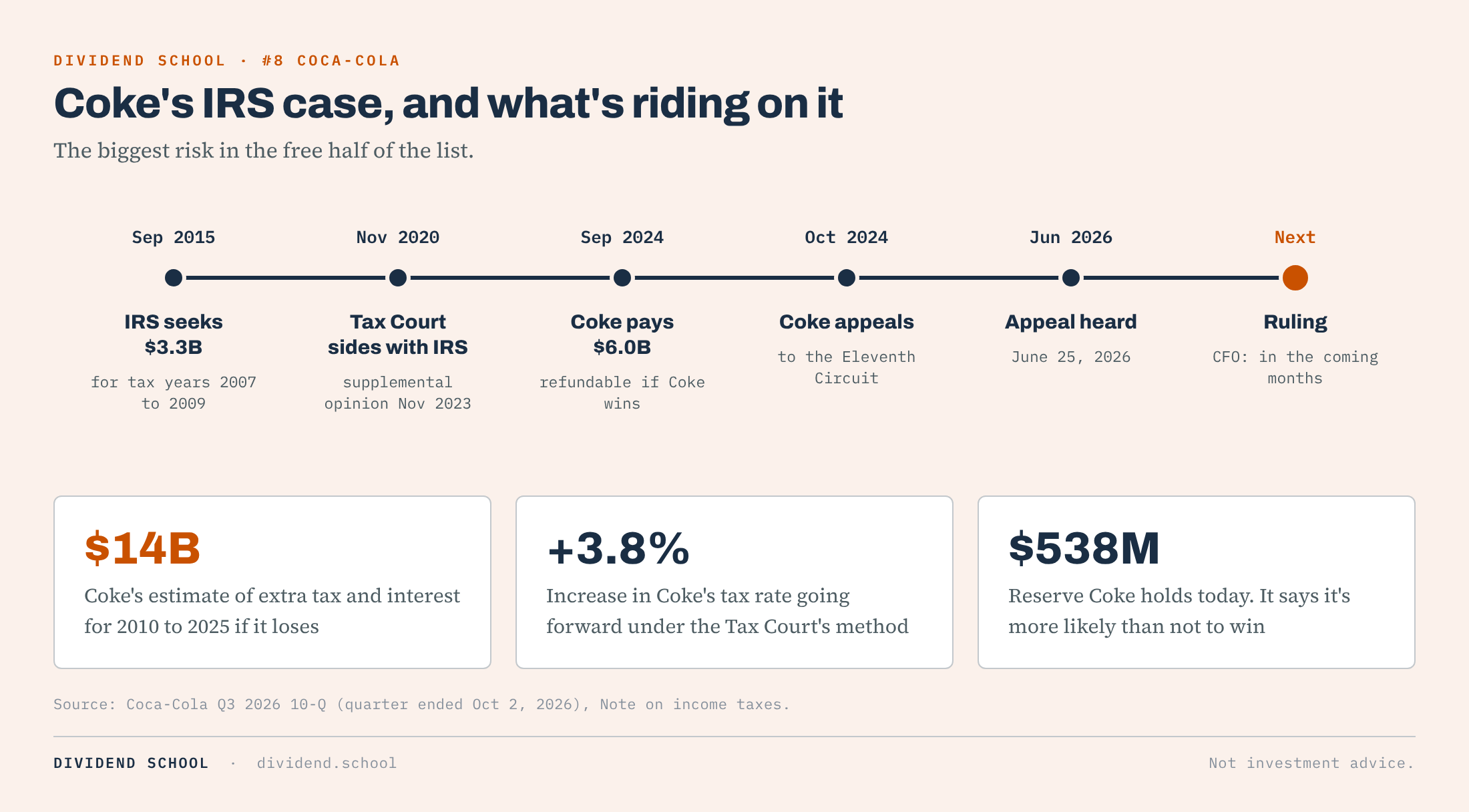
That $6.0 billion IRS deposit isn’t the end of the story. The tax case is the biggest risk in the free half of this list.
The tax case. The Tax Court ruled against Coke on how it priced profits with its overseas licensees from 2007 to 2009. That’s the $6.0 billion. Coke appealed; the Eleventh Circuit heard the case on June 25, and the CFO expects a ruling in the coming months.
What a loss costs. Coke estimates that applying the same method to 2010 through 2025 could add $14 billion in tax and interest. Applying it going forward would raise its effective tax rate by 3.8%.
What Coke says. It still believes it’s more likely than not to win the appeal.
New leadership. Henrique Braun took over as CEO on March 31, with James Quincey staying on as executive chairman.
What would $14 billion mean for our dividend?
It’s more than a full year of adjusted free cash flow. I think Coke absorbs it, but it would slow the buybacks and the raises for a while.
That’s three of the ten, free, with the full dividend math on each.
Below the paywall, paid Dividend School Pro subscribers get the top seven:
A gas utility whose annual report doesn’t mention data centers once, paying out 46% of its earnings
A 5.87% yield with 28 straight years of raises, and the tax form to understand before buying it in an IRA
A railroad with a $20 billion cash merger hanging over it
The one on this list I own, and how big the position is
#1: 70 straight years of raises, with profits covering the interest bill 22.5 times
All ten in one table: yields, payouts, debt, streaks, and Buy Belows
Every financial figure comes from the companies’ own filings, so feel free to check my work.
Membership is $369 a year or $35 a month, with a 30-day money-back guarantee.
